In today’s modern workplace, time management plays a major role in productivity and employee organization. One of the most commonly used tools for tracking working hours is a timesheet. Many businesses rely on timesheets to monitor employee attendance, calculate payroll, manage projects, and improve efficiency. Whether used in offices, remote work environments, construction companies, or freelance businesses, timesheets help employers and employees stay organized.
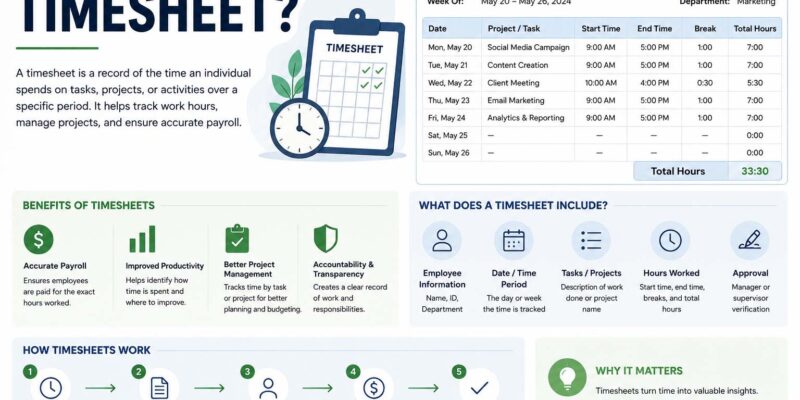
If you have ever wondered what is a timesheet, the answer is simple. A timesheet is a document or digital system used to record the amount of time an employee spends working during a specific period. It helps businesses keep accurate records of work hours, overtime, breaks, and project-related tasks.
Timesheets have evolved significantly over the years. Traditional paper sheets have mostly been replaced by online software and digital tracking systems that automatically calculate hours and improve accuracy. Despite these changes, the main purpose remains the same: tracking work time efficiently and fairly.
Understanding What Is a Timesheet
To fully understand what is a timesheet, it is important to know why companies use them. A timesheet allows businesses to monitor employee attendance and ensure workers are paid correctly for the hours they complete. Employees usually enter their start time, end time, break periods, and total working hours for each day.
Many industries depend heavily on accurate time tracking. Freelancers use timesheets to bill clients, while large companies use them for payroll management and productivity analysis. Employers can also use timesheets to identify workload trends and allocate resources more effectively.
Modern timesheet systems often include advanced features such as automatic clock-ins, project tracking, GPS location verification, and overtime alerts. These features reduce human error and make time management more efficient for businesses of all sizes.
Timesheets also create transparency between employers and workers. Employees can verify their recorded hours, while managers can review schedules and attendance records quickly.
What Is 45 Minutes on a Timesheet
One common question employees ask is what is 45 minutes on a timesheet. This means employees need to convert minutes into decimal values when entering hours worked.
Forty-five minutes on a timesheet is usually written as 0.75 hours. This conversion is important because payroll systems often calculate wages using decimal-based hour tracking instead of minutes.
For example, if an employee works 8 hours and 45 minutes during a shift, the total time entered on the timesheet would be 8.75 hours. Understanding these conversions helps prevent payroll errors and ensures employees receive accurate compensation.
Businesses use decimal formats because they simplify payroll calculations. Instead of manually converting minutes every time wages are processed, software can calculate totals quickly using decimals.
Employees who misunderstand time conversions may accidentally submit incorrect hours, which can affect payment accuracy. That is why many companies provide conversion charts or automatic calculators within their timesheet systems.
What Is 15 Minutes on a Timesheet
Another frequently asked question is Similar to other time conversions, 15 minutes equals 0.25 hours in decimal format.
For instance, if an employee works 7 hours and 15 minutes, the timesheet entry would typically show 7.25 hours. Understanding these smaller conversions is essential because even minor mistakes can create payroll discrepancies over time.
Digital timesheet systems usually perform these calculations automatically, but employees still benefit from understanding the process. Accurate time reporting helps businesses maintain proper payroll records and comply with labor laws.
Many workplaces round time entries to the nearest quarter hour. This means employees may record time in 15-minute increments such as 0.25, 0.50, or 0.75. Learning how these values work makes timesheet completion faster and easier.
What Is a Timesheet for Work
Many people also wonder what is a timesheet for work and why companies require employees to complete them regularly. In the workplace, timesheets serve several important purposes beyond simply tracking attendance.
One major purpose is payroll processing. Employers need accurate records of employee hours to calculate wages, overtime pay, bonuses, and leave balances. Without timesheets, payroll errors become much more common.
Timesheets also help businesses manage productivity. Managers can review how much time employees spend on specific projects or tasks. This information helps companies improve workflow efficiency and identify areas requiring additional support.
Project-based industries rely heavily on timesheets for client billing. Law firms, marketing agencies, consultants, and freelancers often charge clients according to hours worked. Detailed timesheets provide proof of labor and ensure transparent billing practices.
Remote work has also increased the importance of digital timesheets. Since managers cannot physically observe employees working from home, time-tracking systems help monitor schedules and project progress effectively.
What Information Is Required on a Timesheet
Understanding what information is required on a timesheet is important for both employees and employers. While requirements vary between companies, most timesheets contain several standard details.
Employee information is usually included first. This may involve the worker’s name, employee ID number, department, or position within the company. The reporting period, such as weekly or biweekly dates, is also clearly listed.
The main section of the timesheet records daily working hours. Employees typically enter start times, end times, break periods, and total hours worked for each day. Overtime hours may be recorded separately depending on company policies.
Some businesses also require project or task descriptions. Employees may need to explain what work they completed during certain hours, especially in project-based industries.
Approval sections are another important part of many timesheets. Supervisors or managers often review and approve submitted hours before payroll processing begins. This verification step helps prevent mistakes and unauthorized claims.
Digital timesheets may also include automated tracking features such as timestamps, location data, and productivity monitoring tools. These technologies improve accuracy and reduce manual entry errors.
The Benefits of Using Timesheets
Timesheets provide advantages for both employers and employees. Businesses benefit from accurate payroll calculations, improved project management, and better productivity tracking. Employees gain transparency regarding work hours and payment accuracy.
Conclusion
Understanding what is a timesheet is essential in today’s professional environment. Timesheets are valuable tools that help businesses track employee hours, manage payroll, monitor productivity, and maintain legal compliance. Whether learning what is 45 minutes on a timesheet, understanding , exploring what is a timesheet for work, or identifying what information is required on a timesheet, proper knowledge of time tracking systems benefits everyone involved.