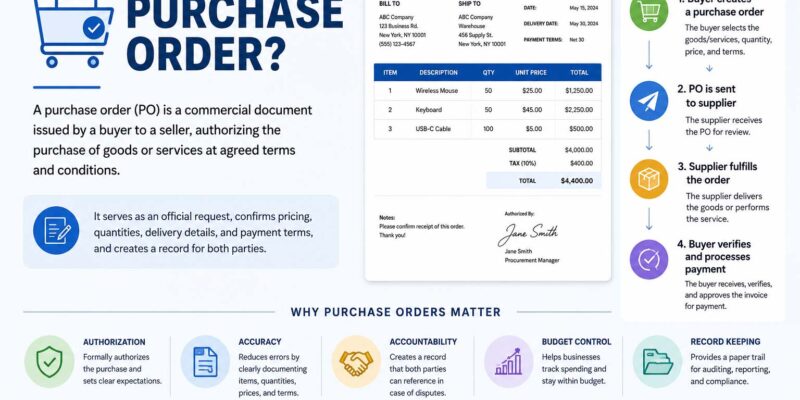
A order is an official business document sent by a buyer to a supplier to request products or services. It includes important details such as item descriptions, quantities, prices, payment terms, and delivery dates.
Businesses use purchase orders to create a clear and organized purchasing process. A helps prevent misunderstandings between buyers and sellers while improving inventory management and financial tracking.
Why Are Purchase Orders Important?
Purchase orders are important because they create a written agreement between the buyer and supplier before goods or services are delivered.
Without a purchase order, businesses may face issues such as:
- Incorrect deliveries
- Payment disputes
- Inventory confusion
- Unauthorized purchases
- Accounting errors
A proper purchase order system improves communication and provides legal documentation for both parties.
What Is the Purpose of a Purchase Order?
One of the most common business questions is:
The main purpose of a is to formally authorize a transaction. It protects both the buyer and supplier by clearly documenting the agreement.
Purchase Orders Help Businesses:
Track Spending
Companies can monitor purchases and control budgets more effectively.
Improve Inventory Management
Purchase orders help businesses know what products are incoming and when they will arrive.
Reduce Errors
Clear documentation reduces confusion regarding pricing, quantities, and delivery details.
Create Legal Protection
A order can serve as evidence if disputes occur between buyer and supplier.
Simplify Accounting
Finance teams use purchase orders to match invoices and payment records.
Modern businesses often automate these processes using procurement software and cloud accounting systems.
How Does a Purchase Order Work?
The purchase order process usually follows several simple steps.
Step 1: Identify a Need
A business determines that products or services are required.
Step 2: Create the Purchase Order
The buyer prepares a containing important details such as:
- Product names
- Quantities
- Pricing
- Shipping information
- Payment terms
Step 3: Send the Purchase Order
The document is sent to the supplier for review.
Step 4: Supplier Approval
The supplier accepts or rejects the order.
Step 5: Product Delivery
Once approved, the supplier delivers the requested products or services.
Step 6: Invoice and Payment
The supplier sends an invoice, and the buyer completes payment according to agreed terms.
This organized process helps businesses maintain accurate purchasing records.
What Is a Purchase Order Number?
Another common business search is: “what is a purchase order number?”
A number is a unique identification code assigned to each . It helps businesses track transactions and organize procurement records.
For example, a number may look like:
PO-2026-1045
This number allows accounting departments, suppliers, and inventory managers to quickly locate specific orders.
Benefits of Purchase Order Numbers
- Faster document tracking
- Easier accounting reconciliation
- Better inventory organization
- Reduced paperwork confusion
- Improved audit preparation
Most modern accounting software automatically generates numbers for businesses.
What Is a Blanket Purchase Order?
Businesses with recurring purchases often ask: “what is a blanket purchase order?”
A blanket is a long-term agreement between a buyer and supplier for repeated purchases over time. Instead of creating multiple separate purchase orders, the business uses one master agreement.
Blanket purchase orders are common for:
- Office supplies
- Manufacturing materials
- Maintenance services
- Wholesale inventory
- Monthly operational products
Advantages of Blanket Purchase Orders
Saves Time
Businesses avoid creating repetitive purchase orders every month.
Improves Supplier Relationships
Long-term agreements often lead to better pricing and stronger partnerships.
Reduces Administrative Work
Finance and procurement teams handle fewer documents.
Supports Budget Planning
Businesses can better forecast purchasing costs over time.
Many growing companies use blanket purchase orders to streamline procurement operations.
Purchase Order vs Invoice
Many beginners confuse purchase orders and invoices, but they serve different purposes.
| Feature | Purchase Order | Invoice |
|---|---|---|
| Sent By | Buyer | Supplier |
| Purpose | Request products/services | Request payment |
| Timing | Before delivery | After delivery |
| Main Goal | Authorization | Billing |
A purchase order starts the transaction, while the invoice completes the payment process.
Understanding this difference is essential for proper business accounting.
Real-World Purchase Order Example
Imagine a small technology company that needs 50 laptops for new employees.
The company creates a containing:
- Laptop model details
- Quantity requested
- Agreed pricing
- Delivery address
- Payment terms
The supplier reviews and approves the before shipping the laptops.
After delivery, the supplier sends an invoice referencing the number. The accounting department then verifies the order and processes payment.
This simple example shows how purchase orders improve organization and accountability.
Digital Purchase Orders in Modern Business
Today, most companies use digital purchase order systems instead of paper documents.
Modern procurement software offers features such as:
- Automated approvals
- Real-time inventory tracking
- Cloud storage
- Supplier management
- Mobile access
- Financial reporting
Popular accounting platforms like QuickBooks, SAP, Oracle, and Zoho include digital management tools.
Digital transformation has made procurement faster, safer, and more efficient.
Common Purchase Order Mistakes to Avoid
Businesses should avoid several common mistakes when handling purchase orders.
Missing Information
Incomplete purchase orders can create confusion and delivery problems.
Incorrect Pricing
Pricing errors may lead to disputes with suppliers.
Lack of Approval Processes
Unauthorized purchases can damage company budgets.
Poor Record Keeping
Lost purchase orders create accounting and inventory issues.
Delayed Processing
Slow approvals may affect production schedules and customer service.
Implementing clear procurement policies helps businesses avoid these problems.
Business Strategy Benefits of Purchase Orders
Purchase orders are not just accounting tools. They also support long-term business strategy.
Better Financial Control
Purchase orders help businesses monitor operational spending.
Stronger Supplier Relationships
Clear communication improves trust with suppliers.
Improved Cash Flow Management
Businesses can plan future expenses more accurately.
Scalability
Organized procurement systems support company growth.
As businesses expand, purchase orders become even more important for operational stability.
FAQ About Purchase Orders
What is a purchase order?
A purchase is an official document sent by a buyer to a supplier requesting products or services under agreed terms.
What is the purpose of a purchase order?
The purpose of a is to authorize purchases, improve tracking, reduce errors, and create legal documentation between buyer and supplier.
What is a purchase order number?
A purchase order number is a unique tracking code assigned to each for identification and record management.
What is a blanket purchase order?
A blanket is a long-term purchasing agreement used for recurring orders from the same supplier.
Are purchase orders legally binding?
Yes, once accepted by the supplier, a can become a legally binding agreement.
Do small businesses need purchase orders?
Yes, even small businesses benefit from improved organization, budgeting, and supplier communication through purchase orders.
Conclusion
Understanding what a is helps businesses improve purchasing accuracy, financial organization, and supplier management. Purchase orders play a critical role in modern procurement systems by providing clear communication and legal protection for both buyers and sellers.