If you have ever shopped for a car, electronics, furniture, or retail products, you have probably seen the term . Many consumers and business owners ask questions like what is mean or what is price because the term appears frequently in both online and physical stores.
plays an important role in retail pricing, business strategy, and customer expectations. Manufacturers use to suggest how much a product should cost when sold to consumers.
Understanding helps buyers compare prices and helps businesses create better pricing strategies.
What Is MSRP Stand For?
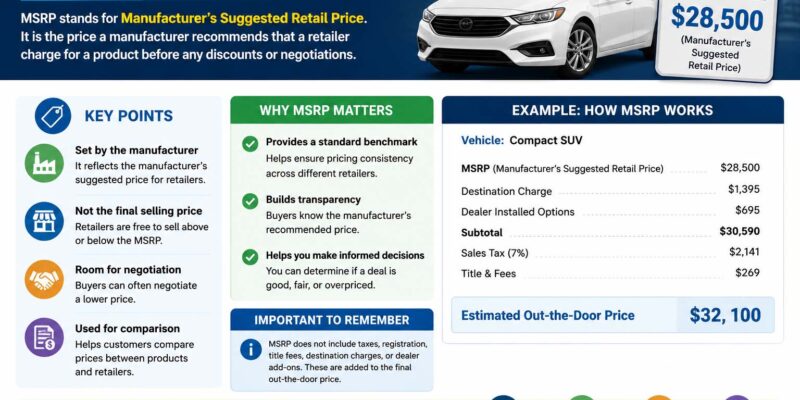
It is the recommended selling price a manufacturer gives to retailers for a product.
Manufacturers use to create pricing consistency across different stores and markets.
What Is MSRP Mean in Business?
In business, acts as a pricing guideline rather than a mandatory rule.
Retailers are usually free to:
Match the .
Sell below .
Sell above .
The final selling price depends on:
Market demand.
Competition.
Inventory levels.
Location.
Seasonal trends.
Business strategy.
helps customers understand what the “standard” price of a product should be.
What Is MSRP Price?
The price is the official suggested retail value assigned by the manufacturer.
Consumers often compare with actual selling prices to determine whether they are getting a good deal.
For example:
A gaming console may launch with a $499 .
If stores sell it for $650 during shortages, customers know the product is selling above the suggested price.
This pricing transparency helps buyers make more informed decisions.
Why Manufacturers Use MSRP
Pricing Consistency
creates a standard price reference across retailers.
Brand Positioning
Premium brands often maintain higher levels to protect their market image.
Consumer Expectations
Customers can compare deals more easily when is clearly displayed.
Marketing Strategy
helps companies advertise discounts and promotions.
For example, a retailer may advertise:
“20% below .”
This makes discounts appear more attractive to customers.
What Is MSRP for Cars?
The automotive industry is one of the most common places where is used.
When people ask what is for cars, they are usually referring to the sticker price shown on new vehicles.
Car includes:
Base vehicle price.
Factory-installed features.
Optional upgrades.
Manufacturer pricing recommendations.
However, dealership fees, taxes, insurance, and demand can increase the final purchase price.
How Car MSRP Works
Imagine a manufacturer releases a new SUV with a starting of $40,000.
The dealership may:
Sell at .
Offer discounts below .
Charge above during high demand.
During vehicle shortages or popular model launches, dealers sometimes add “market adjustment” fees that push prices beyond .
MSRP vs Invoice Price
Many consumers confuse with invoice price.
MSRP
Suggested retail price for customers.
Invoice Price
Amount the dealer reportedly pays the manufacturer.
Dealers may still earn profits through financing, incentives, warranties, and service packages even when selling near invoice price.
Real-World MSRP Examples
appears across many industries.
Electronics
Gaming consoles and smartphones often launch with fixed pricing.
Fashion
Luxury brands maintain high levels to protect brand prestige.
Furniture
Retailers frequently advertise discounts compared to .
Automotive
Vehicle pricing heavily relies on benchmarks.
Consumers use to compare value between competing products.
Why Retailers Sometimes Sell Above MSRP
Retailers may increase prices above when:
Demand is extremely high.
Inventory is limited.
Products become trendy or collectible.
Supply chain issues occur.
Popular sneakers, graphics cards, gaming consoles, and vehicles have all experienced major price increases above in recent years.
Advantages of MSRP
provides several benefits for businesses and consumers.
Easy Price Comparison
Customers can compare retailer prices quickly.
Better Marketing
Stores can advertise discounts more effectively.
Brand Stability
Manufacturers maintain stronger pricing control.
Consumer Trust
Clear suggested pricing improves transparency.
Disadvantages of MSRP
also has some limitations.
Prices May Become Unrealistic
Retailers Ignore MSRP
Some businesses set completely different prices.
Discounts Can Be Misleading
Some retailers artificially inflate comparisons.
Consumers should still research prices carefully instead of relying only on labels.
Business Strategy and MSRP
Businesses use as part of broader pricing strategies.
Some companies focus on premium pricing while others compete through discounts.
Premium Strategy
Luxury brands often keep prices near to protect exclusivity.
Discount Strategy
Budget retailers may sell products below to attract customers.
Dynamic Pricing
Online retailers sometimes adjust prices automatically based on demand.
Understanding helps entrepreneurs build smarter pricing models.
How Consumers Should Use MSRP
Buyers can use to:
Compare deals.
Avoid overpriced products.
Track discounts.
Research fair market value.
However, should only be one part of the buying decision.
Customers should also consider:
Warranty quality.
Customer service.
Shipping fees.
Product reviews.
Long-term value.
MSRP in Online Shopping
E-commerce has changed how works.
Online marketplaces allow rapid price changes depending on:
Competition.
Stock availability.
Consumer demand.
Flash sales.
As a result, online prices may fluctuate much faster than traditional retail stores.
Common MSRP Mistakes
Many buyers misunderstand completely.
Common misconceptions include:
Believing is the required selling price.
Assuming always reflects market value.
Thinking higher automatically means higher quality.
Smart consumers compare multiple retailers before purchasing.
FAQ About What Is MSRP
What is MSRP stand for?
What is MSRP mean?
It means the recommended retail selling price suggested by the manufacturer.
Is MSRP the final price?
No. Retailers may charge more or less depending on market conditions.
What is for cars?
Car is the manufacturer’s suggested starting price before taxes, fees, and dealer adjustments.
Why do products sell above ?
High demand, limited supply, and market trends can increase prices above .
Conclusion
Understanding what is helps both consumers and businesses make smarter pricing decisions. serves as a recommended retail benchmark that improves pricing transparency, marketing strategies, and customer expectations.