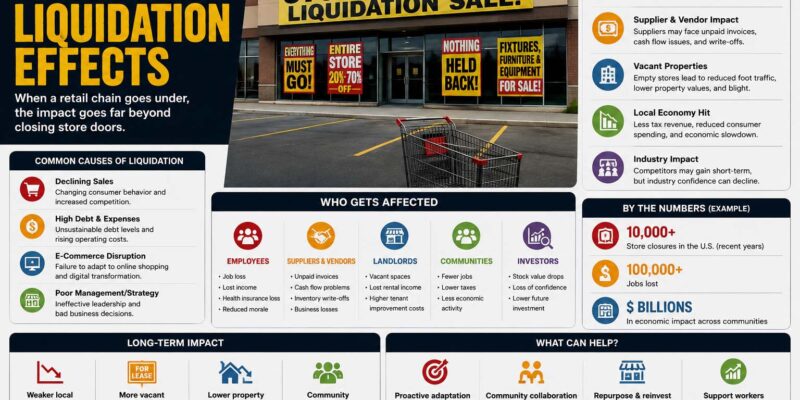
The retail industry has experienced major changes over the past decade as consumer habits, technology, and economic conditions continue to evolve. One of the most significant events affecting the retail sector is the liquidation of large retail chains. Retail chain liquidation effects can influence employees, customers, suppliers, shopping centers, and even local economies. When a major retailer closes its stores and liquidates inventory, the impact often extends far beyond the company itself.
Retail chain liquidation occurs when a business permanently shuts down operations and sells its remaining assets, inventory, and property to repay debts or recover losses. These closures may happen because of financial struggles, declining sales, changing consumer preferences, or increased competition from online marketplaces. While liquidation may provide short-term financial relief for struggling companies, the long-term consequences can reshape entire communities and industries.
Understanding retail chain liquidation effects is important for business owners, investors, employees, and consumers because the retail industry plays a major role in economic activity worldwide.
What Causes Retail Chain Liquidation
Several factors contribute to retail chain liquidation. One of the most common causes is the growth of e-commerce. Online shopping platforms have changed the way consumers purchase products, reducing foot traffic in physical retail stores. Many traditional retail chains struggle to compete with the convenience, pricing, and speed offered by digital marketplaces.
Economic downturns also contribute to liquidation. During periods of inflation, recession, or rising unemployment, consumers often reduce spending on non-essential products. Retailers with high operational costs may face declining profits and mounting debt.
Poor management decisions can further accelerate financial problems. Expanding too quickly, failing to adapt to market trends, or carrying excessive inventory can weaken a company’s financial position. In some cases, outdated business models prevent retailers from competing effectively in modern markets.
Changing consumer behavior also plays a major role. Modern shoppers increasingly prefer convenience, fast delivery, and personalized shopping experiences. Retail chains that fail to innovate often lose customers to more flexible competitors.
Impact on Employees
One of the most immediate retail chain liquidation effects is job loss. When a retail company closes stores, employees often face sudden unemployment. Cashiers, store managers, warehouse workers, customer service representatives, and administrative staff may all lose their jobs within a short period.
Job losses can create financial stress for workers and their families. Many retail employees rely on steady wages, healthcare benefits, and employee discounts provided by their employers. Losing these benefits can create long-term economic challenges.
Communities with limited employment opportunities may experience even greater difficulties after major retail closures. In small towns, a large retail chain might serve as one of the primary employers. When that business closes, unemployment rates can increase significantly.
Retail chain liquidation effects on employees also include emotional stress. Workers may experience uncertainty, anxiety, and reduced confidence while searching for new employment opportunities. Older workers and employees with specialized retail experience sometimes face additional challenges when transitioning to different industries.
Effects on Local Economies
Retail chains contribute significantly to local economies through taxes, wages, and consumer spending. When a major retailer liquidates, local governments often lose valuable tax revenue. This reduction can affect public services such as schools, infrastructure, and community programs.
Shopping centers and commercial districts may also suffer financially. Empty storefronts reduce customer traffic and create a less attractive shopping environment. Nearby businesses often experience declining sales because fewer people visit the area.
Property values can decrease as vacant retail spaces remain empty for extended periods. Large abandoned stores may become difficult to repurpose, especially in regions already experiencing economic challenges.
Retail chain liquidation effects can create a domino effect throughout local economies. Suppliers, delivery companies, maintenance providers, and marketing agencies that depended on the retailer may also lose revenue and customers.
Consumer Impact
Consumers also experience changes when retail chains close. Many shoppers lose access to familiar stores, trusted products, and convenient locations. In rural areas, retail closures may force consumers to travel longer distances to purchase everyday items.
Liquidation sales often attract large crowds because products are heavily discounted. While these sales may benefit consumers temporarily, they also signal the permanent loss of retail options in the community.
The reduction of competition in local markets can lead to higher prices over time. When fewer retailers operate in an area, remaining businesses may face less pressure to keep prices competitive.
Retail chain liquidation effects on consumers can also include reduced customer service quality. Large retail chains often provide return policies, loyalty programs, and product variety that smaller businesses may struggle to match.
Impact on Suppliers and Manufacturers
Suppliers and manufacturers are heavily affected when retail chains liquidate. Many companies rely on large retailers to distribute products and generate revenue. When a major chain closes, suppliers may lose significant business contracts overnight.
Unpaid invoices can create serious financial problems for smaller suppliers. If a liquidating retailer cannot pay outstanding debts, manufacturers may experience cash flow shortages and production delays.
Some suppliers may need to reduce production, lay off workers, or search for new distribution partners. Smaller businesses with limited financial reserves are especially vulnerable during large retail liquidations.
Shopping Mall and Real Estate Challenges
Shopping malls often suffer greatly when anchor stores close. Large retail chains usually attract customers who then visit smaller stores within the mall. When anchor tenants liquidate, overall customer traffic declines.
Long-Term Industry Changes
The retail industry continues evolving as businesses respond to changing market conditions. Retail chain liquidation effects often encourage surviving companies to adopt new strategies focused on digital technology, customer experience, and operational efficiency.
Many retailers now invest heavily in e-commerce platforms, mobile apps, and same-day delivery services to remain competitive. Physical stores increasingly focus on creating unique in-person experiences rather than simply selling products.
Conclusion
Retail chain liquidation effects extend far beyond the closure of individual stores. Employees lose jobs, local economies lose tax revenue, suppliers face financial uncertainty, and consumers experience reduced shopping options. These closures can reshape entire communities and influence long-term retail industry trends.