
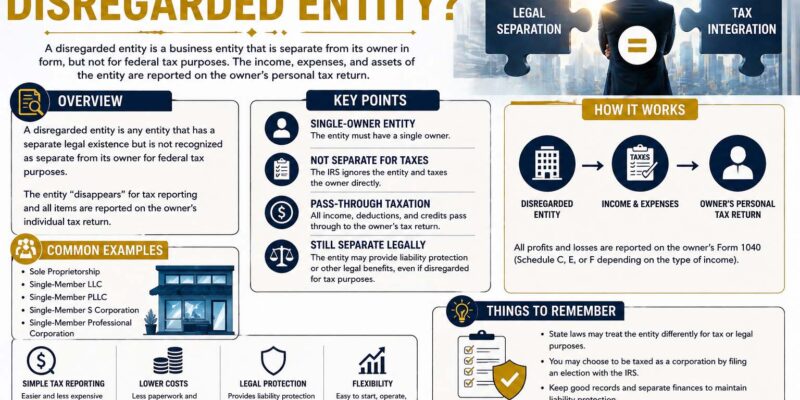
Understanding what is a disregarded entity is essential for entrepreneurs, freelancers, and small business owners who want to manage taxes efficiently. A disregarded entity is a business structure that is separate from its owner legally but not considered separate for federal tax purposes. This means the Internal Revenue Service treats the business’s income and expenses as part of the owner’s personal tax return rather than requiring a separate business tax filing.
This concept is most commonly associated with single-member limited liability companies. While the business provides liability protection, it simplifies taxation by avoiding the complexity of corporate tax returns. Knowing how a disregarded entity works can help you make smarter decisions when forming or managing a business.
Before choosing this structure, entrepreneurs should also understand What Is a Business License, since legal registration and licensing requirements vary depending on the type of business and location.
What Is a Disregarded Entity for Tax Purposes
To fully understand what is a disregarded entity for tax purposes, it is important to look at how taxation works. In this setup, the business itself does not pay income taxes separately. Instead, all profits, losses, deductions, and credits flow directly to the owner’s personal tax return.
For example, if you own a single-member LLC that qualifies as a disregarded entity, you typically report your business income on your individual tax return using Schedule C if you are operating as a sole proprietor. This approach simplifies tax filing and reduces administrative burdens compared to corporations or partnerships.
The business may still need to pay certain taxes, such as employment taxes if it has employees, or state-level taxes depending on local laws. It is also important to note that a disregarded entity maintains its legal status, meaning the owner still benefits from liability protection.
Understanding this distinction is crucial. While the IRS disregards the entity for income tax purposes, it still recognizes the entity for legal and operational matters. This balance between simplicity and protection is one of the main reasons why many entrepreneurs choose this structure.
Businesses that own equipment, vehicles, or office assets may also benefit from understanding What Is a Depreciation Schedule to properly track deductible asset expenses over time.
What Is a Disregarded Entity LLC
When exploring what is a disregarded entity LLC, the most common example is a single-member limited liability company. By default, the IRS treats a single-member LLC as a disregarded entity unless the owner elects to have it taxed as a corporation.
The owner does not need to file a separate business tax return, which makes the process easier and more cost-effective. Free Enterprise System Despite this simplicity, the LLC still exists as a separate legal entity, offering protection for personal assets against business liabilities.
One of the key advantages of a disregarded entity LLC is flexibility. Business owners can later choose a different tax classification if their company grows or their financial goals change. This adaptability makes it a popular choice for startups and small businesses.
Compared to corporations, which require more extensive reporting and compliance, a disregarded entity LLC allows owners to focus more on running their business and less on administrative tasks. However, maintaining proper records and separating personal and business finances is still essential to preserve liability protection.
What Is a Disregarded Entity on a W9
If you are wondering what is a disregarded entity on a W9, the answer relates to how businesses report their tax classification when providing information to clients or partners. A W-9 form is used in the United States to provide a taxpayer identification number and certify tax status.
For a disregarded entity, the owner’s name is generally entered as the taxpayer rather than the LLC itself. This is because the IRS treats the income as belonging to the owner, not the entity itself.
For example, if you operate a single-member LLC, you would enter your personal name on the W-9, followed by your LLC name if applicable. The taxpayer identification number provided is usually the owner’s Social Security Number or an Employer Identification Number assigned to the owner.
This distinction is important for accurate tax reporting. Clients who issue payments will use the information on the W-9 to prepare forms such as the 1099-NEC.
What Is a Disregarded Entity?
To answer the broader question, what is a disregarded entity?, it is a business structure that combines legal separation with tax simplicity.
This structure is particularly beneficial for individuals who want the liability protection of an LLC without the complexity of separate tax filings. It allows business owners to operate with fewer administrative requirements while still maintaining a professional business structure.
However, there are some considerations to keep in mind. While federal tax treatment is straightforward, state tax rules may differ. It is also important to maintain clear financial records to avoid issues with liability protection.
Another key point is that a disregarded entity is not a separate taxpayer for income tax purposes. This means the owner is personally responsible for reporting and paying taxes on the business’s income.
Business owners operating in competitive markets can also benefit from understanding the, since it explains how private businesses compete, grow, and respond to market demand. Likewise, manufacturers and production-based businesses may find How Would a Manufacturer Benefit by Using Fewer Scarce Resources useful for improving efficiency and reducing operating costs.
Conclusion
In conclusion, understanding what is a disregarded entity provides valuable insight into one of the simplest and most flexible business structures available. It allows business owners to enjoy the benefits of legal protection while keeping tax reporting straightforward. From its role in tax filings to its use in LLCs and W-9 forms, a disregarded entity offers a practical solution for individuals seeking efficiency and simplicity in managing their business.