
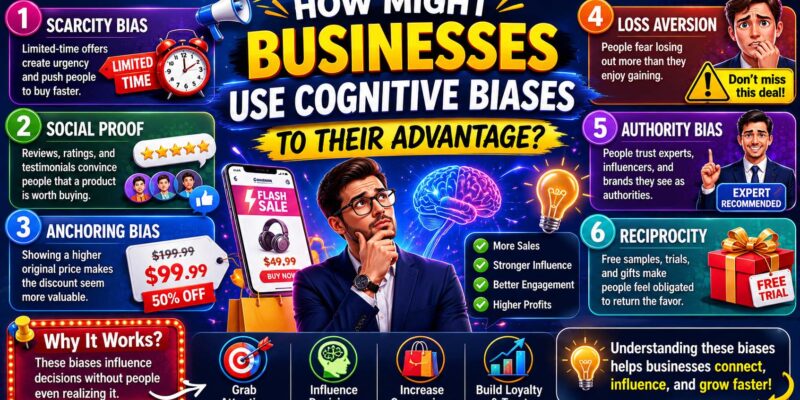
Understanding customer behavior is essential for successful marketing. Companies study how consumers evaluate products, compare prices, and make purchasing decisions. This raises an important question: how might businesses use cognitive biases to their advantage?
Businesses can use cognitive biases to influence product perception, improve marketing communication, build customer confidence, and encourage purchasing decisions. For example, authentic reviews provide social proof, while clear price comparisons help shoppers evaluate different options.
However, successful marketing requires more than psychological techniques. Businesses must also provide reliable products, transparent information, and positive customer experiences.
Understanding consumer psychology helps companies create more relevant content. Similar principles appear in What Is Curated Content, which explains how useful information can strengthen audience engagement.
What Are Cognitive Biases in Business?
Cognitive biases are patterns of thinking that influence how people interpret information and make decisions.
Instead of carefully analyzing every available detail, people often rely on mental shortcuts. These shortcuts make everyday choices easier. However, they can also cause consumers to overlook relevant information.
For example, someone might choose a familiar brand because they recognize its name, even when another product offers similar features.
Cognitive biases can affect:
- Product comparisons
- Customer trust
- Brand preferences
- Advertising responses
- Price perceptions
- Subscription decisions
- Customer loyalty
Therefore, understanding these patterns can help businesses communicate more clearly and create better shopping experiences.
How Might Businesses Use Cognitive Biases to Their Advantage?
Businesses can apply behavioral psychology to advertising, pricing, product presentation, and customer communication.
For instance, marketers may highlight genuine customer reviews, organize product options clearly, or explain actual purchasing deadlines.
These strategies can make information easier to understand and help customers evaluate available choices.
Common business applications include:
- Using social proof to strengthen customer confidence
- Applying anchoring bias to present pricing options
- Communicating genuine scarcity to explain limited availability
- Building familiarity through consistent branding
- Using loss aversion to explain the value of existing benefits
- Personalizing content around customer interests
However, businesses should use these techniques responsibly rather than pressure customers into unnecessary purchases.
How Might Businesses Use Cognitive Biases to Their Advantage Through Scarcity?
Scarcity bias describes how people may place greater value on products or opportunities when availability seems limited.
Businesses often communicate genuine restrictions through messages such as:
- Limited product quantities
- Seasonal collections
- Registration deadlines
- Time-sensitive discounts
- Limited appointment availability
For example, an online store might display a message indicating that only three items remain in stock.
If the information is accurate, customers can use it when deciding whether to purchase immediately or wait.
Why scarcity influences customers
Scarcity can make an offer appear more desirable because shoppers believe they might lose the opportunity to purchase it.
As a result, some customers make decisions more quickly when availability is genuinely limited.
However, artificial countdown timers and fabricated stock warnings can mislead consumers.
Therefore, businesses should communicate actual limitations rather than manufacture urgency.
How Businesses Use Cognitive Biases Through Social Proof
Social proof describes how people consider other people’s behavior and experiences when making decisions.
When shoppers feel uncertain, they often look at reviews, ratings, testimonials, and recommendations before purchasing.
Businesses can provide social proof through:
- Verified customer reviews
- Authentic testimonials
- Product ratings
- Customer success stories
- Relevant case studies
- Clearly disclosed influencer endorsements
For example, a shopper comparing two online stores may feel more confident choosing one with detailed, credible reviews.
How social proof builds customer confidence
Positive customer experiences help potential buyers understand what they can expect from a product or service.
However, companies should avoid fabricated testimonials or misleading review practices.
In addition, recognizable brand messaging can reinforce customer confidence. Understanding What Is a Tagline can help businesses create memorable messages that support brand recognition.
How Businesses Use Cognitive Biases in Pricing
Anchoring bias occurs when people rely heavily on initial information while evaluating later options.
In business, the first price a customer sees may become a reference point for comparing other products.
For example, consider two televisions:
- Premium television: $1,000
- Standard television: $700
After viewing the premium model, a shopper may perceive the $700 television as relatively affordable.
However, a lower price does not automatically make it the better purchase. Product features, quality, and customer needs still matter.
Applying anchoring to product comparisons
Businesses may use anchoring when presenting:
- Product packages
- Subscription plans
- Premium and standard options
- Genuine sale prices
- Service tiers
For instance, a software company might display its premium subscription beside a basic plan.
This comparison can help customers understand differences in features and costs.
Nevertheless, reference prices should remain accurate. Misleading discounts can undermine customer confidence.
Brand Familiarity and Consumer Trust
Consumers often feel more comfortable choosing brands they recognize.
Repeated exposure can increase familiarity, although recognition alone does not guarantee trust or product quality.
Businesses develop brand familiarity through:
- Consistent logos
- Advertising campaigns
- Social media content
- Recognizable packaging
- Brand messaging
- Customer communication
For example, a shopper may notice a familiar household product before considering competing brands.
Building recognition through familiarity
Consistent branding makes it easier for customers to recognize a company across different platforms.
In addition, positive experiences can turn recognition into genuine trust.
However, repeated advertising cannot replace reliable products, responsive customer service, and honest communication.
Therefore, businesses should combine recognizable branding with consistent customer value.
Loss Aversion in Customer Decisions
Loss aversion refers to the tendency for people to respond strongly to potential losses.
Businesses sometimes use this principle when explaining what customers might lose by delaying a decision or ending a service.
For example, a subscription company may offer a free trial so customers can experience its features before deciding whether to pay.
After becoming familiar with the service, some customers may feel reluctant to lose access.
Applying loss aversion responsibly
Common applications include:
- Free trials with transparent terms
- Subscription renewal reminders
- Genuine loyalty benefits
- Clear explanations of service interruptions
- Product comparisons that explain trade-offs
For instance, a cloud storage provider might explain what happens when a subscription expires.
However, companies should not exaggerate risks or make cancellation unnecessarily difficult.
Instead, they should explain benefits and limitations clearly so customers can make informed decisions.
Confirmation Bias and Personalized Marketing
Confirmation bias occurs when people favor information that supports their existing beliefs or expectations.
In marketing, customers may respond positively to messages that align with their interests.
However, personalization and confirmation bias are not identical. Relevant recommendations can reflect customer preferences without necessarily reinforcing existing beliefs.
Businesses may personalize experiences using:
- Previous purchases
- Product preferences
- Customer-selected interests
- Browsing behavior, where appropriate
- Responses to earlier campaigns
For example, an online retailer might recommend running shoes to someone who previously explored fitness products.
Personalization and customer engagement
Relevant recommendations can make shopping more convenient and help customers discover suitable products.
However, businesses should respect privacy and avoid misleading claims.
Professional service providers can also benefit from audience-focused communication. For example, Digital Marketing for Dentists explores ways dental practices can connect with potential patients.
Emotional Marketing and Consumer Psychology
Emotions influence how people remember advertisements, evaluate brands, and respond to products.
Although emotional marketing is not itself a specific cognitive bias, it connects closely with consumer psychology.
Businesses may use storytelling to communicate feelings associated with:
- Happiness
- Security
- Family
- Achievement
- Nostalgia
- Belonging
For example, a holiday advertisement might focus on family experiences rather than listing product specifications.
As a result, viewers may remember the brand because the message connects with familiar emotions.
Creating meaningful emotional connections
Effective emotional marketing begins with understanding the audience.
A business can then develop messages that reflect genuine customer needs and experiences.
However, emotional appeals should support accurate product information rather than replace it.
For instance, a company advertising a safety-related product should provide reliable information instead of relying only on fear.
How Might Businesses Use Cognitive Biases to Their Advantage Ethically?
Businesses can use behavioral insights responsibly by making decisions easier without removing customer choice.
Ethical strategies include:
- Display authentic reviews. Help customers evaluate genuine experiences.
- Communicate real deadlines. Explain limited availability only when it is accurate.
- Present honest price comparisons. Avoid fabricated discounts and misleading reference prices.
- Explain subscription terms clearly. Make costs, renewal conditions, and cancellation policies understandable.
- Respect customer privacy. Use personal information responsibly and provide appropriate controls.
- Support informed decisions. Give customers enough information to compare products and alternatives.
For example, an online store can use a straightforward comparison table to explain differences between product models.
This approach may improve purchasing experiences while helping customers make informed choices.
Avoiding manipulative marketing practices
Some businesses use deceptive design techniques to push customers toward decisions they might not otherwise make.
These techniques are sometimes called dark patterns.
Examples include hidden subscription charges, confusing cancellation processes, and misleading urgency messages.
The Federal Trade Commission’s guidance on dark patterns explains concerns surrounding deceptive digital practices that can influence consumer choices.
Therefore, companies should evaluate whether their marketing helps customers understand an offer or deliberately makes informed decisions more difficult.
Why Businesses Use Cognitive Biases in Modern Marketing
Understanding consumer psychology can help businesses improve marketing communication and customer experiences.
For example, an online retailer might combine accurate product information with verified customer reviews. Meanwhile, a service provider might organize pricing packages to make comparisons easier.
These approaches can support business objectives without relying on misleading tactics.
Improving marketing effectiveness
Behavioral insights can help companies test different messages and understand which information customers find useful.
For instance, a business might compare an advertisement focused on product features with one emphasizing customer experiences.
However, results will vary depending on the audience, product, and context.
Supporting better customer experiences
Companies can use behavioral research to reduce unnecessary complexity.
Clear navigation, understandable pricing, and transparent purchasing steps help customers evaluate their options.
As a result, businesses may improve satisfaction while reducing confusion during the buying process.
Competing through customer understanding
Companies operating in a Free Enterprise System often compete by improving their products, services, and customer relationships.
Understanding decision-making patterns can help them identify customer needs and communicate value more effectively.
Sales teams can apply similar insights when discussing product benefits and answering customer questions. This also connects with the broader sales practices discussed in What Is Inside Sales.
Frequently Asked Questions About Cognitive Biases in Business
How might businesses use cognitive biases to their advantage?
Businesses can use cognitive biases to improve pricing presentations, highlight genuine customer reviews, build brand recognition, and communicate product benefits more effectively.
However, responsible businesses avoid deception and allow customers to make informed choices.
What is an example of cognitive bias in marketing?
Anchoring bias is a common example.
For instance, a customer may view a $700 product as relatively affordable after first seeing a similar product priced at $1,000.
Why do businesses use social proof?
Social proof can help customers evaluate products through other people’s experiences.
For example, verified reviews and detailed testimonials may reduce uncertainty before a purchase.
Can cognitive biases improve customer loyalty?
They may influence customer perceptions, but loyalty also depends on product quality, customer service, and consistent experiences.
Therefore, companies should prioritize genuine customer satisfaction rather than relying only on psychological techniques.
Is using cognitive biases in marketing ethical?
It can be ethical when businesses provide accurate information and respect customer choice.
However, fabricated scarcity, misleading pricing, and deceptive subscription practices can harm consumers.
Conclusion: Using Cognitive Biases Responsibly
When evaluating how might businesses use cognitive biases to their advantage?, the answer involves understanding how consumers interpret information, compare products, and make purchasing decisions.
Businesses can apply these insights through social proof, anchoring, genuine scarcity, brand familiarity, loss aversion, and relevant personalization.
However, effective marketing should not depend on misleading customers. Instead, companies should use behavioral insights to simplify decisions, communicate value, and build lasting trust.
When businesses combine consumer psychology with transparent practices, they can create better shopping experiences while supporting sustainable business growth.