
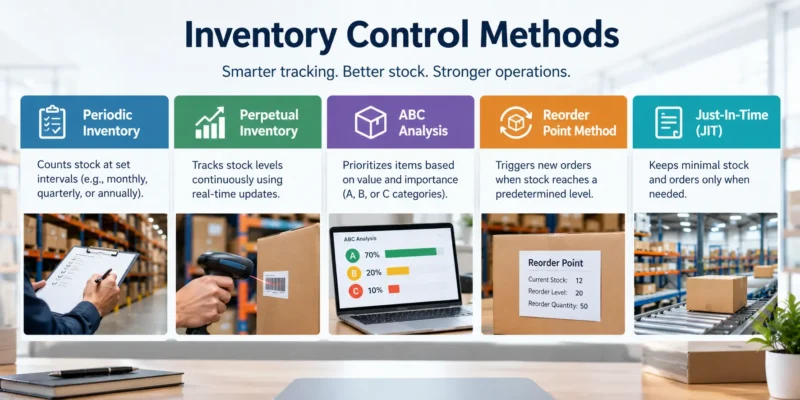
Running out of popular products can frustrate customers, while keeping too much stock ties up money and valuable storage space. That’s why businesses use inventory control methods to maintain the right stock levels, reduce unnecessary expenses, and keep operations running smoothly. Whether you manage a retail store, warehouse, manufacturing company, or online business, effective inventory control helps you balance product availability with operating costs.
However, inventory management involves more than counting products on shelves. Businesses must understand demand, monitor stock movement, coordinate with suppliers, and decide when to reorder. By choosing suitable inventory control techniques, companies can improve cash flow, reduce waste, and provide more reliable customer service.
What Are Inventory Control Methods?
Inventory control methods are systems and techniques businesses use to monitor, organize, and regulate their available stock.
These methods help companies determine how much inventory to keep, when to reorder products, and how to prevent shortages or excessive stock.
For example, a clothing retailer might track its bestselling items weekly while reviewing slower-moving products monthly. As a result, the business can prioritize popular products without filling its warehouse with unnecessary merchandise.
Inventory control generally focuses on stock availability, accuracy, and movement. Meanwhile, inventory management covers broader activities, including purchasing, demand planning, supplier coordination, and inventory strategy.
Although these functions overlap, understanding their differences helps businesses develop more effective stock management processes.
Why Inventory Control Matters for Businesses
Effective inventory control also supports better financial management. According to the U.S. Small Business Administration, maintaining organized financial records helps businesses understand their financial position and make informed decisions. Similarly, accurate inventory records help managers monitor stock-related expenses, manage working capital, and avoid unnecessary purchasing.
Poor inventory control can affect profitability, customer satisfaction, and daily operations.
For instance, excessive inventory increases storage expenses and creates a greater risk of damaged or outdated products. On the other hand, insufficient stock can cause missed sales and delayed orders.
Effective stock control helps businesses:
- Reduce unnecessary inventory holding costs.
- Prevent frequent stockouts and overstocking.
- Improve order fulfillment and customer satisfaction.
- Maintain accurate inventory records.
- Support better purchasing decisions.
- Reduce product damage, waste, and shrinkage.
- Improve working capital and cash flow.
Before selecting a control technique, businesses should understand the different types of inventory they handle, including raw materials, work-in-progress goods, finished products, and maintenance supplies.
Each category may require different tracking and replenishment practices.
8 Common Inventory Control Methods and Techniques
Businesses use several inventory control methods depending on their size, product categories, customer demand, and operational requirements.
While some techniques focus on inventory classification, others help calculate order quantities or determine when products should move through storage.
1. ABC Inventory Analysis
ABC analysis classifies inventory according to its relative business value, often measured through annual consumption value.
Under this method, products fall into three categories:
- Category A: High-value items requiring close monitoring.
- Category B: Moderately valuable items needing regular supervision.
- Category C: Lower-value items requiring simpler controls.
For example, an electronics retailer might classify expensive laptops as A items, accessories as B items, and inexpensive cables as C items.
Consequently, managers can focus more attention on products that represent the greatest financial exposure.
However, businesses should also consider demand variability and product criticality rather than relying on value alone.
2. First In, First Out (FIFO)
FIFO is an inventory rotation method that prioritizes selling or using older stock before newer stock.
Businesses commonly use this approach for products that may become outdated, damaged, or less desirable over time.
For example, a grocery store places older packaged products toward the front of shelves. As customers purchase those items first, the store reduces the risk of unsold aging inventory.
FIFO works particularly well for:
- Grocery products.
- Cosmetics and personal care items.
- Clothing collections.
- Consumer electronics.
- Products with limited shelf lives.
However, businesses handling products with expiration dates may prefer First Expired, First Out (FEFO), which prioritizes the earliest expiration date.
3. Just-in-Time (JIT) Inventory
Just-in-Time inventory control aims to receive materials or products close to when businesses need them.
Instead of maintaining large stock reserves, companies coordinate deliveries with production schedules or customer demand.
For example, a furniture manufacturer might order components shortly before scheduled production begins.
As a result, the company can reduce storage requirements and avoid tying up excessive capital.
However, JIT depends heavily on reliable suppliers, accurate forecasting, and dependable transportation.
Unexpected delivery delays can disrupt production, so businesses often maintain contingency plans for critical materials.
4. Economic Order Quantity (EOQ)
Economic Order Quantity helps businesses estimate an order size that minimizes the combined costs of ordering and holding inventory.
The basic EOQ formula is:
EOQ = √(2DS ÷ H)
Where:
- D: Annual demand in units.
- S: Cost of placing one order.
- H: Annual holding cost per unit.
Suppose a retailer sells 10,000 units annually, spends $40 per order, and pays $2 annually to store each unit.
Using the formula:
EOQ = √(2 × 10,000 × 40 ÷ 2)
EOQ ≈ 632 units
Therefore, ordering approximately 632 units at a time may minimize the relevant ordering and holding costs under the model’s assumptions.
However, basic EOQ assumes relatively stable demand and costs. Businesses should adjust their decisions when supplier discounts, storage limits, or uncertain demand affect purchasing.
5. Reorder Point Method
The reorder point method identifies the inventory level at which a business should place another order.
It considers expected demand during supplier lead time and any safety stock maintained.
The basic formula is:
Reorder Point = Average Daily Demand × Lead Time + Safety Stock
For example, a business selling 20 units daily with a supplier lead time of seven days and 40 units of safety stock would calculate:
Reorder Point = (20 × 7) + 40
Reorder Point = 180 units
Therefore, the business should normally reorder when its inventory position reaches 180 units.
Understanding What Is Lead Time helps managers calculate reorder points more accurately, particularly when supplier delivery schedules vary.
6. Safety Stock Inventory Control
Safety stock refers to additional inventory businesses maintain to protect against unexpected demand or supply delays.
For example, an online retailer might keep extra stock of popular products during seasonal shopping periods.
Consequently, the business can continue fulfilling orders when customer demand exceeds expectations.
However, excessive safety stock increases storage costs and ties up working capital.
Businesses should therefore calculate appropriate reserves using demand variability, supplier reliability, and desired service levels.
7. Minimum-Maximum Inventory Method
The minimum-maximum method establishes lower and upper inventory limits for individual products.
When inventory reaches the minimum threshold, the business replenishes stock toward its predetermined maximum level.
For example, a hardware store might maintain a minimum of 50 units and a maximum of 200 units for a frequently purchased item.
This approach offers a straightforward way to manage products with reasonably predictable demand.
However, businesses should regularly review their thresholds as sales patterns and supplier conditions change.
8. Perpetual Inventory Control
A perpetual inventory system updates inventory records whenever businesses record purchases, sales, returns, or stock adjustments.
For example, when a retailer sells an item through its point-of-sale system, connected inventory software automatically reduces the recorded quantity.
As a result, managers can monitor stock availability without waiting for a full physical inventory count.
Barcode scanners, RFID technology, and inventory management software can support this process.
Nevertheless, physical counts remain necessary because theft, damage, scanning errors, and unrecorded transactions can create discrepancies.
Comparing Popular Inventory Control Methods
Different methods solve different inventory problems. Therefore, businesses often combine several techniques rather than relying on one approach.
| Method | Primary Purpose | Best Suited For |
|---|---|---|
| ABC Analysis | Prioritize valuable inventory | Businesses with diverse products |
| FIFO | Rotate older stock first | Retail and perishable goods |
| JIT | Reduce unnecessary stock | Manufacturing operations |
| EOQ | Optimize order quantities | Businesses with stable demand |
| Reorder Point | Determine replenishment timing | Retailers and distributors |
| Safety Stock | Protect against uncertainty | Businesses facing demand fluctuations |
| Min-Max | Maintain stock within limits | Small and medium businesses |
| Perpetual Inventory | Track stock continuously | Ecommerce and multi-location retailers |
Although these inventory control methods techniques address different challenges, combining compatible approaches can improve overall stock accuracy and efficiency.
How to Implement Inventory Control Methods Successfully
Choosing an inventory technique is only the beginning. Businesses also need reliable processes to make their inventory systems effective.
Step 1: Review Current Inventory Records
Start by examining existing stock levels, sales history, damaged products, and inventory discrepancies.
Then, identify products that frequently experience shortages or remain unsold for long periods.
This initial assessment helps managers understand where improvements are needed.
Step 2: Establish Clear Purchasing Procedures
Businesses should create consistent procedures for ordering and receiving products.
For example, understanding What Is a Purchase Order helps purchasing teams document product quantities, agreed prices, delivery expectations, and supplier information.
Clear purchasing records also make it easier to identify incorrect deliveries and resolve supplier disputes.
Step 3: Choose Suitable Control Techniques
Select inventory methods based on product value, demand patterns, storage requirements, and supplier reliability.
For instance, a retailer might combine ABC analysis with reorder points and safety stock.
Meanwhile, a manufacturer might use EOQ for predictable materials while applying JIT to selected production components.
Step 4: Introduce Inventory Tracking Tools
Inventory software can help businesses record stock movements, monitor reorder levels, and identify discrepancies.
Small businesses may begin with spreadsheets. However, growing operations often benefit from systems connected to purchasing, sales, and warehouse activities.
Step 5: Train Employees and Standardize Procedures
Even effective software cannot compensate for inconsistent inventory practices.
Employees should understand how to receive deliveries, record stock movements, investigate discrepancies, and complete inventory counts.
Understanding What Is SOP also helps managers establish standard operating procedures for these activities.
As a result, businesses can reduce avoidable errors and maintain more consistent records.
Common Inventory Control Mistakes to Avoid
Even experienced businesses encounter inventory problems when their processes lack consistency.
Relying on Inaccurate Demand Forecasts
Ordering products based only on previous sales can create problems when customer preferences change.
Instead, businesses should consider seasonal patterns, promotions, market conditions, and recent demand trends.
Ignoring Slow-Moving Inventory
Products that remain unsold consume storage space and working capital.
Therefore, managers should regularly review inventory turnover and identify products requiring discounts, redistribution, or purchasing adjustments.
Failing to Conduct Physical Counts
Inventory software records transactions, but it cannot automatically detect every missing or damaged product.
Regular cycle counting helps businesses identify discrepancies before they become larger problems.
Using the Same Rules for Every Product
High-value electronics and inexpensive office supplies rarely require identical inventory controls.
Instead, businesses should adjust monitoring frequency, reorder policies, and safety stock according to product characteristics.
Frequently Asked Questions About Inventory Control
What Are the Most Effective Inventory Control Methods?
The most effective methods depend on business requirements. However, ABC analysis, FIFO, EOQ, reorder points, safety stock, and perpetual inventory systems are commonly used to improve stock control.
What Are the Methods of Inventory Control in Management?
The main methods of inventory control in management include inventory classification, stock rotation, demand forecasting, reorder point planning, safety stock management, and continuous inventory tracking.
Managers often combine these approaches to balance product availability with inventory costs.
Where Can Businesses Find an Inventory Control Methods PDF?
Businesses searching for an inventory control methods pdf can consult educational institutions, professional supply chain organizations, and inventory software providers.
However, they should check publication dates, formulas, and examples before applying downloadable materials to business operations.
Can Small Businesses Use Inventory Control Software?
Yes. Small businesses can use inventory software to track product quantities, automate low-stock alerts, and monitor sales activity.
However, the right solution depends on inventory volume, budget, and operational complexity.
Building a More Reliable Inventory Control System
Effective inventory control starts with understanding which products matter most, how quickly they sell, and when suppliers can replenish them.
Rather than introducing every technique immediately, businesses should begin with a few practical improvements.
For example, start by categorizing inventory, establishing reorder points, and conducting regular stock counts. Then, introduce additional methods as operational needs become more complex.
By reviewing inventory performance consistently, businesses can reduce unnecessary costs, prevent avoidable shortages, and maintain better control over their working capital.
A reliable inventory system supports smoother operations, more accurate purchasing decisions, and better customer experiences.