
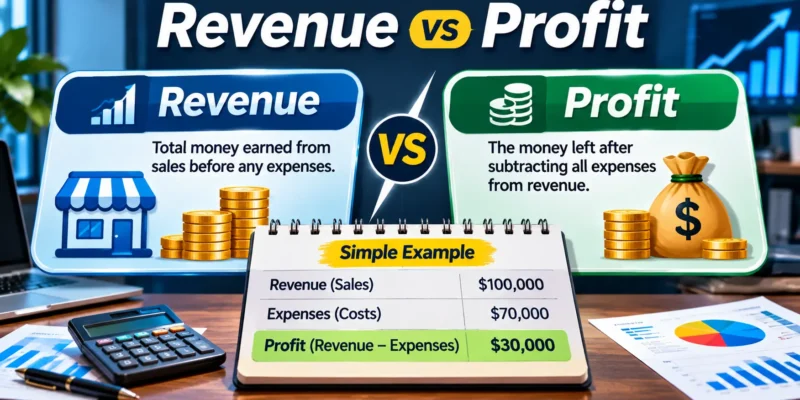
A small business owner proudly says, “We made half a million dollars this year!” But after rent, wages, supplies and taxes, only a fraction of that money is left. That gap is the heart of the revenue vs profit question. Revenue is the money coming in, while profit is what you keep after paying the bills.
In this guide, you will learn clear definitions, simple formulas, a worked example and the different types of each. Also, you will see why both numbers matter and how to improve them.
Revenue vs Profit: The Quick Answer
Here is the simplest way to remember it:
- Revenue is the total money a business earns from selling goods or services. It sits at the top of the income statement, so people call it the “top line.”
- Profit is what remains after you subtract costs and expenses. Because net profit sits at the bottom of the income statement, people call it the “bottom line.”
In short, sales tell you how much demand you have, while profit tells you whether the business model actually works.
What Is Revenue?
Revenue is the total income a business earns from its normal activities. For example, a bakery’s revenue comes from selling bread and cakes, while a software company earns it from subscriptions.
The basic formula looks like this:
Revenue = Price × Number of Units Sold
So, if you sell 1,000 shirts at $25 each, your sales total $25,000. Every sale usually starts with paperwork, and our guide on invoice vs receipt explains how each document records that income.
Gross Revenue vs Net Revenue
Not every dollar from sales stays in the business. That is why accountants split this number in two:
- Gross revenue: The total value of all sales before any deductions.
- Net revenue: Gross sales minus returns, refunds, discounts and allowances.
For instance, if you sell $100,000 worth of goods but customers return $5,000, your net figure is $95,000. Usually, net revenue gives a more honest picture of real sales.
What Is Profit?
Profit is the money left after you pay for the costs of running the business. However, there are three main types, and each one tells a different story.
Gross Profit
Gross profit equals net sales minus the cost of goods sold (COGS). COGS includes direct costs like raw materials, inventory and production labor.
Gross Profit = Net Revenue − COGS
This number shows how efficiently you make or buy what you sell.
Operating Profit
Next, operating profit subtracts everyday running costs from gross profit. These include rent, salaries, marketing, utilities and depreciation. If you want to see how equipment costs spread out over time, our guide on What Is a Depreciation Schedule walks through it step by step.
Operating Profit = Gross Profit − Operating Expenses
Net Profit
Finally, net profit subtracts interest and taxes. This is the true bottom line.
Net Profit = Operating Profit − Interest − Taxes
The SEC’s Beginners’ Guide to Financial Statements describes this same flow, moving down the income statement from the top line to net earnings.
Revenue vs Profit Side by Side
| Feature | Revenue | Profit |
|---|---|---|
| Meaning | Total money from sales | Money left after costs |
| Income statement spot | Top line | Bottom line (net) |
| Shows | Demand and sales volume | Efficiency and health |
| Can be negative? | No | Yes, as a loss |
| Main types | Gross, net | Gross, operating, net |
A Simple Example: Maria’s Coffee Shop
Let’s walk through one year at a small coffee shop.
- Gross sales: $300,000
- Minus discounts and refunds: $10,000
- Net revenue: $290,000
- Minus COGS (coffee, milk, cups): $110,000
- Gross profit: $180,000
- Minus operating expenses (rent, wages, marketing, depreciation): $140,000
- Operating profit: $40,000
- Minus interest and taxes: $13,000
- Net profit: $27,000
So, even though Maria’s shop brought in $300,000, she kept about $27,000. In other words, her net margin is roughly 9%. Meanwhile, her gross margin is about 62%, which shows her drinks are priced well above ingredient costs.
Behind numbers like these sits a record of every transaction. To understand how businesses track all of this, see our guide on What Is a Ledger.
Gross Profit vs Revenue
People often mix up these two. However, the difference is simple. Revenue is everything you sell, while gross profit is what remains after paying only for the product itself.
For example, an electronics store might sell a TV for $800 that cost $600 to buy. In that case, sales equal $800, but gross profit is just $200.
Also, comparing the two gives you gross margin:
Gross Margin = Gross Profit ÷ Net Revenue × 100
So, a higher gross margin means you keep more from each sale to cover other costs.
Net Revenue vs Profit
Net revenue only removes returns, discounts and allowances. In contrast, net profit removes every expense, including COGS, rent, wages, interest and taxes.
That is why net revenue is almost always much larger than net profit. Then, dividing one by the other gives your net margin:
Net Margin = Net Profit ÷ Net Revenue × 100
Margins vary widely by industry. For instance, grocery stores often run on thin margins, while software companies can earn much higher ones.
Why Both Numbers Matter
Looking at just one number can mislead you. For example, a company can grow sales quickly while losing money on every order. On the other hand, a business can earn healthy profits while sales stay flat.
Here is what each number tells different people:
- Owners and managers: Sales show market demand, while the bottom line shows whether the model is sustainable.
- Lenders: They look at consistent earnings to judge if you can repay loans.
- Investors: They track growth in sales and long-term earnings power.
Also, different groups care about these numbers for different reasons. To understand who those groups are, our guide on stakeholder vs shareholder explains the difference.
How to Grow Revenue and Profit
Growing sales and growing the bottom line take slightly different strategies.
Ways to Boost Sales
- Reach new customers: Try new markets, channels or marketing campaigns.
- Sell more to current customers: Use upsells, bundles and loyalty programs.
- Adjust pricing: Review prices against value and competitors. For example, our guide on What Is MSRP explains how suggested retail prices affect what you charge.
- Launch new products: Fill gaps your customers already ask about.
Ways to Improve Margins
- Lower COGS: Negotiate with suppliers or buy in bulk.
- Trim overhead: Cut unused software, reduce waste and review rent.
- Focus on high-margin items: Promote products that earn more per sale.
- Improve efficiency: Automate repetitive tasks to save time and labor.
Common Mistakes to Avoid
- Treating sales as earnings: Big sales numbers do not guarantee money left over.
- Ignoring returns and discounts: These can quietly shrink net sales.
- Confusing profit with cash: A profitable company can still run short on cash if customers pay late.
- Growing too fast: Chasing sales without watching costs can lead to losses.
- Skipping regular reviews: Check your income statement monthly, not just at tax time.
Frequently Asked Questions
Can a company have revenue but no profit?
Yes. In fact, many startups bring in sales but still report losses because their costs are higher than their income.
Is profit the same as cash?
No. Profit follows accounting rules, while cash shows the actual money in your bank account. For example, unpaid customer invoices count toward profit but not toward cash yet.
Is revenue the same as sales?
Often, yes. However, revenue can also include other income, such as interest, rent or licensing fees.
Which matters more, revenue or profit?
Both matter. Sales show growth and demand, while the bottom line shows long-term health.
Key Takeaways for Business Owners
To sum up, revenue is the money coming in, and profit is what you keep after costs. Also, gross, operating and net profit each reveal a different layer of your business.
So, start by tracking both numbers every month. Then, calculate your gross and net margins, compare them over time and look for small changes in pricing and costs. Over time, those small steps can turn strong sales into steady, healthy earnings.