
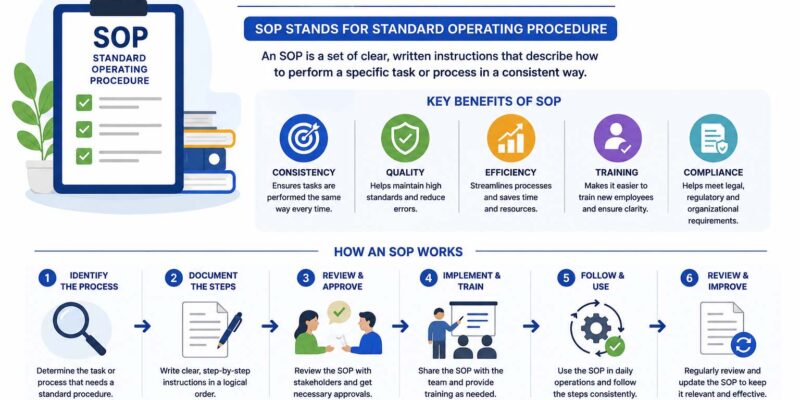
Every successful business depends on organized systems and consistent processes. One of the most important tools used to achieve this is an SOP. If you are wondering what is SOP, the simple answer is that SOP stands for Standard Operating Procedure.
An SOP is a written document that explains how to complete a task or process step by step. Businesses use SOPs to maintain consistency, improve productivity, reduce mistakes, and train employees effectively.
From small startups to global companies, SOPs help organizations operate smoothly and efficiently. Whether managing customer service, marketing, manufacturing, or finance, standard procedures are essential for long-term business success.
What Is a SOP?
Many beginners search for what is a SOP because the term is commonly used in business management and operations.
A SOP, or Standard Operating Procedure, is a detailed instruction document that explains exactly how a specific task should be completed.
The goal of a SOP is to ensure that every employee follows the same process each time.
For example, a business may create SOPs for:
- Hiring employees
- Handling customer complaints
- Managing inventory
- Creating marketing campaigns
- Processing orders
- Responding to emails
Without SOPs, employees may perform tasks differently, leading to confusion and inconsistency. Organizations also benefit from documenting recurring administrative tasks such as how to write meeting minutes, ensuring meetings are recorded consistently across departments.
What Is an SOP?
The question what is an SOP is especially common among new business owners and entrepreneurs.
An SOP acts like a roadmap for business activities. Instead of relying on memory or verbal instructions, employees can follow written procedures.
This provides several advantages:
- Faster employee training
- Improved productivity
- Better quality control
- Reduced operational errors
- Easier workflow management
For example, a restaurant SOP may explain how staff should prepare food safely, while a software company SOP may outline how developers should test applications before release.
What Is SOP in Business?
Understanding what is SOP in business is important because SOPs are the foundation of organized operations.
Businesses use SOPs to standardize work processes. This means every employee follows the same approved method.
In business environments, SOPs help with:
Operational Efficiency
Employees can complete tasks faster because they know exactly what steps to follow.
Consistency
Customers receive the same level of service every time.
Employee Training
New workers can learn procedures more easily using documented instructions.
Risk Reduction
SOPs reduce errors, accidents, and compliance issues.
Business Growth
As companies expand, SOPs make it easier to scale operations without losing quality. Well-designed SOPs also support an overall business strategy by creating repeatable systems that help organizations achieve long-term goals.
What Is an SOP in Business?
When discussing what is an SOP in business, it is important to understand how SOPs support management and leadership.
Business owners cannot supervise every task personally. SOPs allow managers to delegate responsibilities while maintaining consistent standards.
For example, an ecommerce business may use SOPs for:
- Product uploads
- Customer support replies
- Shipping procedures
- Social media posting
- Refund processing
This helps employees work independently while following company expectations.
Businesses without SOPs often struggle with inconsistent performance, delayed workflows, and employee confusion.
Why SOPs Are Important for Businesses
SOPs are valuable for companies of all sizes.
Improved Productivity
Employees spend less time asking questions because procedures are already documented.
Better Communication
SOPs ensure everyone follows the same procedures, reducing misunderstandings and improving communication across teams.
Easier Employee Onboarding
New team members can quickly learn processes through SOP documentation.
Higher Customer Satisfaction
Consistent service creates trust and professionalism. Companies focused on a strong customer engagement strategy often rely on SOPs to ensure customers receive a consistent experience regardless of who provides the service.
Stronger Business Systems
Businesses become less dependent on individual employees because knowledge is documented.
These benefits make SOPs essential for long-term business success.
Step-by-Step Guide to Creating an SOP
Creating an effective SOP does not need to be complicated. Businesses can follow a simple process.
Step 1: Identify the Process
Choose the task or workflow that needs documentation.
For example:
- Client onboarding
- Inventory management
- Invoice processing
Step 2: Define the Objective
Explain why the SOP exists and what result it should achieve.
Step 3: List Required Steps
Write each step clearly and logically.
Avoid confusing language.
Step 4: Add Roles and Responsibilities
Specify who is responsible for completing each part of the process.
Step 5: Include Tools or Resources
Mention software, templates, or equipment needed.
Step 6: Review and Test
Test the SOP to ensure employees can follow it easily.
Step 7: Update Regularly
Businesses evolve over time, so SOPs should stay current.
Regular updates improve efficiency and accuracy.
Real-World SOP Examples
Retail Business SOP
A retail store may create SOPs for opening and closing procedures, inventory checks, and customer service guidelines.
Marketing Agency SOP
A marketing agency may use SOPs for content creation, SEO audits, and client communication.
Restaurant SOP
Restaurants rely on SOPs for food preparation, hygiene, and staff safety.
Ecommerce SOP
Online businesses often create SOPs for returns, shipping, product listings, and order fulfillment.
These examples show how SOPs improve workflow and organization.
SOPs and Business Strategy
SOPs are not just operational documents. They also support long-term business strategy.
Businesses with strong SOP systems can:
- Scale operations faster
- Reduce management stress
- Improve employee accountability
- Maintain quality during growth
- Increase operational efficiency
Senior leadership, including a chief strategy officer, often uses SOPs to ensure strategic initiatives are implemented consistently throughout the organization.
For startups, SOPs create structure early. For large companies, SOPs maintain consistency across teams and locations.
Entrepreneurs who invest time into creating SOPs often build more stable and scalable businesses.
Common SOP Mistakes to Avoid
Many businesses create SOPs incorrectly.
Overcomplicated Instructions
Complex language can confuse employees.
Solution
Use simple and direct wording.
Outdated Procedures
Old SOPs may no longer reflect current business processes.
Solution
Review SOPs regularly.
Lack of Employee Input
Employees performing the tasks often know the best workflow improvements.
Solution
Ask team members for feedback.
Missing Visuals
Some tasks are easier to understand with screenshots or diagrams.
Solution
Add visuals when necessary.
How Technology Improves SOP Management
Modern businesses often use software tools to manage SOPs.
Popular SOP management tools include:
- Notion
- Trello
- Asana
- ClickUp
- Google Docs
These platforms help businesses:
- Organize procedures
- Collaborate with teams
- Track updates
- Improve accessibility
Digital SOP systems are especially useful for remote teams and growing companies. Businesses also integrate SOPs with operational documents such as what is a purchase order to standardize procurement and approval workflows.
FAQ About SOPs
What does SOP stand for?
SOP stands for Standard Operating Procedure.
What is the purpose of an SOP?
The purpose of an SOP is to create consistent processes and improve efficiency.
Are SOPs only for large businesses?
No. Small businesses and startups also benefit greatly from SOPs.
How long should an SOP be?
An SOP can be short or detailed depending on the task complexity.
Who creates SOPs in a company?
Managers, team leaders, business owners, or process specialists usually create SOPs.
Can SOPs improve employee performance?
Yes. SOPs provide clear instructions and reduce confusion.
Conclusion
Understanding what is SOP is essential for anyone involved in business management, entrepreneurship, or operations. SOPs help businesses create organized systems, improve efficiency, and maintain consistency across daily tasks.
Whether you run a small startup or a large company, well-written SOPs can improve productivity, employee training, customer satisfaction, and long-term growth. They reduce mistakes, simplify workflows, and create stronger business foundations.