
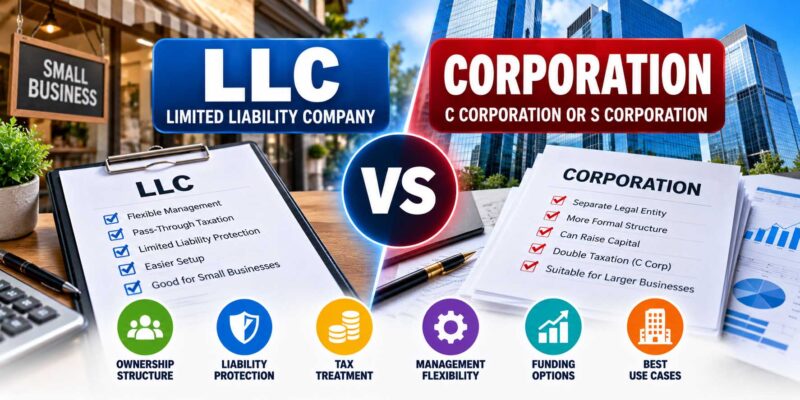
Starting a business involves several important decisions, but choosing the right legal structure can affect your taxes, ownership, and long-term growth. When comparing LLC vs corporation, the main differences involve management flexibility, tax treatment, administrative requirements, and how ownership works.
Both structures generally provide limited liability protection, meaning business owners aren’t personally responsible for most company debts. However, they operate differently.
An LLC offers flexible management and several tax options. Meanwhile, a corporation follows a more formal structure and can make raising investment capital easier.
So, which one should you choose?
This guide explains how LLCs and corporations work, compares their advantages and disadvantages, and helps you select a structure that fits your business goals.
LLC vs Corporation: What’s the Main Difference?
An LLC, or limited liability company, is a business structure that combines liability protection with flexible management and taxation.
A corporation, on the other hand, is a separate legal entity typically governed by shareholders, directors, and officers.
Although both can protect owners’ personal assets, they differ in how they’re managed, taxed, and operated.
LLC vs Corporation Comparison Table
| Feature | LLC | Corporation |
|---|---|---|
| Owners | Members | Shareholders |
| Liability protection | Generally yes | Generally yes |
| Management | Flexible | Formal board and officers |
| Default federal taxation | Pass-through in most cases | C corporation taxation |
| Tax elections | Several options | S corporation election if eligible |
| Ownership structure | Membership interests | Shares of stock |
| Outside investors | Possible, but sometimes less convenient | Often preferred for equity investment |
| Administrative requirements | Usually fewer formalities | Generally more formalities |
| Profit distribution | Flexible, subject to tax rules | Based on shares and corporate rules |
| Best suited for | Many small and medium businesses | Businesses planning significant equity financing |
However, state laws and individual circumstances can affect these differences.
Therefore, consider both your immediate needs and long-term plans before registering.
What Is an LLC?
A limited liability company is a legal business entity formed under state law.
Its owners are called members, and an LLC can have one or multiple members.
Generally, members receive protection from personal liability for ordinary business obligations.
However, that protection isn’t absolute. Personal guarantees, fraud, and certain other circumstances can create personal liability.
How Does an LLC Work?
An LLC can be managed directly by its members or by appointed managers.
For example, two friends opening a marketing agency could form an LLC and share management responsibilities.
Alternatively, they could appoint one person to handle daily operations.
This flexibility makes LLCs attractive to entrepreneurs who want fewer formal management requirements.
LLC Tax Treatment
By default, the IRS generally treats a single-member LLC as a disregarded entity for federal income tax purposes.
Meanwhile, a multi-member LLC is generally taxed as a partnership unless it elects another classification.
If you’re unfamiliar with this arrangement, understanding What Is a Disregarded Entity can help explain why a single-owner LLC’s income usually appears on the owner’s tax return.
An eligible LLC can also elect corporate taxation.
Therefore, forming an LLC doesn’t automatically determine one permanent tax treatment.
For additional details, review the IRS explanation of limited liability company tax classifications.
What Is a Corporation?
A corporation is a legal entity formed under state law that exists separately from its shareholders.
Its ownership is divided into shares of stock.
Typically, shareholders elect a board of directors, while the board oversees major decisions and appoints officers to manage daily operations.
How Corporate Ownership Works
Imagine a technology startup with three founders.
Initially, each founder receives shares representing an ownership interest.
Later, the company may issue additional shares to investors, subject to applicable laws and corporate approvals.
As a result, corporations often provide a familiar ownership structure for businesses seeking venture capital.
Advantages of a Corporate Structure
One of the main advantages of corporation ownership is the ability to issue stock and establish structured ownership rights.
Corporations may also offer:
- Clear ownership arrangements
- Easier transfer of shares, subject to restrictions
- Established governance procedures
- Potential access to institutional investment
- Continuity when shareholders change
However, these benefits come with more formal administrative responsibilities.
LLC vs Corporation Taxes: Which Structure Is Better?
Tax treatment is one of the biggest factors when choosing between an LLC and a corporation.
However, the better option depends on how the business earns money, distributes profits, and compensates its owners.
How LLCs Are Taxed
By default, most LLCs use pass-through federal income taxation.
This means business profits generally pass through to the owners rather than being subject to a separate entity-level federal income tax.
However, owners may owe income tax on their allocated profits even when the business doesn’t distribute all the cash.
Depending on the circumstances, self-employment taxes may also apply.
How C Corporations Are Taxed
A C corporation generally pays federal corporate income tax on its taxable profits.
Under current federal law, the corporate income tax rate is 21%.
When a C corporation distributes taxable dividends, shareholders may also pay personal income tax on those dividends.
This creates the possibility of double taxation.
However, not every dollar of corporate profit is automatically taxed twice. The second layer generally arises when taxable dividends are distributed.
What About S Corporations?
An S corporation is a federal tax classification available to eligible businesses, not a separate state-law entity type.
Both qualifying corporations and LLCs can elect S corporation tax treatment.
Therefore, the comparison between s corp vs llc requires understanding whether you’re comparing legal structures or federal tax classifications.
S corporations generally pass income through to shareholders for federal income tax purposes, although special rules and state taxes may apply.
For some eligible owner-operated businesses, S corporation taxation may provide payroll-tax advantages. However, shareholder-employees must receive reasonable compensation for their services.
LLC vs S Corporation: Understanding the Difference
Many entrepreneurs assume they must choose between forming an LLC and creating an S corporation.
However, these options aren’t mutually exclusive.
An LLC can elect S corporation taxation while remaining an LLC under state law.
For example, a consulting business might form an LLC and later elect S corporation status after reviewing its income and payroll obligations.
When researching s corporation vs c corporation, you’ll also discover that these classifications differ in taxation, eligibility requirements, and shareholder restrictions.
Therefore, the right tax election deserves a separate analysis from the decision about which legal entity to form.
Corporation vs LLC: Ownership and Management
Ownership flexibility can influence your decision, especially if you plan to bring in partners or investors.
LLC Ownership
LLCs generally allow flexible ownership arrangements.
For example, members can establish different economic rights through an operating agreement, subject to applicable law and tax requirements.
This flexibility can benefit family businesses, consulting firms, and partnerships between entrepreneurs.
However, complex membership arrangements may become less convenient when attracting certain institutional investors.
Corporate Ownership
Corporations issue shares to shareholders.
Depending on their structure and legal requirements, corporations may offer different classes of stock.
For example, a startup may issue common stock to founders and preferred stock to investors.
As a result, the corporate model often fits businesses planning multiple investment rounds.
However, corporations must also follow governance requirements, including board oversight and required records.
LLC vs Partnership vs Corporation: How Do They Compare?
Entrepreneurs sometimes consider traditional partnerships before forming a registered business entity.
However, liability protection creates a major distinction.
| Structure | Personal Liability | Management | Typical Federal Taxation |
|---|---|---|---|
| General partnership | Partners generally face personal liability | Partners manage | Pass-through |
| LLC | Members generally have limited liability | Flexible | Usually pass-through by default |
| Corporation | Shareholders generally have limited liability | Board and officers | C corporation by default |
A general partnership may arise when two or more people operate a business together for profit without forming another entity.
However, partners can face personal liability for partnership obligations.
An LLC can provide a useful alternative when business owners want liability protection without adopting traditional corporate governance.
How Much Does It Cost to Form an LLC or Corporation?
Formation costs vary by state.
For example, filing fees, annual reports, franchise taxes, and registered-agent expenses can affect the total cost.
Typical LLC Expenses
LLC expenses may include:
- State formation filing fees
- Registered-agent services
- Operating agreement preparation
- Annual or periodic state fees
- Business licenses and permits
Some states impose additional taxes or minimum annual payments.
Therefore, the cheapest state filing fee doesn’t always mean the lowest long-term cost.
Typical Corporate Expenses
Corporations may face similar formation costs.
However, they also generally need to maintain corporate records, follow governance procedures, and document important decisions.
For businesses with multiple shareholders, professional legal and accounting assistance may increase expenses.
Still, the extra administration may be worthwhile when a business needs a formal investment structure.
Which Is Better for Small Businesses?
For many small businesses, an LLC provides a practical combination of liability protection and operational flexibility.
For example, a local cleaning company, freelance design agency, or small online store may not need a corporate board structure.
An LLC can allow the owners to focus on running the business while meeting state filing and tax obligations.
However, a corporation may make more sense when founders plan to raise substantial equity financing.
Before choosing, compare the sole proprietorship vs llc options as well, especially if you’re launching a one-person business.
A sole proprietorship is simpler to establish, but it generally doesn’t create a separate liability shield.
When Should You Choose a Corporation Instead?
A corporation may be preferable when your business has ambitious financing or ownership goals.
For example, a software startup planning to raise venture capital might choose a Delaware C corporation.
Many institutional investors prefer this structure because of familiar corporate governance and stock ownership arrangements.
However, not every growing business needs to incorporate.
If your company expects steady profits without outside equity investors, an LLC may remain suitable for years.
The right choice depends on your financing strategy rather than business size alone.
Common Mistakes When Choosing a Business Structure
Business owners sometimes focus entirely on taxes while overlooking other important factors.
However, choosing a structure requires a broader perspective.
Assuming Liability Protection Is Unlimited
Both LLCs and corporations generally protect owners from ordinary business debts.
However, personal guarantees, misconduct, and certain legal obligations can still create personal exposure.
Therefore, maintain proper business records and keep business finances separate.
Ignoring State Requirements
Formation rules differ across states.
For example, annual fees, reporting obligations, and business taxes may vary considerably.
Check the requirements where your company will actually operate.
Choosing Based Only on Filing Costs
A lower formation fee doesn’t guarantee a better long-term arrangement.
Instead, consider accounting expenses, taxes, management needs, and future ownership changes.
Forgetting About Future Growth
A structure that works for one owner may become less convenient when several investors join.
Therefore, think about your business goals over the next three to five years.
LLC vs Corporation: How to Choose the Right Structure
Before registering your business, answer these questions:
- Will you seek outside investors? A corporation may offer a more familiar equity structure.
- Do you want flexible management? An LLC generally provides more options.
- How will profits be taxed? Compare default taxation and available elections.
- Will ownership change frequently? Corporate shares may simplify certain transfers.
- What are your state’s ongoing costs? Calculate more than the initial filing fee.
- Do you need specialized legal or tax advice? Complex ownership arrangements deserve professional review.
For instance, a two-person consulting firm might prioritize flexibility and choose an LLC.
Meanwhile, a technology startup seeking venture capital may prefer a corporation.
Neither option is automatically better for every entrepreneur.
Frequently Asked Questions About LLCs and Corporations
Is an LLC Better Than a Corporation?
An LLC may be better for owners who value flexible management and simpler governance.
However, corporations often work well for businesses seeking substantial equity investment.
Can an LLC Become a Corporation?
Yes. Depending on state law, an LLC may be able to convert into a corporation or use another restructuring process.
However, conversions can have legal and tax consequences.
Does an LLC Pay Less Tax Than a Corporation?
Not necessarily.
Tax obligations depend on income, deductions, ownership, distributions, and tax elections.
Therefore, compare the actual tax consequences rather than assuming one structure is always cheaper.
Can One Person Own a Corporation?
Yes. A corporation can generally have a single shareholder.
Similarly, an LLC can have one member.
Which Structure Protects Personal Assets Better?
Both structures generally provide limited liability protection.
However, the effectiveness of that protection depends on legal circumstances and how the business operates.
Making the Right Business Decision
Choosing between an LLC and a corporation comes down to how you want to operate, manage taxes, and grow your business.
For many small business owners, an LLC offers useful flexibility and fewer traditional corporate formalities.
Meanwhile, a corporation may provide a stronger fit for businesses planning substantial equity financing or complex stock ownership.
Before filing, compare your state’s requirements, estimate ongoing expenses, and review your tax options with a qualified professional.
That preparation can help you choose a structure that supports your business today and remains practical as your company grows.