
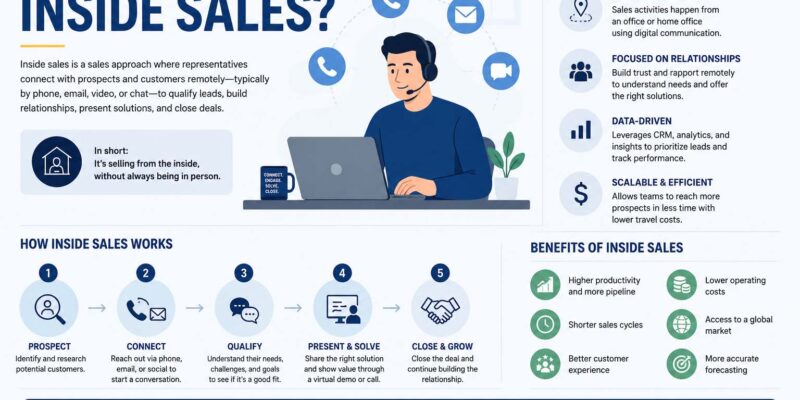
Today, inside sales has become one of the most important parts of modern business growth. Companies across many industries rely on these teams to connect with customers, generate leads, and close deals without face-to-face meetings. As technology keeps improving communication, more businesses are investing in this approach to raise revenue and strengthen customer relationships.
If you have ever wondered what is inside sales, the answer is simple. In short, it means selling products or services remotely through phone calls, emails, video meetings, and online tools. Unlike traditional field sales, these professionals usually work from an office or from home instead of traveling to meet clients.
Meanwhile, the rise of digital communication has changed the way businesses operate. Companies can now reach clients worldwide without leaving the office, which makes remote selling one of the fastest-growing career paths in sales. In addition, businesses value it because it cuts travel costs, improves efficiency, and lets teams handle more customer conversations each day.
Companies that build successful sales operations often thrive in a Free Enterprise System, where innovation, competition, and customer relationships drive business growth.
What Is an Inside Sales Rep
To understand the industry better, it helps to know what is an inside sales rep. This professional talks with potential customers and guides them through the buying process remotely. Above all, their goal is to build relationships, explain products or services, answer questions, and close sales.
Every day, these reps use tools such as customer relationship management (CRM) software, email platforms, phone systems, and video apps. As a result, they can organize leads, track customer conversations, and stay productive throughout the sales cycle.
Because most conversations happen without face-to-face contact, a rep must communicate very well. In particular, confidence, active listening, and problem-solving skills are essential. On top of that, reps need strong time management because they often juggle several clients and follow-ups in one day.
However, the duties of the role vary by company and industry. Some reps focus on finding new leads, while others look after existing customers. For example, in technology companies they may explain software, whereas in retail or manufacturing they may promote products directly to businesses or consumers.
Not surprisingly, many businesses like these teams because they can work well from almost anywhere. Likewise, the growth of remote work has made this career more popular around the world.
How This Role Differs From Other Sales Jobs
Also, another common question is how a remote seller differs from other sales positions. Put simply, this professional sells from a desk instead of traveling to customer locations. As a result, the work centers on digital communication and relationship building.
For instance, reps contact potential clients through cold calls, emails, or online meetings and guide them toward a buying decision. Above all, their ability to build trust through conversation strongly shapes their results.
Today, the modern rep also uses data to improve performance. Specifically, businesses track customer behavior, email engagement, and sales conversations to spot the best opportunities. This way, teams can make informed decisions and work more efficiently.
Furthermore, training plays a big part in success. Many companies teach communication techniques, negotiation strategies, and product knowledge. After all, clients expect personal solutions and professional guidance throughout the buying process. For job details and pay data, the U.S. Bureau of Labor Statistics guide to sales representatives is a useful source.
Finally, businesses hiring remote sellers should meet legal requirements, such as getting What Is a Business License where it applies before operating commercially.
What Is Inside Sales vs Outside Sales
Many people compare remote selling with traditional methods and ask what is inside sales vs outside sales. Although both roles aim to bring in revenue, they work in very different ways.
On one hand, remote reps use digital tools such as phone calls, emails, video calls, and online presentations. On the other hand, outside reps travel to meet customers in person. For example, they may attend business meetings, conferences, trade shows, or client visits.
Clearly, one major advantage of selling from a desk is efficiency. Because reps do not spend time traveling, they can speak with more customers each day. Consequently, productivity rises and business costs often drop.
Still, outside sales remains valuable for industries that depend on personal meetings or large contracts. Some clients prefer meeting in person when they discuss complex products or long-term partnerships. For this reason, many companies now mix both methods for a balanced approach.
What Is the Difference Between Inside and Outside Sales
Knowing what is the difference between inside and outside sales helps businesses choose the right strategy for their goals. Mainly, the two differ in work setting and in how reps reach customers.
Typically, remote teams work from offices or from home. As a result, their communication happens digitally, which allows faster conversations and more flexible schedules. By contrast, field reps spend much of their time on the road meeting clients.
Next, cost is another difference. Generally, remote selling is cheaper because businesses save on travel, hotels, and transport. Moreover, companies can grow these teams more easily by hiring reps from different regions.
Similarly, sales cycles may vary. Remote selling often suits short or medium-length sales because communication is quick. Meanwhile, field sales may work better for high-value deals that need in-person presentations over a longer period.
As organizations grow their sales departments, practices such as a Skip Level Meeting can improve communication between leaders and staff. In addition, companies operating as single-member LLCs may benefit from understanding What Is a Disregarded Entity. Likewise, businesses offering healthcare services can learn from Digital Marketing for Dentists, where trust and qualified leads drive long-term growth.
Conclusion
In the end, understanding what is inside sales is essential for businesses and professionals interested in modern sales strategies. Simply put, it lets companies reach customers remotely through phones, emails, and digital platforms, which makes selling more efficient and cost-effective.