
In today’s manufacturing and automation industries, precision and efficiency are critical for success. One technology that plays a major role in achieving accurate motion control is the linear guide rail. These components are widely used in industrial equipment, CNC machinery, robotics, and automated production lines.
Understanding how a linear guide rail works can help businesses improve productivity, reduce maintenance costs, and enhance operational performance. Whether you are a manufacturer, engineer, entrepreneur, or procurement manager, learning about linear motion technology can support better investment decisions. Businesses that optimize production processes often monitor What Is Lead Time to improve workflow efficiency and deliver products more quickly.
What Is a Linear Guide Rail?
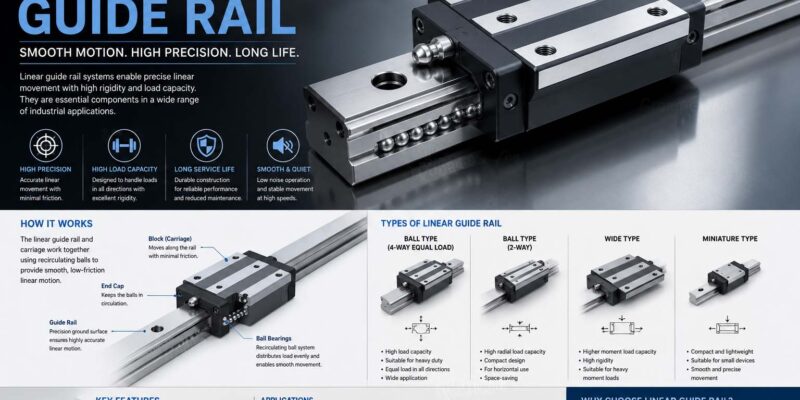
A linear guide rail is a mechanical component designed to provide smooth, precise, and low-friction movement.
It consists of two primary parts:
- Guide rail
- Bearing block or carriage
The bearing block moves along the rail while maintaining accurate positioning and supporting loads.
Linear guide rails help machines perform controlled movement in a straight line, which is essential for manufacturing accuracy and automation.
How Does a Linear Guide Rail Work?
A linear guide rail system uses rolling elements such as steel balls or rollers between the carriage and guide rail.
These rolling elements reduce friction while supporting loads.
The process typically works as follows:
Step 1: Rail Installation
The guide rail is securely mounted to the machine frame.
Step 2: Carriage Placement
A bearing block is installed onto the rail.
Step 3: Motion Control
Motors or actuators move the carriage along the rail.
Step 4: Precise Positioning
The system maintains smooth movement and accurate positioning during operation.
This combination enables highly repeatable motion in industrial applications.
Key Components of a Linear Guide Rail System
A typical linear guide rail system includes several essential parts.
Guide Rail
Provides the path for movement.
Bearing Block
Moves along the rail and supports loads.
Rolling Elements
Balls or rollers minimize friction.
Lubrication System
Reduces wear and extends service life.
Mounting Hardware
Secures the system to machinery.
Together, these components create reliable and efficient motion control.
Benefits of Linear Guide Rail Systems
Businesses invest in linear guide rail systems because of the significant operational advantages they provide.
High Precision
Linear guides deliver exceptional positioning accuracy.
This precision is critical for:
- CNC machines
- Semiconductor equipment
- Robotics
- Medical devices
Reduced Friction
Rolling contact dramatically lowers friction compared to traditional sliding systems.
Longer Equipment Life
Properly maintained guide rails experience less wear and provide extended service life.
Improved Productivity
Smooth and reliable motion reduces downtime and increases production output. Manufacturers looking to maximize efficiency often incorporate these improvements into a broader Marketing Strategy Template and operational plan to support sustainable business growth.
Higher Load Capacity
Many systems are designed to support substantial loads while maintaining precise movement.
Rail Linear Guide Applications
A rail linear guide can be found across numerous industries.
Manufacturing Equipment
Production machinery relies on guide rails for precise movement during assembly and processing.
CNC Machines
Computer-controlled machining centers use linear guides for accurate cutting and positioning.
Robotics
Robotic arms often require precise linear motion to perform repetitive tasks.
Packaging Systems
Packaging equipment uses guide rails to ensure consistent product handling.
Medical Technology
Medical devices benefit from smooth and controlled movement.
Semiconductor Production
High-precision manufacturing environments depend heavily on advanced linear guide technology.
Linear Guide Rail Systems in Modern Business
Modern businesses increasingly adopt automation to remain competitive.
Linear guide technology supports this trend by enabling:
- Faster production
- Higher accuracy
- Reduced labor costs
- Consistent product quality
Companies investing in automation often view guide rails as foundational components of efficient manufacturing systems. Successful organizations also understand the difference between Strategy vs Tactics, ensuring that investments in automation support long-term business goals rather than only short-term operational improvements.
Miniature Linear Guide Rail Assemblies
For compact applications, miniature linear guide rail assemblies offer a smaller alternative to standard systems.
These assemblies are commonly used in:
- Laboratory equipment
- Medical devices
- Small automation systems
- Electronics manufacturing
- Precision instruments
Benefits include:
- Compact size
- Lightweight construction
- High precision
- Smooth operation
Despite their smaller dimensions, miniature guide systems can deliver impressive performance.
Choosing the Right Linear Guide Rail
Selecting the correct system is essential for maximizing performance.
Load Requirements
Determine how much weight the guide must support.
Higher loads require stronger rails and larger bearing blocks.
Accuracy Requirements
Applications such as CNC machining require greater precision than general material handling.
Environmental Conditions
Consider factors such as:
- Dust
- Moisture
- Temperature
- Chemicals
Some environments require specialized coatings or sealing systems.
Speed Requirements
High-speed automation systems may require advanced guide technologies.
Available Space
Miniature assemblies are useful where installation space is limited.
Careful evaluation of these factors helps ensure the best return on investment.
Linear Guide Rail System vs. Traditional Sliding Systems
| Feature | Linear Guide Rail System | Traditional Sliding System |
|---|---|---|
| Friction | Low | Higher |
| Accuracy | Excellent | Moderate |
| Speed | High | Lower |
| Maintenance | Reduced | More Frequent |
| Efficiency | High | Moderate |
| Service Life | Longer | Shorter |
This comparison explains why guide rail technology has become a preferred choice in modern industries.
Business Strategy: Why Companies Invest in Linear Guide Technology
A strong business strategy often includes operational improvements. Organizations led by a Chief Strategy Officer often evaluate manufacturing technologies like linear guide rails to improve efficiency, reduce operating costs, and strengthen long-term competitiveness.
Linear guide systems support several key objectives.
Increased Productivity
More accurate machinery can produce higher-quality products faster.
Reduced Downtime
Reliable motion systems minimize production interruptions.
Better Quality Control
Precision movement improves consistency and reduces defects.
Competitive Advantage
Manufacturers that invest in advanced automation often gain an edge over competitors.
Lower Long-Term Costs
Although initial investment may be higher, maintenance and operational savings often provide long-term value. Businesses also benefit by optimizing equipment usage and understanding How Would a Manufacturer Benefit by Using Fewer Scarce Resources, allowing them to improve productivity while minimizing waste.
Maintenance Tips for Linear Guide Rails
Proper maintenance helps maximize system lifespan.
Keep Rails Clean
Remove dust, debris, and contaminants regularly.
Apply Lubrication
Follow manufacturer recommendations for lubrication schedules.
Inspect Components
Check for signs of wear or damage.
Monitor Alignment
Misalignment can reduce accuracy and increase wear.
Replace Worn Parts Promptly
Early replacement prevents larger system failures.
Future Trends in Linear Motion Technology
The future of linear guide technology continues to evolve.
Emerging trends include:
- Smart monitoring systems
- Predictive maintenance
- Industry 4.0 integration
- Advanced materials
- Energy-efficient designs
These innovations help businesses improve performance while reducing operational costs.
FAQ
What is a linear guide rail?
A linear guide rail is a precision motion component that enables smooth and accurate movement along a straight path.
What industries use linear guide rail systems?
Manufacturing, robotics, medical technology, semiconductor production, packaging, and automation industries commonly use them.
What are miniature linear guide rail assemblies?
They are compact guide systems designed for applications requiring precision movement in limited spaces.
How long do linear guide rails last?
With proper maintenance, many systems can operate effectively for years under demanding conditions.
Why are linear guide rail systems important?
They improve precision, reduce friction, increase productivity, and support modern automation technologies.
How do I choose the right linear guide rail system?
Consider load capacity, accuracy requirements, environmental conditions, speed, and available installation space.
Conclusion
A linear guide rail is a critical component in modern manufacturing, automation, and precision engineering. By delivering smooth movement, high accuracy, and long-term reliability, these systems help businesses improve efficiency and product quality.
Whether exploring a rail linear guide, evaluating miniature guide rail assemblies, researching guide rail systems, or selecting a complete system, understanding the technology can lead to smarter purchasing decisions and stronger business performance. As automation continues to grow, linear guide technology will remain an essential foundation for industrial success.