
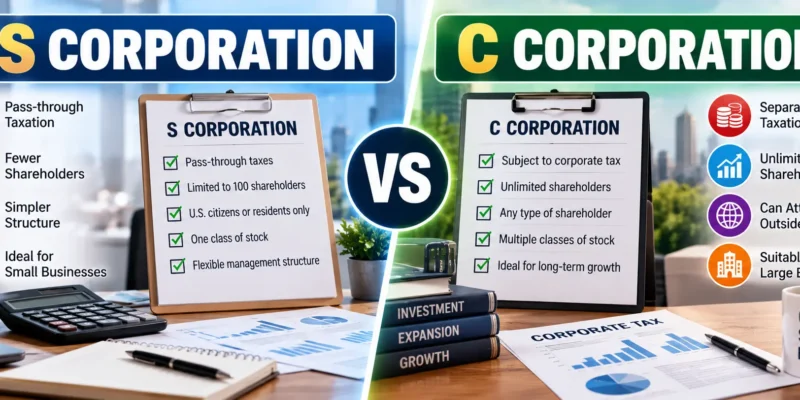
Choosing between an S corporation vs C corporation can affect how a company pays taxes, distributes profits, brings in investors, and plans for future growth. Both structures can provide corporate liability protection, yet their tax treatment and ownership rules differ significantly. For many business owners, the right choice depends on the company’s size, goals, shareholders, and plans for raising capital.
At first, the terminology can seem confusing. However, an S corporation and a C corporation are not two completely different types of businesses. Instead, the distinction largely comes from how a corporation is treated for federal income tax purposes.
Here is what business owners should understand before making a choice.
What Is a C Corporation?
A C corporation, often called a C corp, is generally the standard tax classification for a corporation under federal tax rules. The corporation exists as a legal entity separate from its owners.
As a result, the company can enter contracts, own assets, take on liabilities, hire employees, and conduct business in its own name. Meanwhile, shareholders own interests in the company through shares of stock.
This situation is commonly called double taxation.
Still, C corporation status offers significant flexibility. For example, a company can generally have an unlimited number of shareholders and multiple classes of stock. Therefore, businesses planning to attract institutional investors or pursue substantial outside funding often use this structure.
When exploring the broader advantages of corporation structures, limited liability, continuity, and opportunities to raise capital are among the factors business owners often consider.
What Is an S Corporation?
An S corporation is a corporation, or an eligible entity such as certain LLCs, that elects to be taxed under Subchapter S of the Internal Revenue Code.
Unlike a typical C corporation, an S corporation generally does not pay federal income tax at the corporate level on its operating income. Instead, eligible items of income, losses, deductions, and credits generally pass through to shareholders.
Shareholders then report their respective shares on their individual tax returns, subject to applicable tax rules.
Therefore, S corporation taxation can avoid the traditional corporate-level double taxation associated with C corporations.
Shareholders must also meet specific eligibility requirements, and the corporation can have only one class of stock, although differences in voting rights can be permitted.
Business owners who want to understand the tax and structural appeal in greater detail may also find the benefits of s corp useful when evaluating this election.
S Corporation vs C Corporation Differences at a Glance
Although both options use a corporate framework, their tax and ownership characteristics can produce very different outcomes.
| Feature | S Corporation | C Corporation |
|---|---|---|
| Federal income taxation | Generally pass-through | Generally taxed at corporate level |
| Shareholder limit | Generally up to 100 | Generally no federal tax-law limit |
| Stock classes | One class of stock | Multiple classes allowed |
| Shareholder eligibility | Restricted | Much more flexible |
| Venture capital suitability | Often limited | Commonly preferred |
| Dividend double taxation | Generally avoided on pass-through operating income | Can apply to distributed corporate profits |
| Administrative requirements | Corporate requirements plus S election rules | Standard corporate requirements |
| Best fit | Often closely held eligible businesses | Often growth-focused companies or companies seeking diverse investors |
These distinctions make the S corporation vs C corporation differences more significant than their similar names suggest.
For instance, a local professional business with a small number of eligible owners may value pass-through taxation. In contrast, a startup expecting several rounds of outside investment may value the flexibility of a C corporation.
How S Corporation vs C Corporation Taxation Works
Taxes are usually the central issue in the S corporation vs C corporation comparison.
C Corporation Tax Treatment
A C corporation generally calculates and pays federal income tax on its taxable income. If it later distributes profits to shareholders as taxable dividends, those shareholders may pay tax on the dividend income as well.
Suppose a corporation earns a profit and keeps part of that money inside the company. The corporation generally pays the applicable corporate income tax, while retained after-tax earnings can remain available for business purposes.
If the corporation distributes some of its after-tax earnings as dividends, shareholders may have personal tax obligations related to those payments.
However, the actual tax result depends on far more than the entity label. Compensation, deductions, retained earnings, distributions, state taxes, and each shareholder’s circumstances can all affect the final outcome.
S Corporation Tax Treatment
An S corporation works differently because qualifying income and other tax items generally pass through to shareholders.
For example, assume an eligible S corporation has two equal shareholders. Subject to the applicable tax rules, each owner generally reports their allocated share of the company’s taxable income even if the company does not distribute all that income in cash.
That last point matters. Owners sometimes assume they owe tax only when money reaches their personal bank accounts. However, pass-through taxable income can create a personal tax liability even when some cash remains in the business.
S corporations must also handle owner-employee compensation correctly. In particular, shareholder-employees who perform services generally need reasonable compensation before certain non-wage distributions are made.
C vs S Corporation: Ownership and Investment
Taxation is only one part of the C vs S corporation decision. Ownership restrictions can become even more significant as a company grows.
An S corporation faces federal eligibility requirements regarding the number and types of shareholders. It also cannot use multiple economic classes of stock in the same way a C corporation can.
Consequently, those restrictions may create problems for companies seeking certain institutional or international investors.
A C corporation provides more flexibility. It can generally issue different classes of shares, which allows companies to structure ownership rights around the needs of founders and investors.
For this reason, a founder who expects venture capital funding may approach the decision differently from an owner planning to keep a company closely held.
The choice also belongs within the wider discussion about types of ownership, because ownership structure influences control, financing, succession, liability, and long-term business planning.
S vs C Corporation for Small Businesses
For a smaller company, an S vs C corporation comparison often centers on taxation, payroll, reinvestment, and ownership plans.
Consider a consulting company owned by two eligible shareholders. The business generates consistent profits, both owners actively work for the company, and neither expects outside institutional investment.
In that situation, the owners might investigate an S election because pass-through taxation may align with their business model. However, they would still need to consider payroll, reasonable compensation, distributions, state rules, and administrative costs.
Now consider a technology startup. Its founders expect several investment rounds, want flexibility in issuing equity, and hope to attract institutional investors.
A C corporation may better accommodate those structural needs because it does not carry the same shareholder and stock-class restrictions imposed on S corporations.
Therefore, the best structure depends on what the business needs rather than simply which option appears to offer lower taxes.
How Does an S Corporation Compare With an LLC?
Another common source of confusion is the relationship between an S corporation and a limited liability company.
An LLC is a legal business structure created under state law. In contrast, S corporation status refers primarily to a federal tax election available to qualifying entities.
Therefore, an eligible LLC can potentially elect S corporation tax treatment without becoming a corporation under state law.
Business owners comparing these options should understand this distinction before assuming they must choose between an LLC and an S corporation as mutually exclusive legal structures. A more detailed s corp vs llc comparison can help explain how legal structure and federal tax classification interact.
Advantages and Disadvantages of an S Corporation
An S corporation can offer several potential advantages. Pass-through taxation generally avoids corporate-level federal income tax on qualifying operating income. Meanwhile, shareholders still receive the liability protections associated with the underlying corporate or LLC structure, assuming legal requirements are properly maintained.
However, restrictions are the trade-off.
The business must remain eligible for S corporation treatment. Shareholder restrictions can complicate expansion, while the single-class-of-stock rule can limit certain financing arrangements.
Payroll compliance can also require careful management when shareholders work for the company.
Therefore, an S election is not automatically a tax-saving solution for every profitable small business.
Advantages and Disadvantages of a C Corporation
A C corporation offers substantial ownership and financing flexibility.
For example, a growing company can generally bring in many shareholders and issue multiple classes of stock. As a result, the structure can work well for businesses seeking outside equity financing or planning for complex ownership arrangements.
A C corporation can also retain after-tax profits inside the business for future operations, subject to relevant tax rules.
However, taxation can be a drawback. The corporation may pay income tax on profits, while shareholders may later owe tax when they receive taxable dividends.
C corporations also require formal corporate administration. Depending on state law, this can include maintaining records, following governance requirements, holding required meetings, and filing necessary reports.
How to Choose Between an S Corporation and C Corporation
Rather than making the decision based on one tax rate, business owners should evaluate the company as a whole.
Start with ownership. How many shareholders will the business have, and are all of them eligible S corporation shareholders?
Next, consider financing. If the business expects venture capital, foreign investment, or different classes of equity, C corporation flexibility may become especially relevant.
Then, examine how the business will use its profits. Will owners regularly take money from the company, or will substantial earnings stay inside the business to fund expansion?
After that, consider compensation. Owners who actively work in an S corporation need to understand the rules surrounding wages and distributions.
Finally, review both federal and state taxes. State treatment of S corporations is not always identical to federal treatment, so location can change the calculation.
Entrepreneurs who are still deciding whether to incorporate at all may also compare sole proprietorship vs llc before moving into more complex corporate tax elections.
Common Mistakes When Comparing S and C Corporations
One common mistake is choosing an entity based only on potential tax savings.
Taxes matter, but ownership plans, financing needs, administrative requirements, and long-term strategy matter as well.
Another mistake is assuming an S corporation never pays tax at the entity level. While federal pass-through treatment is a central feature, certain entity-level taxes can apply in specific circumstances, and state tax treatment varies.
Business owners may also confuse distributions with wages. An S corporation shareholder who works for the business cannot simply treat every payment as a distribution to avoid employment taxes.
Finally, some entrepreneurs make a structure decision based on the company’s current situation without considering where the business may be several years later.
A structure that works for two founders today may become restrictive when new investors enter the picture.
Frequently Asked Questions
Is an S corporation better than a C corporation?
Neither structure is universally better. An S corporation may suit an eligible closely held business that values pass-through taxation. Meanwhile, a C corporation may suit a company that needs greater flexibility for investors, stock classes, and growth financing.
Can a C corporation become an S corporation?
An eligible corporation can generally elect S corporation tax status by filing the required election with the IRS and satisfying the applicable requirements and deadlines. However, businesses should consider the tax consequences before changing classifications.
Can an S corporation have employees?
Yes. An S corporation can hire employees just like other businesses. In fact, shareholders who provide substantial services to the corporation may also be employees and generally must receive reasonable compensation for those services.
Can an S corporation have more than 100 shareholders?
Generally, an S corporation is limited to 100 shareholders, although certain family-member rules can affect how shareholders are counted for this purpose.
Why might investors prefer a C corporation?
Certain investors may prefer C corporations because they provide more flexibility regarding shareholder eligibility and classes of stock. S corporation eligibility rules can prevent some entities and nonresident aliens from becoming shareholders.
Making the Right Choice for Your Business
The main S corporation vs C corporation decision comes down to how the company expects to earn, distribute, finance, and reinvest money.
An eligible closely held company may find S corporation pass-through taxation attractive. On the other hand, a company expecting complex equity financing, diverse investors, or multiple stock classes may find the C corporation structure more practical.
Before making an election, map out your expected shareholders, compensation, financing plans, profit distributions, and growth strategy. Then, compare the federal and state tax consequences with a qualified tax or legal professional. A decision based on the business you plan to build—not simply the business you operate today—can prevent costly restructuring later.