
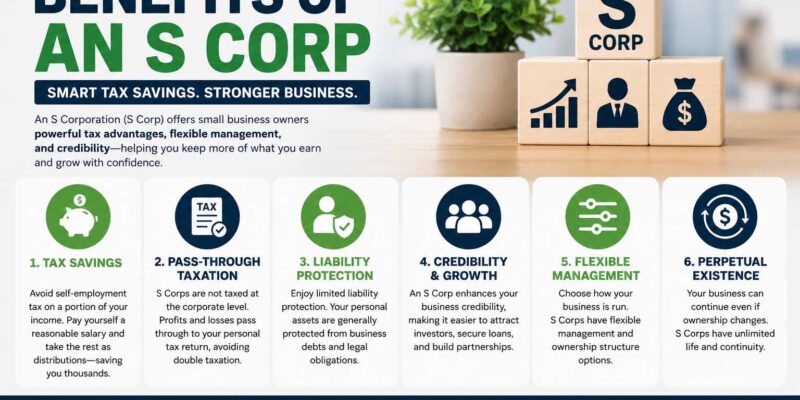
Choosing how your business will be taxed can affect your income, paperwork, payroll responsibilities, and long-term financial planning. For eligible U.S. business owners, the benefits of S Corp taxation can include pass-through treatment and, in some circumstances, potential savings on employment-related taxes. However, an S corporation is not automatically the best choice for every business.
One detail often causes confusion: an S corporation is primarily a federal tax election rather than simply another business structure you select in the same way as an LLC or corporation. For example, an eligible LLC may elect to be taxed as an S corporation while remaining an LLC under state law.
That distinction matters because business owners should compare both legal structure and tax treatment before making a decision.
What Is an S Corporation?
An S corporation is an eligible corporation—or another eligible entity that makes the appropriate election—that generally passes federal income, losses, deductions, and credits through to its shareholders.
Instead of the corporation generally paying federal income tax on its operating profits and shareholders then potentially paying tax again on dividends, qualifying S corporation income generally passes through to shareholders and is reported on their individual returns.
However, certain entity-level taxes can still apply in specific circumstances, and state treatment varies.
Understanding the different types of ownership can make this easier because ownership structure, liability treatment, management rules, and federal tax classification are separate concepts that often overlap.
For many small-business owners, the main attraction is not simply pass-through taxation. Instead, interest often centers on how compensation and distributions may be treated when an owner actively works in the business.
Key Benefits of S Corp Tax Treatment
An S corporation can provide several advantages when the business has enough profit and the owners can handle the extra administrative requirements.
1. Pass-Through Federal Tax Treatment
One of the main benefits of an S Corp is pass-through taxation.
Generally, qualifying business income passes through to shareholders, who report their shares on their individual tax returns. As a result, an S corporation typically avoids the classic federal double-taxation model associated with a C corporation’s distributed profits.
However, shareholders can owe tax on their allocated share of S corporation income even if the company does not distribute all of that cash.
Therefore, owners should plan distributions and tax obligations carefully.
2. Potential Employment Tax Savings
This is often the reason profitable owner-operated businesses consider an S corporation election.
An owner who works for the S corporation generally must receive reasonable compensation as wages before receiving non-wage distributions. Those wages are subject to applicable payroll taxes.
However, qualifying distributions beyond reasonable compensation generally are not treated as wages subject to Social Security and Medicare payroll taxes in the same way.
Consider a simplified example.
Suppose a business generates $120,000 before paying its working owner. If reasonable compensation for the owner’s work is $75,000, the company might pay that amount as wages. Remaining profit may then pass through under S corporation tax rules.
This does not mean an owner can simply choose a tiny salary to avoid payroll taxes. Compensation must be reasonable based on the work performed and relevant facts.
Therefore, the potential savings depend heavily on profit, salary requirements, and the owner’s individual situation.
Benefits of S Corp vs LLC: Understanding the Comparison
The phrase benefits of S Corp vs LLC can be misleading because an LLC and an S corporation are not always competing choices.
An LLC is a business entity created under state law. Meanwhile, S corporation status is a federal tax election available to eligible entities.
For example, a single-member LLC is generally treated as a disregarded entity for federal income tax purposes unless it elects another classification. If you are unfamiliar with that terminology, What Is a Disregarded Entity explains why a business can exist separately under state law while its activity may be reported directly through its owner for federal income tax purposes.
An eligible LLC may later elect S corporation taxation.
That means a business owner may be able to combine the legal features of an LLC with S corporation federal tax treatment.
| Feature | Default Single-Member LLC | LLC Taxed as S Corp | C Corporation |
|---|---|---|---|
| State-law entity | LLC | LLC | Corporation |
| Federal pass-through treatment | Generally yes | Generally yes | Generally no |
| Owner payroll required | Usually no | Generally yes for owner-employees | Yes for employee-owners |
| Separate business return | Generally no for federal income tax | Yes | Yes |
| Payroll administration | Simpler | More involved | More involved |
| Ownership restrictions like S Corp | No S Corp restrictions | Yes | Generally fewer |
This is a simplified comparison. State taxes and individual circumstances can change the result.
Tax Benefits of S Corp vs LLC
A sole owner of a default-taxed LLC generally reports business income through their individual tax return, and net earnings from self-employment are generally subject to self-employment tax, subject to applicable rules and limits.
With an S corporation, a shareholder who performs substantial services generally becomes an employee for compensation purposes. Therefore, the company pays wages subject to payroll taxes.
After paying reasonable compensation, qualifying remaining business profit may generally pass through without being treated as wages subject to those same employment taxes.
That difference can create potential savings for some profitable businesses.
Yet S corporation status also creates new expenses. Payroll processing, tax preparation, bookkeeping, unemployment requirements, state fees, and compliance costs can reduce or even eliminate the financial advantage for a smaller business.
For that reason, tax savings should be calculated rather than assumed.
How an S Corp Differs From a Sole Proprietorship
A sole proprietorship is one of the simplest ways to operate a business. There is generally no separate business entity simply because someone starts conducting business alone, although licenses, registrations, and local requirements may still apply.
Common Sole Proprietorship Examples include independent service providers, small local operators, and freelancers who conduct business personally without forming a separate entity.
S corporations involve considerably more administration.
For example, an S corporation generally needs a separate business tax return, appropriate payroll for shareholder-employees, accurate financial records, and ongoing compliance with eligibility rules.
However, the legal liability comparison depends on the underlying entity. An LLC taxed as an S corporation may provide state-law liability protection because it is an LLC—not because the S election itself creates that protection.
This distinction is easy to overlook.
Benefits of an S Corp for Growing Businesses
The benefits of an S Corp can become more relevant as a business moves beyond the earliest startup stage.
More Formal Compensation Structure
Once owners work as employees, payroll creates a clearer distinction between compensation for labor and business profit.
That structure may support more organized financial management as the company grows.
However, it also creates responsibility. The company must run payroll correctly, withhold applicable taxes, file payroll forms, and maintain records.
Potentially Useful for Established Profitability
A new business making only modest profit may gain little from an S corporation election after administrative expenses are considered.
By contrast, a consistently profitable business may have more room between reasonable owner compensation and remaining business profit.
Therefore, business profitability—not revenue alone—is an important factor when evaluating the election.
Continued Pass-Through Treatment
S corporation shareholders generally receive their allocated share of income through the business’s pass-through structure.
For qualifying owners who want corporate or LLC legal organization without conventional C corporation federal income taxation on operating profits, this can be appealing.
S Corp vs Partnership
Partnerships also commonly use pass-through taxation, but their rules differ significantly from S corporations.
For instance, partnerships can often provide greater flexibility in allocating economic rights among owners, subject to tax rules. S corporations, meanwhile, have tighter requirements and generally must maintain one class of stock for economic rights.
Reviewing Partnership Business Examples can help entrepreneurs see why ownership arrangements should reflect how people will contribute money, labor, decision-making, and risk to the company.
An S corporation also faces shareholder eligibility requirements. For example, there are limits on the number and types of permitted shareholders, and nonresident aliens generally cannot be shareholders.
Drawbacks to Consider Before Electing S Corp Status
S corporation taxation offers potential advantages, but those advantages come with tradeoffs.
More Administration
An S corporation generally needs payroll, a separate tax return, stronger bookkeeping procedures, and additional filings.
Therefore, an owner who currently manages a very simple business may see administrative costs rise.
Reasonable Compensation Rules
Working shareholder-employees cannot simply take all earnings as distributions to avoid payroll taxes.
The IRS can examine compensation arrangements and potentially reclassify distributions as wages when compensation is unreasonably low.
As a result, owners should use a defensible method when establishing salaries.
Ownership Restrictions
S corporations must meet federal eligibility rules.
Certain businesses with foreign owners, ineligible entity shareholders, too many shareholders, or incompatible ownership structures may not qualify.
State Taxes Can Change the Calculation
Federal tax treatment is only part of the picture.
Some states recognize the federal S election closely, while others impose entity-level taxes, franchise taxes, minimum fees, or separate election requirements.
Therefore, the value of S corporation status can differ depending on where the business operates.
S Corp vs Sole Proprietorship: Which Is Better?
There is no universal winner.
A sole proprietorship offers simplicity. Meanwhile, an LLC or corporation with S corporation taxation can provide a more formal structure and potentially different tax treatment.
When comparing the advantages and disadvantages of sole proprietorship, simplicity and low administrative burden often stand out. However, operating personally generally does not create the same liability separation available through properly maintained LLCs or corporations.
For a new freelancer earning modest income, simplicity may matter more than optimizing payroll taxes.
For an established owner-operated company with consistent profits, however, an S election may deserve closer analysis.
The right choice depends on profit, reasonable compensation, state rules, administrative costs, ownership plans, and risk.
How to Elect S Corporation Status
Eligible businesses generally elect S corporation status by filing IRS Form 2553 and meeting applicable deadlines and requirements.
However, eligibility should be checked before filing.
Businesses should consider:
- Current legal entity
- Number and type of owners
- Shareholder residency requirements
- Tax year
- Reasonable owner compensation
- Expected annual profit
- Payroll costs
- State tax treatment
- Accounting expenses
- Future ownership plans
Timing also matters. Late-election relief may be available in certain circumstances, but businesses should not assume it will automatically apply.
Because elections can affect taxes and compliance obligations, professional tax advice may be worthwhile before making the change.
Common S Corporation Mistakes
One of the biggest mistakes is assuming S corporation status automatically reduces taxes.
Another is setting an artificially low owner salary. While owners naturally want to manage tax costs, compensation needs to reflect the services they provide.
Poor bookkeeping can create problems as well. Wages, distributions, shareholder contributions, expenses, and loans should be recorded correctly.
Businesses should also avoid ignoring state rules. A federal S corporation election does not guarantee identical treatment everywhere.
Finally, owners should review their structure as the company changes. A tax election that works well for a small owner-operated business may become restrictive if the company later wants certain investors or a more complex ownership structure.
FAQs About the Benefits of S Corp Status
What Is the Biggest Benefit of an S Corp?
For many qualifying owner-operated businesses, the main attraction is the combination of pass-through taxation and the potential for some business profit to be distributed outside of wages after reasonable compensation requirements are satisfied.
However, the actual savings depend on individual circumstances.
At What Income Does an S Corp Make Sense?
There is no universal income threshold.
The decision depends on net business profit, reasonable owner salary, payroll costs, tax preparation expenses, state taxes, and other factors.
Can a Single-Person LLC Become an S Corp?
An eligible single-member LLC can generally elect to be treated as an S corporation for federal tax purposes if it satisfies the requirements.
The LLC retains its legal status as an LLC under state law while changing its federal tax classification.
What Are the Benefits of an S Corp vs LLC?
An LLC can already provide liability protection under state law, while S corporation taxation may offer a different federal employment-tax treatment for profitable owner-operated businesses.
Therefore, many owners are really comparing default LLC taxation with an LLC that elects S corporation treatment.
Are S Corp Distributions Tax-Free?
No. This is a common misunderstanding.
S corporation income generally passes through to shareholders and may create income-tax liability even when cash is not distributed. Distributions have separate tax-basis rules and should not automatically be described as tax-free.
Deciding Whether an S Corp Fits Your Business
The benefits of S Corp status can be meaningful for the right business, particularly when an owner-operated company has stable profits that exceed reasonable compensation and the potential tax savings justify the added administration.
However, choosing S corporation taxation purely because another entrepreneur says it lowered their taxes can lead to the wrong decision. Your profit, salary, state, ownership plans, compliance costs, and long-term goals all affect the calculation.
Start by comparing your current tax structure with an S corporation scenario using realistic numbers. Then, account for payroll, professional fees, state taxes, and reasonable compensation rather than looking only at potential tax savings.
For a decision with tax or legal consequences, consider reviewing the numbers with a qualified tax professional or business attorney. A well-chosen structure should support the way your business actually operates—not simply carry the most appealing label.