
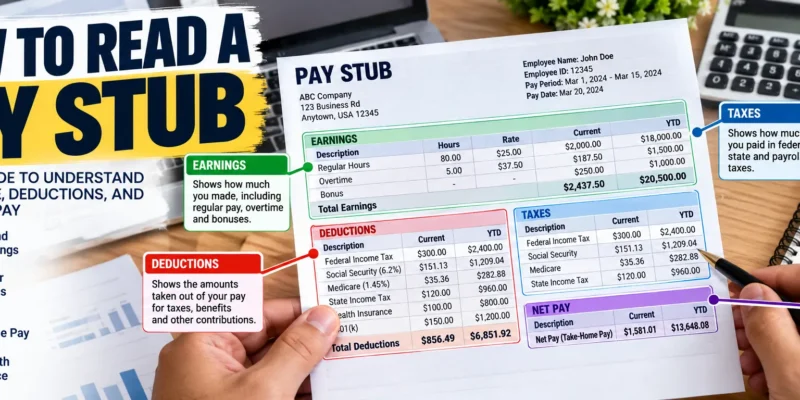
Knowing how to read a pay stub helps you understand exactly where your earnings go each payday. Although a pay stub can look like a page full of abbreviations and numbers, most statements follow a simple pattern: they show what you earned, what was deducted, and how much money you actually received. Checking these details can also help you spot payroll mistakes before they become bigger problems.
Whether you earn an hourly wage, receive a salary, work for tips, or get different types of additional pay, your pay stub provides a useful record of your compensation. Once you understand its main sections, reviewing each paycheck usually takes only a few minutes.
What Is a Pay Stub?
A pay stub is a document that provides details about an employee’s earnings and deductions for a particular pay period. Depending on the employer’s payroll system, you may receive a paper statement or access an electronic version through an employee portal.
A typical pay stub can show your gross earnings, taxes, employee deductions, employer contributions, and net pay. Many statements also display year-to-date totals.
The exact layout varies by employer and payroll provider. Likewise, the information employers must provide can depend on applicable laws and workplace requirements.
Still, the basic purpose remains the same: a pay stub gives you a breakdown of how your paycheck was calculated.
How to Read a Pay Stub Step by Step
The easiest way to understand your statement is to review it in a logical order rather than trying to interpret every number at once.
Start with your personal and payroll information. Then, move through earnings, taxes, deductions, and net pay. Finally, check your year-to-date totals.
Step 1: Check Your Personal and Pay Period Information
First, look at the top section of the statement. It commonly contains basic information such as your name, employer, employee identification details, pay date, and pay period.
The pay period tells you which days the paycheck covers. For example, a paycheck issued on Friday may cover work completed during an earlier one- or two-week period.
Check these dates before reviewing your earnings. Otherwise, you might compare the paycheck against hours from the wrong week.
For hourly workers, payroll calculations often begin with recorded work hours. Understanding What Is a Timesheet can therefore make it easier to see how recorded hours eventually become wages on a pay stub.
Step 2: Find Your Gross Pay
Next, locate your gross pay.
Gross pay is the amount you earned before taxes and other deductions are removed. Depending on your job, this figure might include regular wages, overtime, bonuses, commissions, tips reported through payroll, or other eligible earnings.
Suppose you worked 40 hours at $20 per hour. Your regular gross earnings for that period would be:
40 × $20 = $800
However, if you earned overtime or another form of extra compensation, your total gross pay could be higher.
Because of this, do not assume that the first earnings figure you see represents your final paycheck.
Understanding the Earnings Section
The earnings section often contains more detail than a single gross-pay number.
For hourly employees, you might see separate columns for hours, pay rate, and total earnings. Meanwhile, salaried employees may see their salary converted into a paycheck amount based on the employer’s payroll schedule.
If you are unsure why two employees’ statements look different, learning the difference between salary and hourly compensation can clarify why hours and pay rates may appear differently.
Depending on the job, the earnings section could include:
- Regular pay
- Overtime
- Bonus pay
- Commission
- Holiday pay
- Vacation or paid leave
- Shift-related premiums
- Reported tips
- Other compensation
Read each line rather than focusing only on the total. That way, you can check whether all expected earnings appear.
Regular Hours and Overtime
Hourly employees should compare the hours shown on their pay stub with their own records.
For example, if you worked 80 regular hours during a two-week pay period, verify that payroll reflects those hours correctly.
Then, check overtime separately if applicable. The rate and eligibility rules depend on the worker’s circumstances and applicable employment laws, so employees should not assume every extra hour will appear under the same category.
Bonuses, Commissions, and Other Earnings
Some employees receive compensation beyond standard wages.
For instance, a salesperson may receive commission, while another employee may earn a performance bonus. Therefore, these payments may appear as separate earnings lines.
Likewise, employees working particular schedules may receive extra compensation. If your paycheck contains an unfamiliar premium related to your work hours, understanding what is shift differential can help explain why certain shifts may have a different rate.
How to Read Taxes on a Pay Stub
Taxes are one of the main reasons your gross pay and take-home pay differ.
In the United States, a pay stub may show federal income tax withholding as well as Social Security and Medicare taxes. Depending on where you work and live, state or local tax withholding may also appear.
Your actual deductions depend on factors such as your earnings, tax situation, location, and payroll information.
Therefore, two employees earning similar gross wages do not necessarily receive identical net pay.
Federal Income Tax
Federal income tax withholding is generally an amount the employer withholds from your paycheck and sends toward your federal tax obligations.
The amount can vary based on your taxable wages and the information used by payroll to calculate withholding.
Rather than judging the figure by comparing it with a coworker’s paycheck, review your own payroll and tax information.
Social Security and Medicare
Employees may also see deductions for Social Security and Medicare. On some pay stubs, these may appear under abbreviations rather than full names.
For example, Social Security withholding may appear with a label referring to OASDI, while Medicare may have its own separate line.
As a result, unfamiliar abbreviations do not necessarily indicate unusual deductions. If you cannot identify one, check your employer’s payroll documentation or ask payroll or HR.
State and Local Taxes
Depending on your location, your statement may contain state or local tax deductions.
However, these deductions vary by jurisdiction. Therefore, not every worker’s pay stub contains the same tax lines.
How to Read a Pay Stub for Taxes
If you want to know how to read a pay stub for taxes, focus on three areas: taxable earnings, individual tax deductions, and year-to-date amounts.
First, identify your earnings for the current pay period. Next, review each tax line separately. Then, compare the current-period figures with the year-to-date totals.
Year-to-date information is especially useful because it shows accumulated amounts rather than only one paycheck.
Still, a pay stub is not the same document as an annual tax form. Therefore, keep the two purposes separate when reviewing your records.
Deductions Beyond Taxes
Not every deduction on a pay stub is a tax.
Depending on your employer and benefits, you may see deductions related to health insurance, retirement plans, or other workplace programs.
Some deductions may occur before certain taxes are calculated, while others may be taken afterward. The tax treatment depends on the type of benefit and applicable rules.
Therefore, if a deduction is unfamiliar, do not guess what the abbreviation means. Instead, check your benefits documents or contact payroll.
Employers also have to manage these calculations accurately and consistently. For businesses deciding whether to handle the process internally, the benefits of outsourcing payroll may include access to specialized payroll systems and administrative support, although outsourcing does not remove an employer’s responsibility to oversee payroll properly.
Gross Pay vs. Net Pay
One of the most useful concepts when learning how to read a pay stub is the difference between gross pay and net pay.
| Pay Stub Item | What It Generally Means |
|---|---|
| Gross pay | Earnings before applicable deductions |
| Taxes | Amounts withheld for relevant taxes |
| Other deductions | Benefits or other authorized deductions |
| Net pay | Amount remaining after deductions |
| Year-to-date | Accumulated amount for the year so far |
Net pay is often called take-home pay because it represents the amount left after payroll deductions.
For example, suppose your gross pay is $1,500. If taxes and other deductions total $350, your net pay would be $1,150.
$1,500 − $350 = $1,150
However, real payroll calculations can involve several different deduction categories, so the actual statement may be more detailed.
Why Year-to-Date Numbers Matter
A pay stub often has a column labeled YTD, which means year-to-date.
While the current column shows information for one pay period, the YTD column shows accumulated totals for the year up to that point.
For example, your current gross pay might be $2,000, while your year-to-date gross earnings could be $30,000.
Similarly, the statement may show both current and YTD tax withholding.
These figures help you track earnings and deductions over time. They can also make it easier to identify an unexpected change from one paycheck to another.
Employees comparing compensation structures may also consider the broader benefits of salary, such as predictable base compensation in many salaried roles, while remembering that actual workplace benefits and pay arrangements vary by employer.
How to Read a Waitress Pay Stub
Learning how to read a waitress pay stub can require extra attention because tipped employees may have several types of earnings and payroll entries.
Depending on the workplace and payroll system, the statement might include hourly wages, reported tips, tip-related information, taxes, and other adjustments.
Therefore, compare the pay stub with your own records of hours and any tip information you are responsible for reporting or tracking.
Do not assume that every number labeled as tips represents additional cash being deposited with the paycheck. The way tip income appears can depend on how the employer records and processes it.
If something does not match your records, ask the payroll department for an explanation.
How to Read a Military Pay Stub
Someone searching how to read a military pay stub may actually be looking at a military pay statement rather than a standard private-sector paycheck.
Military compensation records can include categories that do not normally appear on a civilian pay stub. For example, they may distinguish basic pay from various allowances, entitlements, deductions, and other military-specific items.
Because military compensation uses its own terminology, rely on the official explanation for the specific statement you receive rather than trying to interpret every field using a civilian payroll guide.
Still, the general reading strategy remains useful: verify identifying information, review earnings or entitlements, examine deductions, and confirm the final amount.
How to Read a Pay Stub Worksheet
A how to read a pay stub worksheet is often used for financial literacy or employee training. Usually, it gives you a sample pay statement and asks you to identify important figures.
A useful way to complete such a worksheet is to follow this order:
- Identify the pay period and pay date.
- Find the employee’s pay rate or salary information.
- Locate regular and additional earnings.
- Identify gross pay.
- List taxes separately.
- Identify other deductions.
- Find net pay.
- Review year-to-date totals.
- Check whether the arithmetic and categories make sense.
This process also works well when reviewing your real paycheck.
Common Pay Stub Mistakes to Watch For
Even when payroll is automated, employees should still review their statements.
One common issue is an incorrect number of hours. For instance, an hourly employee might notice that a shift is missing from the pay period.
Another possible problem is an incorrect pay rate. This can happen after a raise, promotion, or role change if updated information has not been reflected correctly.
You should also check overtime or other expected premium pay when applicable.
Meanwhile, review deductions for unexpected changes. If a benefit deduction suddenly increases or an unfamiliar deduction appears, ask for clarification.
Finally, confirm that your net pay matches the amount actually paid to you.
A Quick Pay Stub Review Routine
You do not need to analyze every paycheck for an hour. Instead, create a short routine.
First, verify the pay period. Then, compare your hours or expected salary amount with the earnings section.
Next, check bonuses, commissions, overtime, tips, or other expected compensation. After that, scan taxes and benefit deductions for unusual changes.
Finally, compare net pay with the amount deposited into your account.
If something looks wrong, save the statement and contact the appropriate payroll or HR representative. Provide specific details, such as the pay period, questionable line item, and what you expected to see.
Frequently Asked Questions
What is the easiest way to understand a pay stub?
Start with gross pay and work downward. Review earnings first, then taxes and other deductions, followed by net pay. Afterward, check the year-to-date column.
Why is my net pay lower than my gross pay?
Gross pay represents earnings before applicable deductions. Net pay represents what remains after taxes and other deductions have been taken out.
What does YTD mean on a pay stub?
YTD means year-to-date. It shows the accumulated amount from the beginning of the year through the current pay period.
Why does my pay stub show more than one pay rate?
You may have different rates because of overtime, shift premiums, multiple roles, or another compensation arrangement. Ask payroll if the reason is not clear from the statement.
Should I keep my pay stubs?
Keeping payroll records can help when checking earnings, resolving payroll questions, preparing financial documentation, or comparing records. Follow any applicable recordkeeping guidance for your circumstances and store documents securely because they may contain personal information.
Make Pay Stub Checking a Payday Habit
Once you understand how to read a pay stub, the document becomes much less confusing. Start with the pay period and earnings, then review taxes, other deductions, net pay, and year-to-date totals.
Most importantly, do not ignore a number simply because you do not recognize its abbreviation. Compare the statement with your hours, compensation agreement, benefits information, and previous pay stubs.
A two-minute review each payday can help you catch missing hours, unexpected deductions, incorrect rates, or other payroll questions early. When something does not make sense, ask payroll or HR for an explanation instead of waiting for several pay periods to pass.