
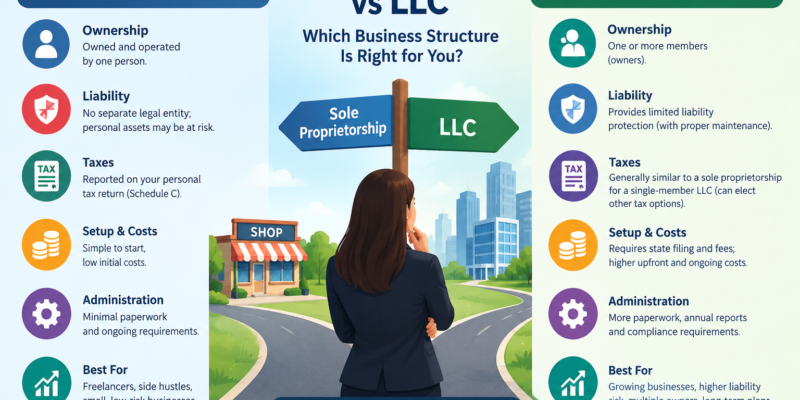
Starting a business involves more than choosing a name, finding customers, and making your first sale. You also need to decide how the business will be legally structured. For many first-time entrepreneurs, the choice comes down to sole proprietorship vs llc because both structures can work well for a one-person business, yet they create very different legal and administrative responsibilities.
A sole proprietorship is generally the simplest structure for an individual who operates a business personally. An LLC, or limited liability company, creates a separate legal entity under state law and can provide liability protection when properly maintained. The right choice depends on factors such as personal liability, taxes, startup costs, paperwork, privacy, and plans for growth.
This guide explains the differences in plain English so you can understand how each structure works before making a business decision.
What Is a Sole Proprietorship vs LLC?
Before comparing the two, it helps to understand what each structure actually means.
A sole proprietorship is a business owned and operated by one person. The owner and the business are generally treated as the same legal person for liability and tax purposes. That simplicity makes this structure common among freelancers, independent contractors, consultants, and small business owners.
For practical examples of how this structure can work across different industries, reviewing Sole Proprietorship Examples can help clarify the concept.
An LLC is a business entity created under state law. A single-owner LLC is often called a single-member LLC. Although one person may own the entire company, the LLC is legally distinct from its owner in many respects.
That distinction can provide personal liability protection for business obligations, although the protection has limits and depends on factors such as state law, business practices, contracts, insurance, and whether the owner properly maintains the LLC.
Sole Proprietorship vs LLC: Key Differences
The biggest differences involve legal separation, liability, formation requirements, taxes, and ongoing administration.
| Factor | Sole Proprietorship | LLC |
|---|---|---|
| Ownership | One individual | One or more owners |
| Legal separation | Generally no separate legal entity | Separate entity under state law |
| Formation | Usually simple to begin | Requires state formation filing |
| Personal liability | Owner generally has personal liability | Often provides limited liability protection |
| Federal tax treatment | Business income generally reported by owner | Single-member LLC is generally disregarded for federal income tax unless another election is made |
| Administration | Minimal | More records and state requirements |
| Startup costs | Usually low | State filing and possible ongoing fees |
| Business continuity | Closely tied to owner | May continue according to state law and operating documents |
The exact rules vary by state. Therefore, business owners should check the requirements where their company operates rather than assuming that every state treats an LLC in exactly the same way.
Liability Protection: The Major Difference
One of the strongest reasons entrepreneurs consider an LLC is personal liability protection.
With a sole proprietorship, there is generally no legal separation between the owner and the business. If the business has debts or faces certain legal claims, the owner’s personal assets may be exposed, subject to applicable law and circumstances.
An LLC is designed to separate the company from its owners. As a result, members generally receive protection from personal liability for many business debts and claims.
However, an LLC is not a personal shield for every situation. For example, an owner can remain personally responsible for their own wrongful acts, certain guarantees, taxes, or obligations imposed by law.
Business insurance can also matter. An LLC and appropriate insurance serve different purposes, so forming an LLC does not automatically eliminate the need for insurance coverage.
Single Member LLC vs Sole Proprietorship
For a one-person business, the single member llc vs sole proprietorship comparison is especially useful.
Both structures allow one person to own and operate a business. Both can also offer relatively straightforward management compared with structures involving multiple owners.
The major distinction is legal structure. A sole proprietor normally does not create a separate business entity, while an LLC does.
That difference can become more meaningful as the business takes on contracts, employees, equipment, inventory, customers, or greater financial risk.
For example, imagine a freelance designer earning a modest income from a handful of low-risk clients. A sole proprietorship may offer the simplicity that person wants.
Now consider a contractor working on expensive commercial projects. The potential financial exposure may make liability protection, contracts, insurance, and formal business structure more significant considerations.
The appropriate structure depends on the actual circumstances rather than business revenue alone.
LLC vs Sole Proprietorship Taxes
Taxes are another major part of the decision, but they are often misunderstood.
For federal income tax purposes, a sole proprietor generally reports business income and expenses on their individual tax return, commonly using Schedule C with Form 1040. Self-employment taxes can also apply.
A single-member LLC is generally treated as a disregarded entity for federal income tax purposes unless the owner elects a different tax classification. In many ordinary cases, that means the federal income tax treatment can look similar to a sole proprietorship.
Therefore, forming an LLC does not automatically mean that the business will pay less federal income tax.
An LLC may later elect to be taxed as a corporation, including an S corporation when eligibility requirements are met. That is a separate tax decision from simply forming an LLC.
State and local taxes can also vary. Some jurisdictions impose annual reports, franchise taxes, business taxes, or other fees on LLCs. Because tax rules can change, a business owner should consider current federal, state, and local requirements when making the decision.
Costs and Administrative Work
A sole proprietorship is generally easier to start because there is usually no separate state entity-formation process.
In many cases, an owner can begin operating under their own legal name while meeting applicable licensing, tax, and registration requirements. However, using a business name may require a DBA or other registration depending on the jurisdiction.
An LLC typically requires filing formation documents with the state and paying a filing fee. Some states also require periodic reports or other ongoing fees.
The extra paperwork does provide a formal business structure, but it also creates responsibilities.
LLC owners should keep business and personal finances separate, maintain appropriate records, follow state requirements, and understand their operating agreement and other governing documents.
The administrative burden is usually manageable for a small company, but it is still greater than operating as a basic sole proprietorship.
Business Name and DBA Considerations
Choosing a business name can create another point of confusion.
A sole proprietor may operate under their personal name or register another business name where required. An LLC can also operate under its legal entity name or use an assumed name, depending on local rules.
Understanding the dba vs llc distinction helps here. A DBA, or “doing business as” registration, is generally a business-name registration rather than a separate legal entity. An LLC, by contrast, is an entity formed under state law.
A DBA therefore does not provide the same type of liability protection as forming an LLC.
Advantages of a Sole Proprietorship
Sole proprietorships remain popular because they are straightforward.
Simple setup
There is generally less formation paperwork than with an LLC. This can make the structure practical for someone testing a business idea.
Lower administrative burden
A sole proprietor usually has fewer entity-level formalities to manage. That can save time for owners who want to focus on serving customers.
Direct control
The owner makes business decisions without needing to coordinate with other members or shareholders.
Straightforward federal tax reporting
For many owners, business income and expenses flow directly onto the owner’s individual federal tax return.
Still, simplicity should not be confused with complete protection. A sole proprietor should understand personal liability exposure and maintain appropriate insurance and financial records.
Advantages of an LLC
An LLC can offer several benefits for growing businesses.
Limited liability
The legal separation between the company and its owners can protect personal assets from many business liabilities.
Flexible ownership
An LLC can have one member or multiple members, depending on the structure and applicable state rules.
Tax flexibility
An LLC may have different federal tax classification options, subject to eligibility requirements and applicable elections.
Professional business structure
Some customers, vendors, lenders, or partners may prefer working with a formally organized business entity.
For owners considering other structures, types of ownership can provide useful context because sole proprietorships and LLCs are only two possibilities.
Common Mistakes When Choosing a Business Structure
Choosing a structure based only on the cheapest startup option can create problems later.
One common mistake is assuming that an LLC eliminates every form of personal liability. It does not.
Even when an owner has an LLC, separate banking and careful recordkeeping are important parts of maintaining a clear business structure.
Tax assumptions can also cause trouble. An LLC does not automatically create tax savings, and choosing a corporate tax election without understanding payroll, compliance, and tax consequences can make a simple business more complicated.
Some owners also forget about local licenses and permits. Entity formation and business licensing are separate issues.
Finally, entrepreneurs sometimes choose a structure without considering future plans. A business expecting employees, investors, multiple owners, significant contracts, or higher liability exposure may have different needs from a small side business.
How to Choose Between a Sole Proprietorship and LLC
A practical decision process can make the choice easier.
Step 1: Identify your business risk.
Consider whether customers could be injured, contracts could create substantial obligations, or the business could accumulate significant debt.
Step 2: Review your budget.
Compare state formation fees, annual costs, accounting expenses, licenses, insurance, and other administrative costs.
Step 3: Consider your growth plans.
Think about whether you expect to hire employees, bring in another owner, seek outside investment, or expand into new markets.
Step 4: Review your tax situation.
Look beyond the business entity itself. Consider federal, state, and local taxes and whether a future tax election might make sense.
Step 5: Separate legal and tax decisions.
An LLC is a legal structure. Its federal tax classification is a related but separate question.
Step 6: Check your state’s rules.
Formation procedures, fees, reporting requirements, and taxes vary by jurisdiction.
Step 7: Get professional advice when the stakes are high.
An attorney or qualified tax professional can help evaluate liability and tax issues based on your particular circumstances.
A Simple Decision Framework
For a low-risk business that is just starting, simplicity may be a major consideration. A sole proprietorship can provide a straightforward way to begin operating.
For a business with greater liability exposure, valuable assets, substantial contracts, or plans to build a more formal company, an LLC may receive closer consideration because of its separate legal structure.
Neither option is automatically right for every entrepreneur.
The decision should reflect your business activity, risk level, location, finances, and growth plans.
What About a PLLC?
Certain licensed professionals may encounter another entity type called a professional limited liability company, or PLLC.
A pllc vs llc comparison can be useful for professionals whose states regulate how licensed services can be organized. Requirements differ by profession and jurisdiction, so professionals should verify the rules that apply to their license and location.
This is one example of why business structure decisions should not rely on a generic checklist alone.
Frequently Asked Questions
Is an LLC better than a sole proprietorship?
The answer depends on the business owner’s circumstances. An LLC creates a separate legal entity and may provide limited liability protection, while a sole proprietorship generally offers greater simplicity. Cost, risk, taxes, and growth plans should all be considered.
Can I change from a sole proprietorship to an LLC?
Yes. A business owner can generally form an LLC later, although the process can involve state filings, tax considerations, contracts, licenses, banking changes, and business-name issues.
Does an LLC reduce taxes automatically?
No. A single-member LLC is generally disregarded for federal income tax purposes unless it makes an election to be taxed differently. State and local tax rules can also vary.
Do sole proprietors need a business license?
Possibly. Licensing requirements depend on the business activity and location. Forming an LLC does not replace licenses or permits that a business legally needs.
Can one person own an LLC?
Yes. A single-member LLC can have one owner, subject to applicable state rules.
Making the Choice With Confidence
The sole proprietorship vs llc decision is really a choice about how you want to organize and manage business risk, administration, and future growth.
A sole proprietorship can be attractive when simplicity and low administrative overhead are priorities. An LLC can provide a formal legal structure and may offer limited liability protection, although it comes with additional setup and ongoing responsibilities.
Before choosing, look at the full picture rather than focusing on one factor. Compare liability exposure, formation costs, taxes, recordkeeping, licensing, insurance, and long-term plans.
Once you understand those trade-offs, you can choose a structure that fits the way you actually intend to operate the business