
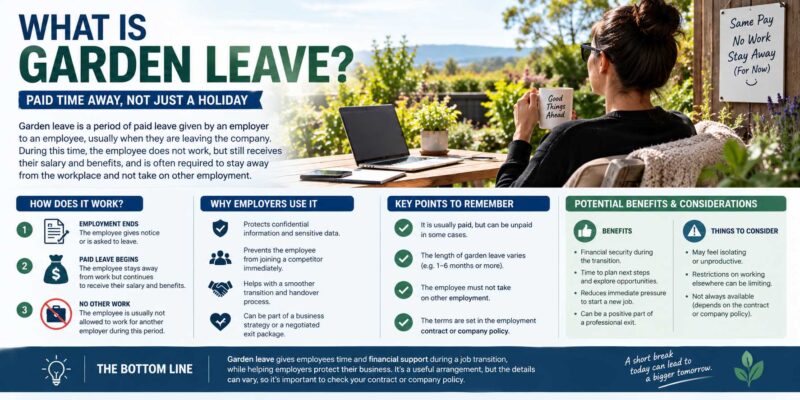
An employee resigns, but instead of spending the next month working at the office, the employer asks them to stay home while continuing to receive pay. This arrangement often raises the question: what is garden leave and why would a company pay someone not to work? leave, sometimes called gardening , is a period when an employee remains employed and usually continues receiving salary and contractual benefits but is instructed not to perform some or all of their normal duties.
Businesses often use when an employee has resigned or received notice of termination, particularly when that person has access to confidential information, important customers, pricing strategies, intellectual property, or other commercially sensitive material.
What Is Garden Leave in Simple Terms?
Instead of continuing normal duties until the final employment date, the employee may be asked to remain away from the workplace
Depending on the contract and applicable law, the employee may continue receiving salary and benefits. Meanwhile, the employer may restrict access to company systems, offices, customers, suppliers, coworkers, or business information.
For example, imagine a senior sales manager gives three months’ notice before joining another company. Their current employer may prefer that the manager does not spend those three months accessing current sales forecasts and customer strategies. Therefore, the employer might place the manager on leave.
To understand where this period fits into the resignation process, it also helps to know what is a notice period, since garden leave commonly occurs during part or all of that period.
Why Do Companies Put Employees on Garden Leave?
Companies usually have a business reason for placing someone on garden leave.
One major reason is protecting confidential information. A departing employee may know upcoming product plans, prices, customer negotiations, financial information, or business strategies.
By removing that employee from daily operations, the company creates time between their access to current information and their potential move to another employer.
Customer relationships can also matter. For instance, a senior salesperson may have direct relationships with valuable clients. During leave, the employer can introduce another account manager and strengthen those relationships before the departing worker joins a competitor.
Companies may also use the period to complete an orderly transition without immediately ending employment.
How Does Garden Leave Work?
The exact process depends on the employment contract, company policies, local law, and circumstances of the departure.
However, a typical process may look like this:
- The employee resigns or receives notice.
- The applicable notice period begins.
- The employee stops some or all normal work duties.
- Salary and applicable contractual benefits generally continue according to the arrangement.
- The employee remains subject to relevant contractual obligations.
During the leave, the employee may need to remain available to answer questions or assist with specific transition matters if their agreement requires it.
Likewise, the employer may request the return of a laptop, security card, phone, documents, or other business property.
What Is Garden Leave Compared With Regular Paid Leave?
Garden leave can look like a paid vacation from the outside, but the purpose is different.
Annual leave or paid time off allows employees to take approved time away from work for personal reasons. Garden leave, by contrast, normally relates to the ending of employment and protects business interests during the transition.
Similarly, someone asking what is a sabbatical is looking at a different workplace arrangement. A sabbatical is generally an extended break from normal work that may be used for rest, study, research, travel, or personal development, with the expectation that the employment relationship may continue afterward.
Garden leave generally leads toward the employee’s final employment date.
The employee also may not be free to start working elsewhere during leave because they remain employed by the existing employer.
Garden Leave vs Notice Period
Garden leave and a notice period are closely connected, but they do not mean exactly the same thing.
| Feature | Garden Leave | Normal Working Notice |
|---|---|---|
| Employment continues | Generally yes | Yes |
| Normal duties continue | Usually limited or stopped | Usually yes |
| Salary | Generally continues under the arrangement | Continues normally |
| Workplace access | May be restricted | Usually maintained |
| Client contact | Often restricted | Usually allowed as needed |
| Purpose | Protect business during departure | Provide transition time |
| Start new job immediately | Usually restricted while still employed | Usually restricted while still employed |
In other words, the notice period describes the time between notice and the end of employment. Garden leave describes how some or all of that period may be handled.
An employee could therefore have a three-month notice period but spend only the final six weeks on garden leave.
What Is Garden Leave in the UK?
People frequently ask what is garden leave in the UK because the term is widely associated with British employment practices.
In the UK, an employer’s ability to require garden leave will often depend on the employment contract and the circumstances. Employers commonly include garden leave clauses in contracts for roles where protecting confidential information, client relationships, or other legitimate business interests may be valuable.
While on garden leave, an employee remains employed. As a result, contractual duties and restrictions can continue to apply.
However, employment situations can differ, and contractual wording matters. Employers and workers dealing with a dispute should therefore seek appropriate employment-law advice rather than assuming that every garden leave clause operates in the same way.
What Is Garden Leave in US Workplaces?
Another common question is what is garden leave in US employment.
The concept exists in the United States, particularly in some financial, executive, technology, sales, and other competitive industries. However, its use and enforceability can differ from the UK model.
U.S. employment law varies by state, while contractual restrictions can also face different legal requirements depending on location and circumstances.
Therefore, businesses should not simply copy a UK clause into a U.S. employment contract and assume it will operate identically.
Instead, employers should review relevant state and federal requirements and obtain appropriate legal guidance when drafting or enforcing restrictive employment provisions.
What Can an Employee Do During Garden Leave?
Being away from normal work does not necessarily mean an employee can do anything they want.
Because employment continues, the employee may still have contractual responsibilities. Depending on the agreement, these could include confidentiality obligations, duties concerning company information, requirements to remain available, and restrictions on working for another organization.
An employee might still be able to handle ordinary personal activities, take approved vacation, prepare for a future role, or complete other activities that do not breach their agreement.
However, they should check the contract before assuming they can begin freelance work, contact former clients, recruit coworkers, or start working for their next employer.
Is Garden Leave the Same as Job Abandonment?
No. These situations are fundamentally different.
Garden leave is normally an employer-directed arrangement during an existing employment relationship. By contrast, what is job abandonment concerns situations where a worker stops attending or communicating with the employer in circumstances that may be treated as abandoning the position.
An employee on authorized has not simply disappeared from work. The company knows the employee is absent and has specifically arranged or required that absence.
That distinction matters for HR records, payroll, benefits, and the formal termination process.
Benefits of Garden Leave for Employers
Garden leave can provide several practical business advantages.
First, it can protect sensitive information. If an employee cannot access new data, their knowledge of current business activity gradually becomes less timely.
Second, the business gains time to transfer customer relationships. Account managers can introduce replacements, while managers can reassign responsibilities.
Third, the arrangement may reduce disruption inside the workplace. In some cases, keeping a departing senior employee involved in daily decisions can create uncertainty for coworkers.
Finally, it can provide a controlled transition. Rather than cutting off the employment relationship immediately, the company has time to manage responsibilities, access rights, and communications carefully.
A well-managed departure also connects with the broader benefits of employee retention, because businesses that handle employee transitions professionally can learn why people leave and identify ways to keep valuable workers in the future.
Possible Disadvantages for Employers and Employees
Garden leave also has costs.
For the employer, the most obvious disadvantage is paying an employee who may perform little or no productive work. For senior employees with lengthy notice periods, that cost can become substantial.
The business may also lose access to the employee’s expertise sooner than expected.
For employees, can delay the start of a new role. A person may already be mentally ready to move forward but remain contractually tied to the previous employer.
Long periods away from active work may also feel isolating, especially for professionals accustomed to busy schedules and frequent interaction with customers or colleagues.
Therefore, employers should use for a clear business purpose rather than treating it as an automatic response to every resignation.
Garden Leave vs Severance Pay
Garden leave should not be confused with severance.
During , the employee generally remains employed until the termination date. Severance, by contrast, generally concerns compensation connected with the ending of employment.
For anyone trying to understand how does severance pay work, the key distinction is timing and purpose: severance arrangements concern separation compensation, while garden leave concerns the employment period before separation is complete.
Depending on the jurisdiction and circumstances, an employee could potentially encounter both concepts during the same departure. However, one does not automatically create entitlement to the other.
What Should an Employee Check Before Garden Leave?
If your employer places you on , read the relevant employment documents carefully.
Check:
- The official start and end dates
- Salary arrangements
- Benefits
- Bonus or commission treatment
- Paid vacation rules
- Company property requirements
- Confidentiality obligations
- Restrictions on contacting clients
- Restrictions on contacting employees
- Whether you must remain available
- Whether outside employment is permitted
- Your official termination date
Also, keep written records of any changes agreed with your employer.
For example, if the company agrees to release you early so you can start another position, make sure the revised date is properly documented.
FAQs About Garden Leave
Do you get paid during garden leave?
Garden leave generally involves continued employment and pay, subject to the employment contract and applicable law. Employees should check how salary, benefits, bonuses, and commissions are treated in their particular arrangement.
Can you start another job while on garden leave?
Usually, you should not assume that you can. Since you remain employed, contractual restrictions may prevent you from starting work for another employer until your current employment ends.
Can an employer force you to take garden leave?
This depends on the employment contract, applicable law, and circumstances. A clear contractual provision can be highly relevant, although legal rules vary by jurisdiction.
How long can garden leave last?
The duration varies. It may cover only part of a notice period or the entire period. Senior and commercially sensitive positions sometimes have longer arrangements.
Is garden leave a punishment?
Not necessarily. Employers commonly use it as a business-protection and transition tool rather than a disciplinary measure.
Handling Garden Leave Professionally
Once you understand what is garden leave, the arrangement becomes easier to distinguish from vacation, severance, sabbaticals, or simply leaving a job immediately.
For employees, the safest approach is to read the contract, confirm the dates, understand what activities remain restricted, and get any negotiated changes in writing. Meanwhile, employers should useconsistently, communicate expectations clearly, and ensure the arrangement complies with applicable employment law.
Handled properly, can create a clean gap between an employee’s active involvement in a business and their move to a new role. That can give the company time to protect relationships and information while giving the departing employee a clear path toward their next professional step.