
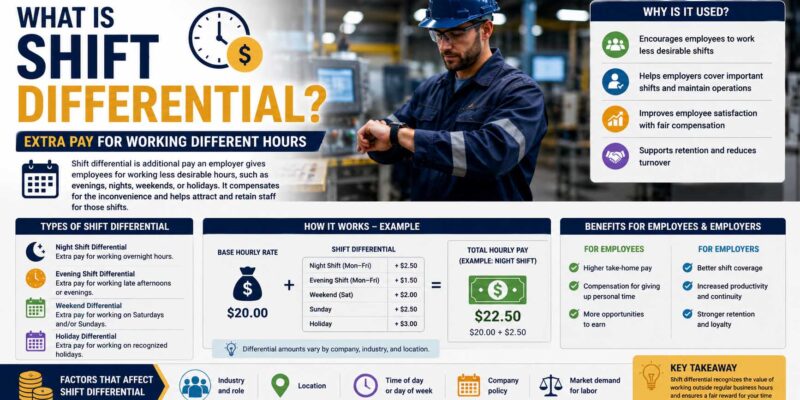
If you’ve seen a job offering extra money for nights, weekends, or other less desirable hours, you may wonder what is shift differential and how that extra compensation works. A shift differential is extra pay an employer provides to employees who work designated shifts, such as evenings, nights, weekends, or holidays. Depending on the employer, the additional compensation may be a fixed dollar amount per hour or a percentage added to the employee’s regular rate.
Shift differential policies vary considerably between workplaces. Some companies use them to make difficult shifts easier to staff, while others include them in union agreements or established compensation plans. Therefore, employees should check their employer’s specific policy rather than assuming every workplace calculates the extra pay in the same way.
What Is a Shift Differential?
A shift differential is extra compensation associated with working a particular schedule or set of hours.
For example, suppose a hospital pays a nurse $25 per hour for a regular daytime shift. If the organization offers a $3-per-hour night differential, that employee could receive $28 per hour for eligible night-shift hours.
Employers commonly use differentials for:
- Evening shifts
- Overnight shifts
- Weekend shifts
- Holiday shifts
- Rotating schedules
- Hard-to-fill working hours
However, eligibility varies by employer. One company might offer extra pay for any work after 6 p.m., while another may reserve its differential for employees whose scheduled shift begins after a specific time.
Shift differentials are especially common in industries that operate beyond standard daytime business hours, including healthcare, manufacturing, logistics, hospitality, security, customer support, and emergency services.
What Is Shift Differential Pay?
When people ask what is shift differential pay, they’re usually asking how much additional compensation an employee receives for working qualifying hours.
The differential sits on top of the employee’s normal compensation rather than replacing it.
For example:
Regular hourly rate: $20
Night differential: $2 per hour
Eligible night-shift rate: $22 per hour
If that employee works eight qualifying night hours, the differential alone adds $16 for that shift before considering taxes, overtime, or other compensation rules.
This structure is easier to understand when you also know the difference between salary and hourly compensation, because shift differentials are often expressed as hourly premiums even though some employers may have policies covering salaried employees as well.
Therefore, workers should review both their base compensation structure and the employer’s differential policy.
Why Do Businesses Offer Shift Differentials?
Running a business around the clock creates a staffing challenge.
Many employees naturally prefer daytime schedules. Overnight work can interfere with family routines, social activities, transportation options, and normal sleep schedules. Meanwhile, weekends may be unpopular because employees often prefer that time for personal activities.
As a result, employers may need an incentive to attract and retain workers for those schedules.
A shift differential can help.
Instead of raising the base wage for every employee in a particular role, an employer can attach extra compensation specifically to the hours that are harder to fill.
For employees, the arrangement provides an opportunity to earn more by accepting less desirable schedules. For employers, it can create a clearer financial incentive for maintaining adequate staffing.
However, money alone won’t solve every scheduling problem. Managers also need reasonable workloads, predictable scheduling where possible, and fair policies.
What Is a Shift Differential Rate?
If you’re wondering what is a shift differential rate, it simply refers to the amount of extra pay attached to an eligible shift.
Employers generally structure the differential in one of two ways.
Fixed Dollar Differential
The employer adds a specific amount for every eligible hour.
For example:
Base rate: $22 per hour
Differential: $2.50 per hour
Eligible rate: $24.50 per hour
This approach is straightforward because employees can quickly see how much extra they receive.
Percentage-Based Differential
Alternatively, an employer may calculate the premium as a percentage of the employee’s base rate.
Suppose an employee earns $24 per hour and receives a 10% differential.
The calculation would be:
$24 × 10% = $2.40
Therefore, the employee would receive $26.40 per eligible hour before considering any other applicable compensation.
Percentage-based policies can scale automatically as base wages rise, while fixed premiums remain the same until the employer changes them.
Shift Differential Calculation Examples
Understanding the concept becomes easier with a few practical examples.
| Example | Base Rate | Differential | Eligible Shift Rate |
|---|---|---|---|
| Evening worker | $18/hour | $1.50/hour | $19.50/hour |
| Night worker | $22/hour | $3/hour | $25/hour |
| Weekend worker | $25/hour | 8% | $27/hour |
| Overnight worker | $30/hour | 10% | $33/hour |
These examples illustrate possible structures rather than universal rates.
Suppose the night worker in the table completes 40 eligible hours.
At the regular rate:
40 × $22 = $880
The differential adds:
40 × $3 = $120
That produces $1,000 in gross compensation for those hours before deductions and any other applicable pay adjustments.
However, real payroll calculations may become more complicated when overtime, bonuses, multiple differentials, or partial-shift eligibility apply.
How Employers Track Eligible Shift Hours
Accurate timekeeping becomes especially important when employees receive different rates at different times.
An employee might begin work during the regular daytime period but finish several hours inside the employer’s evening differential window.
Therefore, the payroll system needs to identify which hours qualify.
Understanding What Is a Timesheet can be useful here because accurate time records help businesses connect actual hours worked with the appropriate pay categories.
Modern timekeeping software can often automate much of this process. For example, an employer might configure the system so eligible hours between 11 p.m. and 7 a.m. automatically receive a night differential.
Still, businesses should regularly review payroll rules and time records. Automation only works correctly when the underlying policies and software settings are accurate.
Shift Differential and Overtime
Shift differential and overtime are different concepts, although they can interact.
A differential compensates employees for working designated shifts. Meanwhile, overtime compensation is governed by applicable wage-and-hour laws and may become due when eligible employees work beyond defined thresholds.
In the United States, the Fair Labor Standards Act generally requires covered, nonexempt employees to receive overtime compensation at no less than one and one-half times their regular rate for hours worked over 40 in a workweek. Certain payments, including some shift differentials, can affect the regular-rate calculation used for overtime.
Therefore, employers shouldn’t simply assume overtime is calculated from the employee’s basic hourly wage while ignoring every premium.
Payroll administrators should classify compensation correctly and follow applicable federal, state, local, contractual, and industry requirements.
Employees who are unsure about a paycheck can review the employer’s written policy and ask payroll or HR how the differential and overtime were calculated.
Shift Differential vs Comp Time
Shift differential and compensatory time address different situations.
A shift differential provides additional pay because of when an employee works. Compensatory time generally refers to time off provided in connection with extra hours worked, subject to applicable rules and workplace policies.
Therefore, understanding what is comp time can prevent employees from treating these two compensation concepts as interchangeable.
For example, an employee might receive a night differential for every qualifying overnight hour. Separately, rules concerning overtime or compensatory time could apply depending on the worker, employer, and legal framework.
Employers should clearly separate these concepts in compensation policies so employees understand what each benefit or payment represents.
Are Employers Required to Pay Shift Differential?
In the United States, federal law generally doesn’t require employers to provide extra pay simply because an employee works nights or weekends.
The U.S. Department of Labor states that extra pay for weekend or night work is generally a matter of agreement between the employer and employee.
However, an employer may still have obligations arising from an employment agreement, collective bargaining agreement, company policy, state or local requirements, or another applicable rule.
Overtime requirements are separate.
Therefore, a night-shift employee shouldn’t automatically assume that federal law guarantees a night premium. Likewise, an employer shouldn’t assume that a voluntarily established differential can be handled without considering how it interacts with overtime calculations and existing agreements.
Shift Differential for Salaried Employees
Shift differentials are most straightforward with hourly workers, but workplaces may use other compensation arrangements for salaried employees.
Whether that happens depends heavily on the employer’s compensation policy, employee classification, contract terms, and applicable law.
Some organizations may offer special premiums, stipends, bonuses, or alternative arrangements for employees covering unusual schedules.
Meanwhile, salary itself offers a different compensation structure. Employees comparing schedules and job offers may want to consider the benefits of salary alongside any available shift premiums rather than evaluating one payment in isolation.
Total compensation matters more than one individual feature.
For example, consider base compensation, schedule predictability, overtime eligibility, health benefits, paid time off, retirement contributions, bonuses, and shift premiums together.
Advantages and Drawbacks for Employees
Shift differential pay can make an evening or overnight schedule financially attractive.
The most obvious advantage is increased earnings. Employees who already prefer working nights may receive extra compensation for a schedule they would have chosen anyway.
Some shifts may also offer quieter working conditions, less traffic during commuting hours, or scheduling that fits other personal commitments.
However, the drawbacks deserve attention.
Night and weekend schedules can conflict with family responsibilities and social activities. Overnight work can also make maintaining a regular routine more difficult.
Therefore, employees shouldn’t choose a shift based solely on the premium. The extra income needs to make sense alongside the practical impact of the schedule.
Advantages and Drawbacks for Employers
Employers can use differentials to improve recruitment for hard-to-fill shifts without permanently increasing every worker’s base wage.
A clear premium can also reduce uncertainty during hiring. Candidates immediately know that accepting a less popular schedule comes with extra compensation.
However, poorly designed policies can create payroll complexity.
For example, employees may become confused if differentials begin and end at unclear times. Likewise, disputes can arise when someone works only part of an eligible shift.
Costs can also increase if management introduces a premium without understanding its effect on overtime and other compensation calculations.
Therefore, a shift differential works best when the policy is simple, documented, consistently applied, and properly integrated into payroll.
Best Practices for Creating a Shift Differential Policy
Businesses considering a differential should first identify the staffing problem they’re trying to solve.
If overnight vacancies remain open longer than daytime positions, review recruiting data and employee feedback before setting the premium.
Then, define eligibility precisely.
A written policy should answer questions such as:
- Which shifts qualify?
- What times define each shift?
- Is the differential fixed or percentage-based?
- Does it apply to partial shifts?
- How are weekends handled?
- Can employees receive multiple premiums?
- How does the policy interact with overtime?
- Which positions or classifications qualify?
Next, compare compensation with relevant labor-market conditions. A premium that is too small may not influence employee decisions, while an unnecessarily high premium may increase labor costs without providing proportional staffing benefits.
Finally, review the policy periodically. Staffing conditions, wages, schedules, and labor-market competition can change.
Common Shift Differential Mistakes
One common mistake is failing to define the qualifying hours clearly.
For example, saying “night employees receive extra pay” leaves obvious questions. What time does night begin? What happens when an employee works from afternoon into evening?
Another mistake is confusing shift differential with overtime. They serve different purposes and may interact differently with payroll calculations.
Businesses can also create problems when managers apply the policy inconsistently. Two employees performing the same eligible work should not receive different treatment without a legitimate policy-based reason.
Employees, meanwhile, sometimes compare job offers using only the advertised differential.
Instead, calculate expected total compensation. A large night premium attached to a lower base wage isn’t automatically better than a smaller premium attached to a stronger overall package.
FAQs About Shift Differential Pay
What is shift differential in simple terms?
Shift differential is extra compensation an employer may provide to employees who work designated schedules, such as nights, evenings, or weekends.
What is shift differential rate?
The shift differential rate is the extra amount paid for eligible hours. It may be expressed as a fixed dollar amount per hour or as a percentage of the employee’s regular rate.
Is shift differential the same as overtime?
No. Shift differential compensates employees for working particular shifts, while overtime compensation applies under relevant wage-and-hour rules when eligible employees meet overtime requirements.
Does everyone who works nights receive shift differential?
No. Federal law in the United States generally doesn’t require extra pay merely for night work. Eligibility depends on the employer’s policy, agreements, and any applicable laws or regulations.
Can weekend workers receive shift differential?
Yes, an employer can establish a weekend differential. However, whether one exists and how much it pays depends on the workplace.
Can shift differential be a percentage?
Yes. Employers may use either percentage-based or fixed-dollar premiums. For example, a company could provide a 10% night differential instead of adding a fixed amount per hour.
Does shift differential affect overtime?
It can. Certain shift differentials may need to be included when determining an employee’s regular rate for overtime purposes under applicable wage-and-hour rules. Employers should calculate overtime according to the relevant legal requirements.
Making Shift Differential Work for Both Sides
Understanding what is shift differential helps employees evaluate job offers more accurately and helps businesses design better compensation policies. The basic idea is simple: eligible employees receive extra compensation for working designated shifts that an employer wants to incentivize.
However, a good policy needs more than an attractive number. Employers should define eligible hours clearly, explain how the premium is calculated, maintain accurate time records, and correctly handle its relationship with overtime and other compensation.
Employees should take a similarly practical approach. Before accepting an evening, overnight, or weekend schedule, calculate the actual additional earnings and compare them with the effect the schedule may have on daily life. That provides a much clearer picture of whether the shift differential makes the job worthwhile.