
Running a business means wearing many hats. Between serving customers, managing employees, handling finances, and planning for growth, payroll can quickly become one of the most time-consuming administrative tasks. That’s why many companies are exploring the benefits of outsourcing payroll instead of handling everything in-house.
Payroll is much more than calculating wages. It involves tax deductions, reporting deadlines, employee benefits, recordkeeping, and compliance with changing regulations.
Outsourcing payroll allows businesses to hand these responsibilities to specialists while focusing on activities that directly support growth. Whether you’re a startup, a growing company, or an established organization, payroll outsourcing can improve efficiency and reduce risk.
What Is Payroll Outsourcing?
Payroll outsourcing is the process of hiring a third-party provider to manage payroll-related tasks on behalf of a business.
Depending on the service provider, outsourced payroll may include:
- Employee wage calculations
- Tax withholding and filing
- Direct deposit processing
- Payslip generation
- Benefits administration
- Payroll reporting
- Compliance monitoring
- Year-end tax documents
Instead of building an internal payroll department, businesses rely on experienced professionals and specialized software to ensure employees are paid accurately and on time.
Benefits of Outsourcing Payroll for Modern Businesses
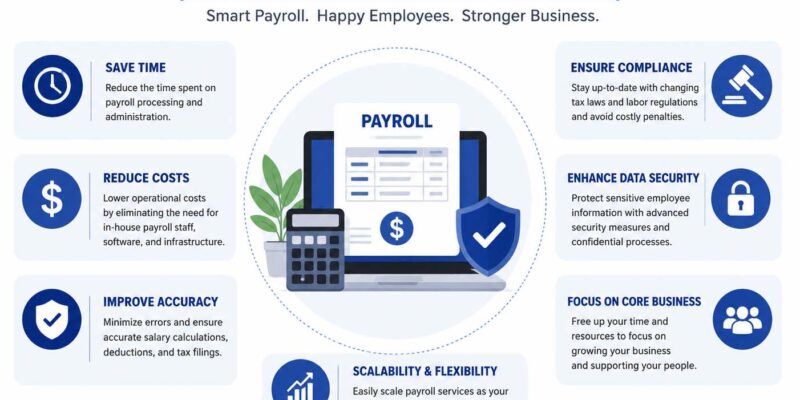
The benefits of outsourcing payroll extend far beyond simply saving time. For many organizations, outsourcing improves financial accuracy, reduces compliance risks, and creates more opportunities to focus on strategic growth.
1. Saves Valuable Time
Payroll often requires hours of preparation every pay period.
Business owners must gather employee hours, calculate deductions, process payments, prepare reports, and verify tax obligations.
When payroll is outsourced, these repetitive tasks move to specialists. As a result, managers can spend more time improving operations, serving customers, and growing revenue.
For businesses that rely on hourly employees, understanding What Is a Timesheet also helps improve payroll accuracy before information reaches the payroll provider.
2. Reduces Payroll Errors
Manual payroll calculations increase the risk of mistakes.
Common payroll errors include:
- Incorrect overtime calculations
- Wrong tax deductions
- Duplicate payments
- Missed bonuses
- Incorrect leave balances
Professional payroll providers use automated systems and quality checks to minimize these issues.
Accurate payroll builds employee trust while reducing costly corrections.
3. Improves Tax Compliance
Tax laws change regularly.
Keeping up with payroll taxes, filing deadlines, and reporting requirements requires continuous attention.
Payroll specialists stay updated with current regulations, helping businesses avoid:
- Late tax filings
- Underpaid payroll taxes
- Filing mistakes
- Government penalties
For companies operating in multiple locations, compliance support becomes even more valuable because payroll rules often vary between states or countries.
4. Enhances Data Security
Payroll contains highly sensitive employee information, including:
- Salaries
- Tax identification numbers
- Bank account details
- Home addresses
- Benefits information
Reputable payroll providers invest heavily in cybersecurity, encrypted systems, secure backups, and access controls.
Most small businesses cannot justify making the same level of investment on their own.
5. Supports Business Growth
Payroll becomes more complex as companies hire additional employees.
A growing workforce often means:
- Multiple pay schedules
- Different tax jurisdictions
- Contractor payments
- Benefit deductions
- Performance bonuses
An outsourced payroll provider can usually scale services without requiring businesses to hire additional payroll staff.
That flexibility makes expansion much easier.
Cost Savings Beyond Payroll Processing
Many business owners assume outsourcing adds another expense.
In reality, it often reduces total operating costs.
Comparing In-House Payroll vs. Outsourced Payroll
| In-House Payroll | Outsourced Payroll |
|---|---|
| Requires payroll software | Software included by provider |
| Ongoing staff training | Experts manage updates |
| Higher risk of compliance errors | Compliance support included |
| Internal administrative workload | Minimal internal workload |
| Hardware and IT maintenance | Cloud-based systems |
Although service fees exist, businesses frequently save money by reducing labor costs, software subscriptions, training expenses, and costly payroll mistakes.
These financial advantages explain why many organizations continue researching the benefits of outsourcing payroll services before expanding their operations.
Better Accuracy Leads to Better Financial Records
Payroll affects several parts of business accounting.
Every payroll cycle creates records that influence:
- Payroll expenses
- Tax liabilities
- Cash flow
- Employee benefit costs
Accurate payroll reports also simplify bookkeeping and financial reporting.
If you’re learning business accounting, understanding What Is a Ledger helps explain how payroll transactions become part of a company’s financial records.
When payroll data is accurate from the beginning, financial reporting becomes much easier throughout the year.
Why Small Businesses Benefit the Most
Large corporations often have dedicated payroll departments.
Small businesses usually don’t.
Instead, payroll responsibilities often fall on:
- The owner
- An office manager
- An accountant
- A human resources employee
These individuals already have many responsibilities.
Outsourcing removes a significant administrative burden without requiring another full-time hire.
That extra time often produces greater business value than handling payroll internally.
The Benefits of Outsourcing Payroll and HRM Functions
Payroll and human resource management often work closely together.
Many payroll providers now offer integrated HR services that support employee management from hiring through retirement.
Some examples include:
- Employee onboarding
- Benefits administration
- Leave management
- Attendance tracking
- Performance documentation
- Compliance reporting
These combined services demonstrate the growing benefits of outsourcing payroll and hrm functions, especially for businesses without dedicated HR teams.
Instead of managing several disconnected systems, companies can centralize employee administration through one provider.
Payroll Outsourcing in the USA
Businesses operating in the United States face complex payroll regulations.
Federal, state, and sometimes local tax rules all affect payroll processing.
That’s one reason many organizations explore the benefits of outsourcing payroll USA providers offer.
Specialized payroll companies understand:
- IRS reporting requirements
- State tax filings
- Employment tax updates
- Wage regulations
- Overtime requirements
Their expertise helps businesses stay compliant while reducing administrative pressure.
Signs Your Business Should Outsource Payroll
Not every business reaches the need for outsourcing at the same stage.
However, several warning signs suggest it’s time to consider making the switch.
You may benefit from payroll outsourcing if:
- Payroll regularly consumes several hours each pay period.
- Tax filing deadlines create stress.
- Payroll mistakes happen repeatedly.
- Your workforce is growing quickly.
- You operate across multiple locations.
- Employee questions take too much management time.
- Compliance concerns keep increasing.
Recognizing these signs early can prevent bigger operational problems later.
Choosing the Right Payroll Provider
Not every payroll service offers the same level of support.
Before selecting a provider, evaluate several key areas.
Look for Industry Experience
A provider that understands your industry can better handle common payroll challenges.
Construction, healthcare, hospitality, retail, and manufacturing often have different payroll requirements.
Evaluate Technology
Modern payroll systems should include:
- Secure employee portals
- Mobile access
- Automated reports
- Direct deposit
- Cloud-based storage
Good technology improves both employer and employee experiences.
Review Customer Support
Payroll issues occasionally require immediate attention.
Ask questions like:
- Is support available by phone?
- Are dedicated account managers assigned?
- What are response times?
- Are emergency payroll corrections available?
Responsive customer service matters just as much as payroll software.
Common Mistakes Businesses Make
Outsourcing payroll works best when businesses remain actively involved.
Avoid these common mistakes.
Choosing Based Only on Price
The cheapest provider isn’t always the best value.
Low-cost services may lack compliance support, reporting features, or responsive customer service.
Providing Incorrect Employee Data
Payroll accuracy depends on accurate information.
Businesses should verify:
- Employee hours
- Salary changes
- Bank information
- Tax forms
- Benefit deductions
Small errors at the beginning often become larger payroll problems later.
Ignoring Internal Processes
Even outsourced payroll requires clear internal procedures.
Creating What Is SOP documentation for payroll approvals helps managers submit accurate information before every payroll cycle.
Simple internal processes reduce delays and confusion.
How Payroll Outsourcing Fits Different Business Structures
Business structure affects payroll responsibilities.
For example, sole proprietors with no employees may not require traditional payroll.
However, companies with staff usually need consistent payroll systems.
Owners should also understand What Is a Disregarded Entity because certain business structures have unique tax treatment that can affect payroll obligations.
Choosing the right payroll approach starts with understanding how your business is legally organized.
The Biggest Benefits of Payroll Outsourcing at a Glance
| Business Challenge | How Payroll Outsourcing Helps |
| Limited staff time | Frees employees for higher-value work |
| Payroll errors | Improves calculation accuracy |
| Tax compliance | Reduces filing mistakes |
| Employee satisfaction | Delivers timely, accurate payments |
| Business growth | Easily scales with new employees |
| Data security | Protects sensitive payroll information |
| Administrative workload | Simplifies payroll management |
Frequently Asked Questions
Is payroll outsourcing only for large companies?
No. Small businesses often gain the greatest value because they usually lack dedicated payroll staff.
Does outsourcing payroll reduce costs?
In many cases, yes. Businesses often spend less on software, employee training, compliance management, and correcting payroll errors.
Will I lose control of payroll?
No. Business owners still approve payroll and maintain oversight. The provider simply handles processing, calculations, and compliance tasks.
Is payroll outsourcing secure?
Most established payroll providers use advanced encryption, secure cloud storage, access controls, and regular security monitoring to protect sensitive information.
Can payroll providers handle tax filing?
Yes. Many providers calculate payroll taxes, prepare reports, submit required filings, and help businesses meet government deadlines.
A Smarter Way to Manage Payroll
Payroll should support business growth—not become a constant source of stress.
The benefits of outsourcing payroll include greater accuracy, improved compliance, stronger security, lower administrative costs, and more time to focus on customers and long-term strategy. As your business grows, those advantages become even more valuable.
Before choosing a provider, review your current payroll process, identify your biggest challenges, and compare service options carefully. The right payroll partner won’t just process employee paychecks—they’ll help create a more efficient, scalable, and reliable business operation for years to come.