
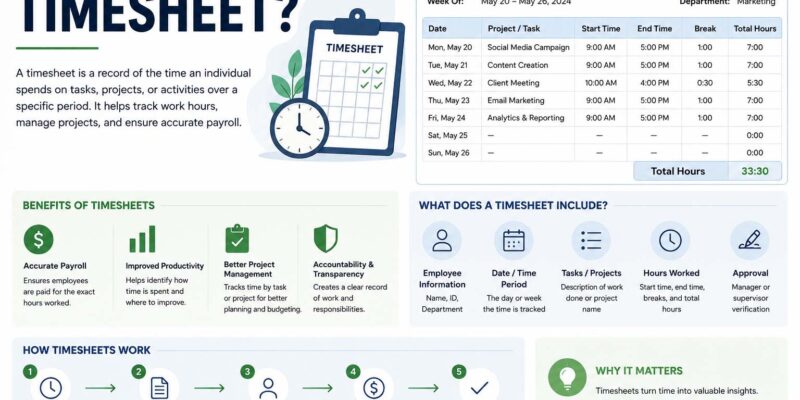
If you are wondering what is a timesheet, it is a paper or digital record that tracks the hours an employee works during a specific period. Businesses use timesheets to calculate wages, manage payroll, monitor attendance, and track time spent on projects. Employees also use them to review their working hours and check payment accuracy.
Timesheets are common in offices, construction companies, retail businesses, remote teams, and freelance work. Depending on the workplace, employees may record their start times, finish times, breaks, overtime, and project-related activities.
Today, many businesses use digital timesheets instead of paper forms. These systems can calculate working hours automatically, simplify payroll preparation, and help managers review time records. However, the main purpose remains the same: maintaining an accurate record of time worked.
Companies that want to improve employee management can combine time tracking with effective communication practices. For example, a Skip Level Meeting can help managers understand employee concerns and improve workplace communication.
What Is a Timesheet and How Does It Work?
A timesheet records the time an employee spends working over a particular period, such as a day, week, or two-week pay cycle.
Employees typically enter their working hours, while managers or payroll teams review the information before processing payments.
For example, an employee might start work at 9:00 AM, take a 30-minute unpaid lunch break, and finish at 5:30 PM. Their total working time would be eight hours.
A timesheet helps document those hours accurately.
How Employees Complete a Timesheet
Most workplaces follow a straightforward process:
- Employees enter the date of each workday.
- They record their starting and finishing times.
- They include break periods when necessary.
- They calculate or confirm their total working hours.
- They submit the timesheet for review.
- A manager or payroll administrator checks the information.
Digital systems often perform the calculations automatically. However, employees should still review their entries before submitting them.
Paper Timesheet vs. Digital Timesheet
Paper timesheets require employees to write their working hours manually. These forms are simple to use but may involve additional administrative work.
Digital timesheets allow employees to enter hours through computers, mobile applications, or dedicated time-tracking systems.
Some software also includes automatic calculations, approval workflows, and project tracking.
Therefore, businesses can choose a method that matches their size, budget, and operational requirements.
What Is 45 Minutes on a Timesheet?
One common payroll question is what is 45 minutes on a timesheet.
In decimal format, 45 minutes equals 0.75 hours.
To convert minutes into decimal hours, divide the number of minutes by 60.
45 ÷ 60 = 0.75
For example, an employee who works eight hours and 45 minutes has completed 8.75 hours.
This conversion matters because many payroll systems use decimal hours to calculate wages.
Example of a 45-Minute Conversion
Suppose an employee earns $20 per hour and works eight hours and 45 minutes.
First, convert the minutes:
45 ÷ 60 = 0.75
Next, add the decimal value to the full hours:
8 + 0.75 = 8.75 hours
Finally, calculate the wages:
8.75 × $20 = $175
The employee earns $175 before deductions, assuming all hours receive the same hourly rate and no special pay rules apply.
What Is 15 Minutes on a Timesheet?
Another frequent question is what is 15 minutes on a timesheet.
Fifteen minutes equals 0.25 hours in decimal format.
The calculation is:
15 ÷ 60 = 0.25
Therefore, an employee who works seven hours and 15 minutes has completed 7.25 hours.
Understanding these conversions helps employees avoid mistakes when recording their working time.
Timesheet Minutes to Decimal Hours Chart
The following chart shows common time conversions:
| Minutes | Decimal Hours |
|---|---|
| 5 minutes | 0.0833 |
| 10 minutes | 0.1667 |
| 15 minutes | 0.25 |
| 20 minutes | 0.3333 |
| 30 minutes | 0.50 |
| 40 minutes | 0.6667 |
| 45 minutes | 0.75 |
| 50 minutes | 0.8333 |
| 60 minutes | 1.00 |
The values for some minute amounts are rounded to four decimal places.
Employees should also distinguish between converting actual minutes and rounding recorded time.
For example, converting 14 minutes into decimal hours is a mathematical calculation. Rounding 14 minutes to a quarter-hour increment is a separate process that may depend on applicable workplace rules and labor laws.
What Is a Timesheet for Work?
A workplace timesheet helps employers maintain accurate records of employee hours and supports several business activities.
Although payroll is a primary purpose, companies also use timesheets for project planning, attendance management, and client billing.
Payroll and Wage Calculations
Employers use timesheets to calculate regular working hours and determine wages.
For hourly employees, accurate time records are particularly important because earnings depend on the hours worked.
In addition, timesheets can help employers identify overtime hours and verify payroll information.
However, overtime requirements depend on applicable employment laws and employee classifications.
Attendance and Scheduling
Timesheets provide a record of when employees worked.
Managers can use this information to identify scheduling gaps, review attendance patterns, and plan staffing requirements.
For example, a retail manager may compare recorded working hours with store activity to determine whether staffing levels match customer demand.
Project Management and Client Billing
Businesses that charge clients by the hour often use timesheets to track billable work.
Consultants, designers, marketing agencies, and freelancers may record how much time they spend on individual projects.
As a result, businesses can prepare more accurate invoices and evaluate project costs.
Remote Work and Sales Teams
Digital timesheets also support remote and hybrid workplaces.
Employees can record their working hours without visiting a physical office, while managers can review submitted information.
For sales organizations, time tracking may complement other performance measurements. Businesses exploring sales roles can also read What Is Inside Sales.
However, working hours alone do not provide a complete picture of employee productivity or performance.
What Information Is Required on a Timesheet?
A timesheet usually contains basic employee details and information about the reporting period.
The exact fields depend on the employer, payroll system, and applicable recordkeeping requirements.
Employee and Reporting Information
Most timesheets include:
- Employee name or identification number
- Department or job title
- Reporting period
- Work dates
- Total hours worked
These details help payroll teams connect the recorded hours to the correct employee and pay period.
Daily Working Hours and Breaks
Employees may also record their start times, finish times, and break periods.
For example, a daily entry might show:
| Timesheet Field | Example |
|---|---|
| Date | Monday |
| Start time | 9:00 AM |
| End time | 5:30 PM |
| Unpaid break | 30 minutes |
| Total hours worked | 8.00 |
The example assumes the employee takes a genuine 30-minute unpaid break and performs no work during that period.
If employees work during a break, employers must account for that time according to applicable wage and hour rules.
Overtime and Project Details
Some timesheets contain separate fields for overtime hours, project names, client accounts, or task descriptions.
These details help businesses manage labor costs and prepare invoices.
However, not every organization needs the same level of detail.
Timesheet Review and Manager Approval
Many employers ask supervisors to review employee timesheets before payroll processing.
Managers can identify missing entries, clarify discrepancies, and request corrections.
Nevertheless, an approval process should not prevent employees from receiving legally required compensation for hours they actually worked.
Are Timesheets Required by Law?
Timesheet requirements depend on the country, employment laws, and type of worker.
In the United States, the Fair Labor Standards Act requires covered employers to maintain certain records for employees subject to its provisions.
However, federal law does not require every employer to use a specific timesheet format.
According to the U.S. Department of Labor’s official recordkeeping guidance, employers may use different timekeeping methods as long as they maintain the required records accurately and completely.
Employers should also check applicable state and local requirements.
For businesses operating in other countries, the relevant labor laws may establish different recordkeeping obligations.
Companies reviewing their broader legal responsibilities may also find What Is a Business License useful when learning about business registration and operating requirements.
How to Calculate Hours on a Timesheet
Calculating working hours requires employees to identify their actual start and finish times and account for any unpaid breaks.
Step 1: Record Start and End Times
Begin by identifying when the employee started and finished working.
For example:
- Start time: 8:30 AM
- End time: 5:00 PM
The total elapsed time is eight hours and 30 minutes.
Step 2: Subtract Unpaid Breaks
If the employee takes a 30-minute unpaid meal break without performing work, subtract that period.
8 hours 30 minutes − 30 minutes = 8 hours
Therefore, the total working time is eight hours.
Step 3: Convert Minutes into Decimal Hours
If the employee works additional minutes, divide those minutes by 60.
For example:
8 hours 30 minutes = 8.50 hours
8 hours 45 minutes = 8.75 hours
This method helps employees enter accurate decimal values.
Step 4: Review the Total
Finally, confirm that the daily and weekly totals match the actual time worked.
Employees should correct missing entries before submitting their timesheets.
Managers should also review discrepancies carefully rather than automatically changing recorded hours.
Benefits of Using Timesheets
Timesheets offer several practical advantages for businesses and employees.
More Accurate Payroll
Reliable time records help employers calculate wages and identify missing or incorrect entries.
As a result, payroll teams can reduce avoidable calculation errors.
Better Project Planning
Timesheets help managers understand how much time employees spend on particular tasks.
This information can support project estimates, resource planning, and workload management.
Improved Employee Transparency
Employees can review their recorded hours and identify possible discrepancies.
Consequently, clear timekeeping procedures can support better communication between workers and employers.
More Effective Labor Cost Management
Businesses can compare labor hours with project budgets and operating expenses.
For example, companies operating within a Free Enterprise System may use accurate labor records to support cost management and business planning.
However, timesheets should support responsible management rather than unnecessary employee surveillance.
Common Timesheet Mistakes and How to Avoid Them
Even simple timekeeping systems can produce errors when employees or managers use them incorrectly.
Incorrect Decimal Conversions
One common mistake involves entering 45 minutes as 0.45 hours instead of 0.75 hours.
However, decimal hours represent fractions of an hour rather than minutes written after a decimal point.
Employees should use the correct conversion formula or an accurate time calculator.
Missing Break Information
Employees sometimes forget to record meal breaks or other relevant time periods.
Therefore, workplaces should explain how to document breaks correctly.
Employers must also follow applicable laws when determining which breaks count as compensable working time.
Forgetting to Submit Timesheets
Late submissions can delay internal payroll preparation and create additional administrative work.
To reduce these problems, businesses can establish clear submission deadlines and reminders.
Recording Estimated Instead of Actual Hours
Employees should record the time they actually worked rather than automatically entering their scheduled hours.
For example, an employee who stays late to complete required work should accurately report that additional time.
Employers should maintain appropriate procedures for reviewing and correcting discrepancies.
Conclusion
Understanding what is a timesheet helps employees and employers manage working hours, payroll records, and project-related activities more effectively.
A timesheet records the time employees spend working during a specific period. Businesses use these records to calculate wages, monitor attendance, manage projects, and support recordkeeping obligations.
Accurate decimal conversions are also essential. For example, 15 minutes equals 0.25 hours, while 45 minutes equals 0.75 hours.
Whether a business uses paper forms or digital software, clear timekeeping procedures help maintain accurate records, improve transparency, and reduce administrative mistakes.