
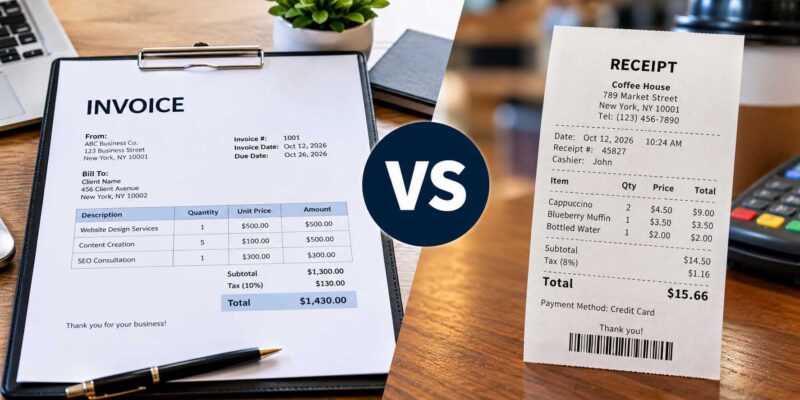
Imagine completing a service for a customer and sending a document requesting payment. Later, once the customer pays, you provide another document confirming the transaction. Understanding invoice vs receipt helps explain why businesses use these two documents at different stages of a sale.
An invoice generally requests or records an amount owed, while a receipt confirms that payment has been received. Although both contain transaction details, they serve different purposes in billing, bookkeeping, and customer communication.
For small business owners, freelancers, and accounting beginners, confusing these documents can create payment disputes or inaccurate financial records.
This guide explains their differences, what each document includes, when to issue them, and how to manage both efficiently.
What Is an Invoice?
An invoice is a business document that records a sale or service and identifies the amount a customer owes.
Typically, sellers issue invoices after delivering products or completing services, although some businesses invoice before delivery or according to agreed milestones.
An invoice commonly includes:
- Seller and customer information
- Unique invoice number
- Invoice issue date
- Description of products or services
- Quantity and unit price
- Applicable taxes and discounts
- Total amount payable
- Payment terms and due date
For example, a graphic designer completing a $600 project might send an invoice requesting payment within 15 days.
The invoice explains what the customer purchased, how much they owe, and when payment is expected.
Why Businesses Issue Invoices
Invoices help businesses communicate payment expectations and track outstanding balances.
For instance, a consulting company may complete several projects before receiving payment.
Therefore, invoices help its accounting team identify which customers still owe money.
However, an invoice alone does not prove that the customer has paid.
What Is a Receipt?
A receipt is a document confirming that a payment or transaction has occurred.
Businesses generally issue receipts after accepting payment, whether through cash, card, bank transfer, or another approved method.
A typical receipt contains:
- Business name and contact details
- Transaction date
- Description of purchased items
- Amount paid
- Applicable taxes
- Payment method
- Transaction or receipt number
For example, when someone purchases office supplies for $85 and pays immediately, the retailer provides a receipt confirming the completed payment.
Unlike an unpaid invoice, a receipt normally shows that money has already changed hands.
Why Receipts Matter
Receipts help customers verify purchases, request eligible returns, and maintain expense records.
Meanwhile, businesses use receipts to support transaction records and reconcile payments.
However, a receipt does not always contain the same detailed payment terms or customer information as an invoice.
Invoice vs Receipt: Main Differences Explained
The primary distinction involves payment status.
An invoice commonly identifies an amount due, whereas a receipt confirms an amount paid.
However, invoices can also be marked as paid, so the document’s status and wording matter.
| Feature | Invoice | Receipt |
|---|---|---|
| Main purpose | Request or document payment due | Confirm payment received |
| Typical timing | Before or around payment | After payment |
| Payment status | Often unpaid when issued | Generally paid |
| Due date | Commonly included | Usually unnecessary |
| Customer details | Often detailed | May be limited |
| Accounting use | Track sales and receivables | Verify payments |
| Common example | Freelancer billing a client | Store confirming a purchase |
For businesses comparing receipt vs invoice documents, timing provides a useful starting point.
However, the exact format and legal requirements may differ across industries and countries.
How Invoice vs Receipt Documents Work Together
Many businesses use both documents during a single transaction.
For example, a web development agency agrees to build a website for $2,000.
After completing the agreed work, the agency sends an invoice showing the project details and payment deadline.
The client then transfers the money.
Once the payment arrives, the agency updates the invoice status and may issue a receipt confirming the amount received.
Where Purchase Orders Fit Into the Process
Some business transactions begin before the seller creates an invoice.
For instance, a company purchasing office equipment may first send a purchase order specifying the requested products, quantities, and agreed prices.
If you’re learning What Is a Purchase Order, understanding its role in the purchasing process can help distinguish authorization to buy from a later request for payment.
A common transaction sequence looks like this:
- The buyer submits a purchase order when required.
- The seller provides the agreed products or services.
- The seller issues an invoice.
- The buyer reviews and pays the invoice.
- The seller records the payment and provides a receipt when appropriate.
However, retail purchases often skip formal purchase orders and invoices because payment happens immediately.
Invoice vs Receipt: Which Document Should You Use?
The right document depends on how and when the customer pays.
A sales receipt is particularly common when payment occurs at the point of sale.
Meanwhile, invoices are more common when customers receive payment terms or businesses need to track accounts receivable.
Example: Retail Store
A customer purchases a printer for $250 and pays using a debit card.
Because payment happens immediately, the store typically provides a sales receipt.
Therefore, a separate invoice may not be necessary for the transaction.
Example: Marketing Agency
A marketing agency completes a monthly service package worth $1,500.
However, the client has agreed to pay within 30 days.
The agency sends an invoice outlining the services and payment deadline.
After receiving the payment, the agency records the transaction and may provide a receipt.
Example: Partial Payment
Suppose a contractor invoices a customer for $4,000.
The customer initially pays $1,500.
In this situation, the contractor can issue a receipt for the amount received while keeping the remaining $2,500 balance outstanding.
Consequently, the receipt confirms the partial payment rather than settlement of the entire invoice.
Invoice vs Bill vs Receipt: Understanding All Three
Businesses often use the words invoice and bill interchangeably.
However, the terminology can depend on who sends or receives the document.
An invoice commonly describes the seller’s request for payment.
Meanwhile, a bill often describes the amount the buyer needs to pay.
For example, a restaurant customer asks for the bill, while a consulting company sends an invoice.
A receipt, by comparison, confirms payment.
Simple Business Example
Consider a business purchasing $300 in cleaning supplies on credit.
The supplier sends an invoice for $300.
From the buyer’s perspective, the document represents a bill that must be paid.
Once payment is completed, the supplier may issue a receipt.
Therefore, the distinction between invoice vs bill vs receipt often comes down to transaction stage and business perspective.
Invoice vs Receipt in Business Accounting
Invoices and receipts help businesses maintain organized financial records.
However, their accounting roles differ depending on the company’s accounting method and transaction details.
Recording Outstanding Payments
Under accrual accounting, an invoice for completed work may support recording revenue and accounts receivable before the customer pays.
For example, a company delivers $1,000 in services and invoices the client.
If the relevant revenue recognition conditions are satisfied, the company records the revenue and outstanding receivable.
Later, receiving payment reduces the receivable.
However, under cash-basis accounting, revenue recognition generally follows different timing rules.
Tracking Payments in a Ledger
After receiving money, businesses must record the transaction accurately.
For accounting beginners asking What Is a Ledger, it helps to understand that a ledger organizes financial transactions into accounts such as cash, revenue, and accounts receivable.
Invoices and receipts provide supporting documentation for these entries.
Consequently, maintaining both records can make reconciliation and financial reporting easier.
Avoiding Duplicate Revenue Records
A business should not automatically record revenue twice simply because it has both an invoice and a receipt.
For example, an accrual-basis company may recognize revenue when it earns it and later record payment against the outstanding receivable.
Therefore, the receipt confirms collection rather than creating another sale.
Malaysian Tax Invoice vs Receipt: What Businesses Should Know
Document requirements can vary considerably by country.
For example, businesses researching Malaysian tax invoice vs receipt rules must consider Malaysia’s applicable tax and electronic invoicing requirements.
Malaysia uses a Sales and Service Tax (SST) framework rather than a general Goods and Services Tax (GST) system.
Therefore, businesses should not assume that older Malaysian GST invoice rules still apply.
Tax Invoices and Electronic Invoicing
Depending on the transaction and the business’s obligations, Malaysian businesses may need to issue documents that meet specific SST or e-Invoice requirements.
Malaysia’s e-Invoice framework also introduces digital reporting and validation requirements for businesses within its implementation scope.
However, rollout dates, exemptions, and document requirements can change.
For current guidance, businesses should consult the Inland Revenue Board of Malaysia’s official e-Invoice guidance and the Royal Malaysian Customs Department.
Can a Receipt Replace an Invoice?
Sometimes, simplified documentation may be acceptable under applicable rules.
However, a regular payment receipt should not automatically be treated as a compliant tax invoice or e-Invoice.
Therefore, businesses should verify the specific documentation requirements for their transaction and jurisdiction.
Common Invoice and Receipt Mistakes
Even small documentation errors can create accounting problems.
Fortunately, consistent procedures help businesses avoid many issues.
Sending Invoices Without Clear Payment Terms
Customers may delay payment when invoices lack due dates or payment instructions.
Therefore, businesses should clearly communicate accepted payment methods and deadlines.
Treating Every Invoice as Paid
An issued invoice does not automatically confirm payment.
Instead, businesses should update its status only after verifying the relevant transaction.
Losing Transaction Records
Missing receipts can make expense tracking, customer support, and financial reviews more difficult.
Consequently, businesses should store documents securely and organize them by date or transaction number.
Confusing Sales With Profit
Invoices may help businesses measure sales activity, but sales figures alone do not reveal profitability.
For example, a company might generate $10,000 in revenue while incurring substantial operating expenses.
Understanding the difference between revenue and profit helps owners evaluate business performance beyond the amounts shown on invoices.
Best Practices for Managing Invoices and Receipts
A reliable documentation process does not need to be complicated.
However, consistency becomes more valuable as transaction volume increases.
Consider these practical habits:
- Use unique document numbers. This makes transactions easier to identify.
- Include accurate customer information. Check names, addresses, and applicable tax details.
- Set clear payment deadlines. Communicate expectations before issuing invoices.
- Verify payments before issuing confirmation. Match received amounts with transaction records.
- Store digital copies securely. Protect financial records from unauthorized access.
- Reconcile transactions regularly. Compare accounting records with bank statements.
- Follow applicable retention rules. Keep documents for the period required by relevant laws.
For growing companies, accounting software can automate invoice generation, payment tracking, and receipt storage.
However, employees should still review information for accuracy.
Frequently Asked Questions About Invoices and Receipts
Is an Invoice Proof of Payment?
No. An invoice generally documents a transaction and an amount payable.
However, a paid invoice may provide supporting evidence when it clearly identifies the payment received.
Can a Receipt Be Issued Before Payment?
A standard payment receipt normally confirms money already received.
Therefore, businesses should avoid issuing documents that falsely indicate payment completion.
Do Small Businesses Need Both Invoices and Receipts?
Not every transaction requires both documents.
For example, immediate retail sales may only need receipts, while credit-based services commonly involve invoices and payment confirmations.
However, legal requirements depend on the business and jurisdiction.
Can an Invoice and Receipt Have the Same Number?
Businesses may link invoices and receipts using a shared transaction reference.
However, maintaining separate document identifiers often makes recordkeeping clearer.
Are Digital Invoices and Receipts Valid?
Digital documents are widely used in business transactions.
However, their legal and tax validity depends on applicable requirements, including electronic recordkeeping and invoicing rules.
Invoice vs Receipt: Choosing the Right Document
Understanding the difference between an invoice and a receipt helps businesses communicate payment expectations, confirm transactions, and maintain reliable accounting records.
When requesting payment, an invoice is generally the appropriate document. Once payment arrives, a receipt can provide confirmation.
Meanwhile, purchase orders may support purchasing approval before billing begins.
For small business owners, the best approach is to establish a simple documentation process, verify payments carefully, and keep records organized.
With these habits in place, businesses can reduce confusion, improve financial tracking, and provide customers with clearer transaction information.