
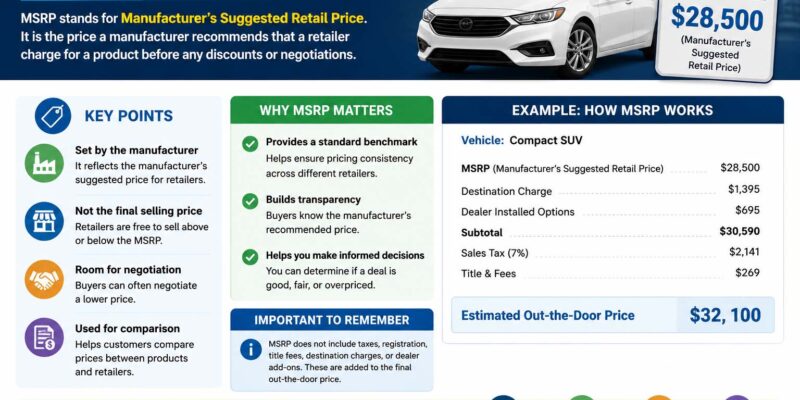
What is MSRP? MSRP stands for Manufacturer’s Suggested Retail Price. It is the price a manufacturer recommends that retailers charge consumers for a product. However, the final selling price may be higher or lower because retailers consider demand, competition, inventory, and promotional offers.
Manufacturers use suggested retail prices to provide a common reference point for shoppers and sellers. As a result, customers can compare advertised prices across stores and decide whether an offer provides good value.
Understanding this pricing benchmark also helps businesses plan their sales strategies. For example, reviewing Perfect Competition Examples can explain how market competition influences prices.
This guide covers the meaning of MSRP, how manufacturers and retailers use it, car pricing, invoice prices, advantages, disadvantages, and practical shopping tips.
What Does MSRP Stand For?
MSRP means Manufacturer’s Suggested Retail Price. Manufacturers recommend this amount as a reference for retailers selling their products.
For example, a manufacturer might suggest a retail price of $500 for a new electronic device. One store may sell it for $500, while another offers it for $450.
Although both retailers sell the same product, their final prices differ.
Therefore, the suggested price provides a reference rather than a guarantee of what customers will pay.
Is MSRP a Required Selling Price?
Generally, MSRP is a recommendation, not a mandatory selling price.
Independent retailers can usually decide whether to sell above, below, or at the suggested amount. However, specific contractual arrangements and applicable competition laws may affect certain pricing practices.
Consequently, shoppers should not assume that every retailer must follow the manufacturer’s recommendation.
What Does MSRP Mean in Business?
In business, the suggested retail price helps manufacturers communicate a recommended market position for their products.
However, retailers must also consider their own operating costs, competition, and customer demand.
The final selling price may depend on:
- Product demand and availability
- Competitor pricing
- Inventory levels
- Store location
- Seasonal promotions
- Retail operating expenses
- Brand positioning
- Overall business strategy
For example, a retailer with excess inventory may offer a discount to encourage faster sales. Meanwhile, another store may charge more when a product becomes difficult to find.
As a result, the manufacturer’s recommendation and the actual market price may differ.
What Is MSRP Price?
The MSRP is the suggested retail amount assigned by the manufacturer.
Consumers often compare this figure with a retailer’s advertised selling price to evaluate potential savings.
For example, imagine a gaming console has an MSRP of $499.
A retailer might offer it for:
- $499 at the suggested price
- $449 during a promotion
- $549 when demand exceeds available inventory
Therefore, the same product can have different selling prices even when the manufacturer has not changed its recommendation.
However, a lower price does not automatically mean the best overall deal. Buyers should also consider warranty coverage, delivery fees, seller reliability, and return policies.
Why Manufacturers Use MSRP
Manufacturers use recommended retail prices for several business reasons. Although these recommendations do not guarantee consistent selling prices, they provide a useful reference.
Pricing Consistency
A suggested retail price gives retailers and consumers a common starting point.
For example, shoppers can compare offers from multiple stores against the same manufacturer’s recommendation.
However, stores may still set different final prices.
Brand Positioning
Manufacturers may recommend prices that reflect their intended market position.
For instance, premium products often carry higher suggested prices than budget alternatives.
Nevertheless, price alone does not establish product quality.
Consumer Expectations
A published suggested price helps customers understand the manufacturer’s intended retail price.
As a result, shoppers may find it easier to recognize when a product sells above or below that amount.
Marketing Strategy
Retailers sometimes use MSRP as a reference when advertising promotional offers.
For example, a store might advertise a product as 20% below its manufacturer’s suggested price.
Businesses developing a marketing strategy template can consider how price comparisons fit into broader promotional planning.
However, advertised savings should be accurate and not misleading. The Federal Trade Commission’s Guides Against Deceptive Pricing explain important principles concerning advertised price comparisons in the United States.
What Is MSRP for Cars?
In the automotive industry, MSRP refers to the manufacturer’s suggested retail price for a vehicle.
People commonly associate this figure with the window sticker displayed on new cars.
However, the sticker price and the final amount paid at a dealership may differ.
A vehicle’s displayed pricing information can include:
- Base vehicle price
- Factory-installed options
- Manufacturer-listed equipment
- Destination or delivery charges
- Total suggested retail price
The exact presentation depends on the vehicle and market.
Additionally, taxes, registration charges, dealer-installed products, and other applicable fees can affect the final purchase amount.
How Car MSRP Works
Imagine a manufacturer introduces an SUV with a suggested retail price of $40,000.
A dealership might offer the vehicle for $39,000 during a promotion. Alternatively, it may advertise a higher price when inventory is limited.
Therefore, buyers should compare the actual selling price rather than relying only on the manufacturer’s recommendation.
Why Dealers Sometimes Charge Above MSRP
Dealerships may charge more than the suggested price when demand is unusually strong.
For example, a newly released vehicle with limited availability may attract buyers willing to pay extra.
Some dealerships describe these additional charges as market adjustments.
However, customers should review the complete written price breakdown before agreeing to purchase.
Does MSRP Include Taxes and Fees?
A vehicle’s MSRP does not normally represent the complete out-the-door purchase price.
Depending on the location, buyers may also pay:
- Sales tax
- Registration fees
- Title fees
- Documentation charges
- Dealer-installed accessory charges
- Other applicable costs
Therefore, requesting an itemized out-the-door quote is a useful step when comparing dealerships.
MSRP vs Invoice Price
Many consumers confuse MSRP with the dealer invoice price. However, these figures represent different parts of vehicle pricing.
| Term | Meaning |
|---|---|
| MSRP | Manufacturer’s suggested retail price for consumers |
| Invoice price | Amount shown on the manufacturer’s invoice to the dealer |
| Selling price | Amount the retailer agrees to charge for the product |
| Out-the-door price | Total purchase amount including applicable taxes and fees |
For example, a car may have an MSRP of $35,000 and a dealer invoice price below that amount.
However, the invoice figure does not necessarily represent the dealership’s final net cost.
Manufacturers may offer incentives, rebates, or other arrangements that affect dealer economics.
As a result, shoppers should avoid assuming that an invoice price reveals the exact profit on a vehicle.
Real-World MSRP Examples
Suggested retail prices appear in several industries. However, their importance varies depending on the product category and sales model.
Electronics
Manufacturers often announce suggested prices for smartphones, gaming consoles, and computer equipment.
For example, a new device may launch with a recommended price of $799.
Later, retailers may offer discounts as competition increases or newer models become available.
Fashion
Clothing and footwear brands may publish recommended prices for their products.
However, seasonal sales and inventory clearance can create substantial differences between suggested and actual prices.
Furniture
Furniture retailers frequently display reference prices alongside promotional offers.
Nevertheless, shoppers should compare similar products and check whether advertised discounts represent genuine savings.
Automotive
Car manufacturers publish suggested retail prices to help buyers compare vehicle models and equipment packages.
However, dealer pricing and additional charges can affect the final cost.
Why Retailers Sometimes Sell Above MSRP
Retailers may price products above the manufacturer’s recommendation for several reasons.
Common factors include:
- Strong customer demand
- Limited inventory
- Supply disruptions
- Product popularity
- Higher local operating costs
- Limited availability of competing products
For example, a newly released gaming console may sell above its suggested price when demand exceeds supply.
Similarly, collectible products may attract higher prices in secondary markets.
However, a higher selling price does not necessarily indicate better quality or value.
Therefore, consumers should compare multiple sellers before purchasing expensive products.
Advantages of MSRP
Suggested retail pricing can provide benefits for both manufacturers and consumers.
Easier Price Comparisons
Customers can compare retailer offers against a common reference price.
As a result, they may identify stores offering lower prices for the same product.
Clearer Product Positioning
Manufacturers can communicate their intended market position through recommended pricing.
For example, premium and budget product lines may have different suggested price ranges.
Promotional Planning
Retailers can use legitimate price comparisons when planning sales campaigns.
However, promotions must accurately represent the prices and savings being advertised.
Better Consumer Awareness
A visible suggested price can help shoppers recognize unusual price differences.
Nevertheless, customers should still research actual market prices before making decisions.
Disadvantages of MSRP
Although the suggested retail price is useful, it has several limitations.
It May Not Reflect Current Market Value
Market conditions can change quickly.
For example, a product may become widely available at prices far below its original recommendation.
Therefore, MSRP should not be treated as a reliable estimate of resale value or current market value.
Retailers May Charge Different Prices
Because MSRP is generally a recommendation, shoppers may find substantial price differences between stores.
Consequently, comparing several retailers is often more useful than focusing on one reference price.
Discounts Can Be Misleading
Some advertisements emphasize large discounts from suggested prices even when customers rarely pay those amounts.
As a result, the advertised savings may create an exaggerated impression of value.
Therefore, shoppers should compare actual selling prices and review promotional claims carefully.
Business Strategy and MSRP
Manufacturers and retailers use recommended prices as part of broader business strategies.
However, the suggested amount is only one factor in a company’s pricing decisions.
Premium Pricing Strategy
Premium brands may recommend higher retail prices to reflect product features, positioning, or customer expectations.
Nevertheless, retailers still need to consider demand and competitive alternatives.
Discount Pricing Strategy
Some retailers offer products below MSRP to attract price-sensitive customers.
For example, a store may discount older inventory to make room for new products.
As a result, customers may find lower prices during clearance periods.
Dynamic Pricing Strategy
Online retailers may adjust selling prices based on inventory, demand, and competition.
Consequently, the same product may have different prices on different days.
Understanding strategy vs tactics can help businesses distinguish long-term pricing goals from individual promotional decisions.
Additionally, companies that purchase inventory from suppliers often use purchase orders to document agreed quantities, costs, and delivery requirements.
How Consumers Should Use MSRP
Shoppers can use the suggested retail price as a starting point when evaluating a purchase.
However, it should not be the only factor in the decision.
Step 1: Check the Manufacturer’s Price
First, identify the suggested retail price for the exact product model.
Make sure the product specifications match the item you intend to buy.
Step 2: Compare Multiple Retailers
Next, check the actual selling prices at several reputable stores.
For example, one retailer may offer a lower price while another includes free delivery.
Step 3: Review Additional Costs
Then, consider taxes, shipping charges, installation fees, and optional services.
These expenses can significantly affect the final purchase amount.
Step 4: Evaluate Warranty and Support
Also, compare warranty terms, return policies, and customer service.
A slightly higher price may provide better overall value if the retailer offers meaningful additional benefits.
Step 5: Make a Value-Based Decision
Finally, consider the total cost alongside product quality and suitability.
As a result, you can make a more informed decision instead of relying only on an advertised discount.
MSRP in Online Shopping
E-commerce has made retail price comparisons easier.
However, online prices can change frequently because retailers respond to demand, stock levels, and competitor activity.
Common influences include:
- Flash sales
- Seasonal promotions
- Inventory availability
- Competitor discounts
- Shipping costs
- Marketplace seller policies
For example, a product may sell below its suggested price during a promotional event.
However, the same item may return to its regular selling price after the promotion ends.
Businesses that understand customer engagement strategy can combine transparent pricing with reliable service to encourage repeat purchases.
Therefore, successful online pricing involves more than offering the lowest advertised amount.
Common MSRP Mistakes to Avoid
Consumers sometimes misunderstand what suggested retail pricing actually means.
Assuming MSRP Is Mandatory
A manufacturer’s recommendation is generally not a required selling price.
Therefore, retailers may offer different prices depending on their circumstances and applicable rules.
Assuming MSRP Equals Market Value
A suggested price reflects the manufacturer’s recommendation, not necessarily the amount buyers currently pay.
For example, older electronics may sell well below their original suggested prices.
Assuming a Discount Always Means Savings
An advertised discount from MSRP does not automatically represent the best available deal.
Instead, compare actual prices across retailers.
Ignoring the Final Purchase Cost
A low advertised selling price may exclude important charges.
Therefore, review shipping, taxes, fees, and optional extras before completing the purchase.
Assuming Higher MSRP Means Better Quality
Price and quality are not identical.
Although premium products may offer additional features, shoppers should evaluate specifications, reliability, and suitability.
Frequently Asked Questions About MSRP
What does MSRP stand for?
MSRP stands for Manufacturer’s Suggested Retail Price. It is the price a manufacturer recommends that retailers charge consumers.
What does MSRP mean?
It refers to a manufacturer’s recommended selling price. However, retailers may charge more or less depending on market conditions and applicable rules.
Is MSRP the final price?
No. The final selling price may differ from the suggested amount. Additionally, taxes, fees, and other charges may affect the total purchase cost.
What is MSRP for cars?
For cars, MSRP is the manufacturer’s suggested retail price for a vehicle. However, the final dealership price may include discounts, adjustments, taxes, and additional fees.
Can retailers sell below MSRP?
Yes. Retailers generally can offer discounts below the manufacturer’s suggested price, subject to applicable laws and arrangements.
Why do products sell above MSRP?
Products may sell above MSRP when demand is high, inventory is limited, or retailers believe customers will pay more.
Is MSRP the same as invoice price?
No. MSRP is the manufacturer’s suggested consumer price, while invoice price refers to the amount shown on the manufacturer’s invoice to the dealer.
How can shoppers tell whether an MSRP discount is good?
Compare the actual selling price with offers from other retailers. Additionally, review product specifications, warranty terms, and total purchase costs.
Conclusion
Understanding what is MSRP helps consumers recognize the difference between a manufacturer’s suggested price and the amount a retailer actually charges.
Although MSRP provides a useful reference, it does not always reflect current market value or the final purchase cost.
Therefore, shoppers should compare retailers, review additional fees, and evaluate product quality before buying.
For businesses, suggested retail pricing can support brand positioning and promotional planning. However, effective pricing decisions must also consider customer demand, competition, and long-term business goals.