
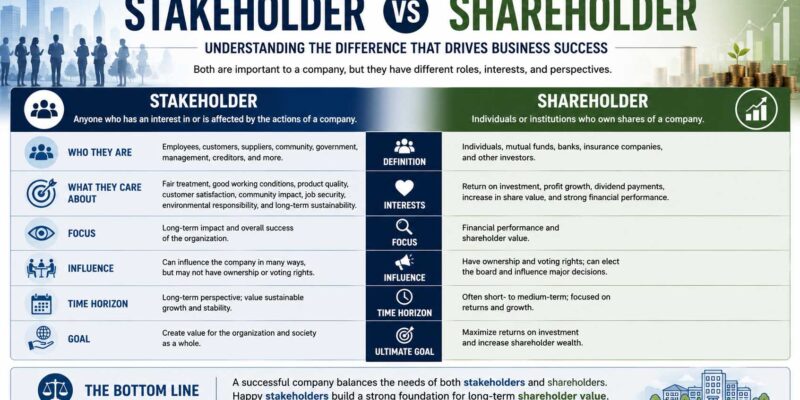
The stakeholder vs shareholder distinction can seem confusing because both groups have an interest in a company’s performance. However, they are not the same. A shareholder owns shares in a company, while a stakeholder is any person or group that can affect the business or be affected by its decisions. As a result, shareholders are stakeholders, but many stakeholders are not shareholders.
This difference matters far beyond terminology. Business leaders regularly make decisions involving investors, employees, customers, suppliers, lenders, communities, and regulators. Understanding what each group wants helps managers make better decisions and recognize where competing interests may arise.
What Is a Shareholder?
A shareholder, also called a stockholder, is a person, institution, or other entity that owns shares of stock in a corporation.
For example, if an investor purchases shares in a publicly traded company, that investor becomes one of its shareholders.
Shareholders generally have a financial interest in the company. If the business performs well, the value of their shares may rise. Depending on the company and the type of shares held, investors may also receive dividends.
Certain shareholders may have voting rights as well. For instance, they may vote on the election of directors or other matters presented for shareholder approval.
However, the exact rights attached to shares vary according to the company’s structure, share class, governing documents, and applicable laws. The U.S. Securities and Exchange Commission’s investor resources provide authoritative information about stocks, ownership, potential returns, and investor considerations.
Understanding different types of ownership helps put shareholders into a broader business context because ownership can work very differently across corporations, sole proprietorships, partnerships, and other organizational structures.
What Is a Stakeholder?
A stakeholder has a broader connection to the organization.
Stakeholders are people or groups that have an interest in the company’s activities or can affect or be affected by what the company does.
Common stakeholders include:
- Shareholders
- Employees
- Customers
- Suppliers
- Lenders
- Business partners
- Local communities
- Governments and regulators
Consider a manufacturing company that decides to close a factory.
Shareholders may care about how the decision affects costs and financial performance. Meanwhile, employees may worry about their jobs, suppliers could lose a major customer, and the surrounding community could experience lower local spending.
All these groups have something at stake even though most do not own company shares.
Stakeholder vs Shareholder: Quick Comparison
The clearest difference is ownership. Shareholders own equity in a corporation, whereas stakeholders do not necessarily own any part of the business.
Here is a quick comparison:
| Factor | Shareholder | Stakeholder |
|---|---|---|
| Owns company shares | Yes | Not necessarily |
| Has a financial investment | Usually | Sometimes |
| Can include employees | Only if they own shares | Yes |
| Can include customers | Only if they own shares | Yes |
| Can include suppliers | Only if they own shares | Yes |
| Main connection | Equity ownership | Interest in or relationship with the business |
| Typical concerns | Returns, company value, dividends | Varies by stakeholder group |
| Time horizon | Can be short or long term | Often tied to an ongoing relationship |
The categories can overlap. For example, an employee who participates in an employee stock ownership arrangement may be both an employee stakeholder and a shareholder.
Likewise, a founder may simultaneously be a shareholder, executive, employee, and member of the local community.
Shareholder vs Stakeholder Interests
The shareholder vs stakeholder difference becomes especially clear when their interests conflict.
Imagine that a profitable company is considering a major investment in new employee training.
Shareholders may ask whether the investment will improve productivity and future profits. Employees may value the opportunity to build skills and advance their careers. Managers may view training as a way to improve retention, while customers could benefit indirectly from better service.
The same decision can therefore affect several groups differently.
Still, it would be misleading to assume shareholders always want short-term profit while other stakeholders always want long-term benefits. Many investors hold shares for years and support investments that may reduce current earnings while strengthening the business over time.
Likewise, stakeholder interests can conflict with one another. Customers may want lower prices, employees may want higher wages, and suppliers may want better payment terms.
Management must often balance these competing priorities.
Internal and External Stakeholders
One useful way to understand stakeholders is to divide them into internal and external groups.
Internal Stakeholders
Internal stakeholders operate within or have a direct internal connection to the organization.
They often include:
- Employees
- Managers
- Executives
- Owners
- Shareholders in some classifications
Employees may care about wages, working conditions, career development, job stability, and workplace culture.
Managers, meanwhile, often have to balance employee needs with budgets, customer expectations, operational goals, and owner expectations.
External Stakeholders
External stakeholders sit outside the company’s internal organizational structure.
Examples include:
- Customers
- Suppliers
- Creditors
- Regulators
- Local communities
- Strategic partners
Their interests can still influence company decisions significantly.
For instance, a supplier that depends heavily on one customer may have a strong interest in that customer’s financial stability.
The structure of business relationships matters here as well. Companies considering joint ventures or shared ownership arrangements may need to understand the types of partnerships and how different structures allocate control, responsibilities, and economic interests.
Shareholder vs Stakeholder Model
The shareholder vs stakeholder model describes two broad approaches to thinking about corporate priorities.
Under a shareholder-focused model, managers place strong emphasis on creating value for the company’s owners. Profitability, efficiency, investment returns, and long-term enterprise value may therefore receive substantial attention.
A stakeholder-oriented model considers a wider set of groups when making business decisions. Leaders may evaluate how a decision affects employees, customers, suppliers, communities, and investors rather than looking at shareholder outcomes alone.
In practice, the distinction is rarely completely black and white.
A company cannot normally serve shareholders well for long if it consistently disappoints customers, loses talented employees, damages key supplier relationships, or creates serious compliance problems.
Likewise, a company that ignores financial sustainability may eventually struggle to serve any stakeholder group.
Shareholder Theory vs Stakeholder Theory
The debate around shareholder theory vs stakeholder theory asks a larger question: Who should a company primarily serve?
Shareholder theory is commonly associated with the idea that managers should operate the business for the benefit of its owners while complying with applicable laws and rules.
Stakeholder theory takes a broader view. It argues that businesses should consider the legitimate interests of multiple groups affected by corporate activity.
These approaches can lead to different questions in the boardroom.
A shareholder-centered discussion might ask:
“How will this decision affect long-term shareholder value?”
A stakeholder-centered discussion might ask:
“How will this decision affect investors, workers, customers, suppliers, and the wider organization?”
Yet the two questions do not always produce different answers.
For example, improving product quality may help customers while reducing returns, strengthening the brand, and supporting shareholder value.
Stakeholder Capitalism vs Shareholder Capitalism
The phrase stakeholder capitalism vs shareholder capitalism extends the discussion from individual management decisions to the broader role of businesses in an economy.
Shareholder capitalism generally emphasizes the corporation’s responsibility to owners and the creation of shareholder value.
Stakeholder capitalism places more emphasis on creating value across several constituencies, which may include workers, customers, communities, suppliers, and shareholders.
However, companies still need viable business models regardless of which philosophy they emphasize.
A company cannot indefinitely increase wages, lower prices, increase supplier payments, invest heavily in communities, and deliver higher investor returns without generating enough economic value to support those commitments.
Therefore, leadership involves trade-offs rather than simply choosing one group and ignoring everyone else.
How Business Structure Changes the Discussion
The shareholder concept applies most directly to corporations because corporations issue shares.
Other business structures operate differently.
For instance, partners own interests in partnerships rather than conventional corporate shares. Anyone considering such a structure should understand partnership advantages and disadvantages, since decision-making authority, liability, taxation, and ownership arrangements can differ significantly from those of corporations.
Likewise, an S corporation is a U.S. federal tax status available to eligible corporations and certain other entities that make the appropriate election. Understanding the benefits of s corp can therefore be useful when comparing business structures, although S corporation rules are separate from the broader stakeholder-versus-shareholder debate.
The legal structure determines who owns the business and how that ownership is represented.
What Happens in a Corporate Group?
Ownership becomes more layered when several corporations operate within the same corporate group.
For example, one company may control another through ownership of its stock.
Learning what is a parent company helps explain this arrangement. A parent company generally owns enough of another company to exercise control over it, while the controlled business may operate as a subsidiary.
This creates several possible stakeholder relationships.
The parent company may be a shareholder in the subsidiary. Meanwhile, the subsidiary’s employees, customers, lenders, and suppliers remain stakeholders in its activities.
As a result, one organization can simultaneously occupy different roles depending on the relationship being examined.
Real-World Stakeholder vs Shareholder Example
Imagine a fictional coffee company called CityCup Coffee.
Its shareholders want the business to grow profitably and increase its long-term value.
Employees want competitive pay, predictable schedules, safe workplaces, and advancement opportunities.
Customers want good coffee, fair prices, convenient locations, and reliable service.
Coffee suppliers want stable orders and dependable payment.
Landlords want rent paid on time.
Local communities may care about employment, traffic, waste, and how stores affect surrounding neighborhoods.
Now imagine CityCup considers switching to a cheaper coffee supplier.
The lower cost could improve margins, which may benefit shareholders. However, if quality drops, customers might become dissatisfied. Meanwhile, the existing supplier could lose substantial business.
Management therefore needs to consider more than the immediate cost reduction.
If poorer quality eventually reduces customer loyalty and sales, a decision that initially looked good for shareholders may harm shareholder value later.
This example shows why stakeholder management and shareholder value are often interconnected.
Can Someone Be Both a Stakeholder and Shareholder?
Yes, and this happens frequently.
An employee who owns company stock is both.
A founder working as CEO while retaining equity is also both.
Likewise, an investment firm may be a shareholder while also having other contractual relationships with the business.
The easiest rule to remember is:
Every shareholder has a stake in the company through ownership, so shareholders fall within the broad stakeholder category. However, not every stakeholder owns shares.
That single distinction resolves much of the confusion surrounding the terminology.
How Managers Can Balance Different Interests
Managers rarely have the luxury of satisfying every stakeholder completely.
Instead, they need a structured decision-making process.
First, identify who will be affected by a decision. Next, determine what each group values and how strongly the decision affects them.
Then, consider financial costs, operational consequences, legal obligations, reputation, risks, and long-term business goals.
Communication also matters.
Employees may react negatively to a major operational change when management provides little explanation. Likewise, investors may become concerned when a costly initiative is announced without explaining its business rationale.
Clear communication does not remove every disagreement. However, it helps stakeholders understand why leaders made a decision and what the company expects to achieve.
Common Misunderstandings
One common mistake is using “stakeholder” and “shareholder” as interchangeable terms.
They overlap, but they are not synonyms.
Another mistake is assuming stakeholders are always people. Organizations can also be stakeholders. A bank lending money to a company, for example, has a financial interest in the borrower’s ability to repay.
It is also inaccurate to assume all shareholders have identical priorities.
One investor may focus on dividend income, while another may prioritize growth. A third may care strongly about governance practices or long-term strategic positioning.
Likewise, employees, customers, and suppliers are not uniform groups. Their priorities can vary considerably.
FAQs About Stakeholders and Shareholders
What Is the Main Difference Between a Stakeholder and a Shareholder?
A shareholder owns shares in a company. A stakeholder is a broader category that includes people or organizations that can affect the business or be affected by its activities.
Is an Employee a Stakeholder?
Yes. Employees are major stakeholders because business decisions can affect their compensation, working conditions, career opportunities, and employment.
Is a Customer a Shareholder?
Usually not. A customer becomes a shareholder only if they also own shares in the company. However, customers are stakeholders because company decisions can affect prices, products, service, and their overall experience.
Are All Shareholders Stakeholders?
Yes, shareholders are generally considered stakeholders because they have an ownership interest in the business. However, many stakeholders have no equity ownership.
What Do Shareholders Care About?
Their priorities vary. Depending on the investor, they may care about share price, dividends, profitability, growth, risk, governance, strategy, or long-term business value.
Why Should Businesses Consider Stakeholders?
Stakeholders can influence a company’s ability to operate successfully. Employees perform the work, customers generate revenue, suppliers provide resources, lenders provide capital, and regulators establish requirements. Managing these relationships can therefore support business stability.
A Practical Way to Remember the Difference
When comparing stakeholder vs shareholder, start with one question: Does this person or organization own shares in the company?
If yes, they are a shareholder and also part of the wider stakeholder picture. If not, they may still be a stakeholder because of another relationship with the business.
For managers and entrepreneurs, however, recognizing the definition is only the starting point. Strong business decisions consider ownership, financial performance, customer needs, employee interests, supplier relationships, legal responsibilities, and long-term consequences together.
That approach helps leaders understand not only who has an interest in the company, but also how today’s decisions can affect the relationships that keep the business operating tomorrow.