
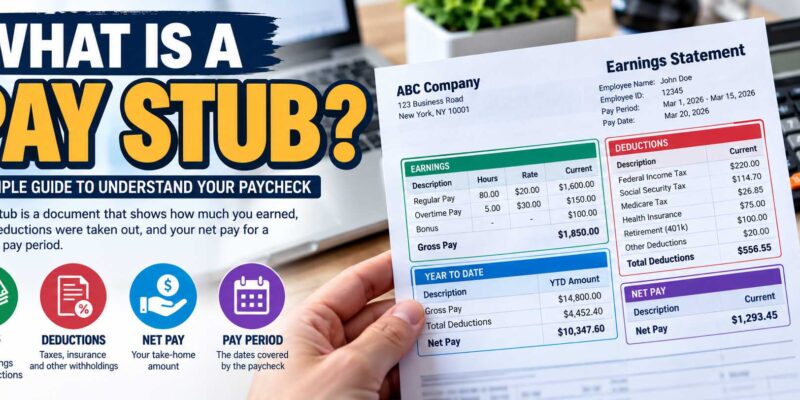
When you receive a paycheck or direct deposit, you may also receive a document showing exactly how your pay was calculated. So, what is pay stub information, and why does it matter? A pay stub is a record that summarizes an employee’s earnings for a specific pay period, along with taxes, deductions, hours or salary information when applicable, and the final amount paid.
You may receive a pay stub on paper or access it electronically through an employer’s payroll system. Either way, it gives you more information than the amount deposited into your bank account.
For employees, pay stubs make it easier to understand where their money went. Meanwhile, employers use payroll records to document compensation and support payroll administration.
Although layouts vary between companies and payroll systems, most pay stubs contain several common sections. Once you understand those sections, the document becomes much easier to read.
What Is a Pay Stub and What Does It Show?
A pay stub, sometimes called a payslip or earnings statement, explains how an employee’s pay was calculated for a particular pay period.
For example, suppose an employee earns $1,500 before deductions. After taxes, insurance premiums, retirement contributions, or other applicable deductions, the employee might receive $1,180.
The pay stub explains the difference between those two numbers.
Therefore, it usually provides much more detail than a paycheck or bank deposit alone.
Typical information may include:
- Employee and employer information
- Pay period dates
- Pay date
- Hours worked when applicable
- Pay rate or salary information
- Gross earnings
- Overtime or other earnings
- Taxes withheld
- Benefit deductions
- Other authorized deductions
- Net pay
- Year-to-date totals
However, the exact information and required disclosures can vary based on the employer, payroll system, type of worker, and applicable laws.
Why Pay Stubs Matter to Employees
At first, a pay stub may look like a collection of payroll codes and numbers. However, it gives employees a useful way to check whether their compensation appears correct.
For instance, an hourly employee can compare the hours shown with the hours they expected to be paid. Likewise, an employee receiving overtime can check whether those earnings appear separately.
Pay stubs can also help workers spot unexpected deductions.
If your net pay suddenly changes, for example, the pay stub can help identify whether the difference came from hours worked, taxes, benefits, a bonus, or another payroll adjustment.
Therefore, learning how to read a pay stub can make it easier to catch questions early rather than noticing a payroll issue weeks later.
Employees may also use pay records when reviewing personal finances or providing income documentation, although the documents accepted for a specific purpose depend on the organization requesting them.
What Important Information Is Available on a Pay Stub?
So, what important information is available on a pay stub? Although formats differ, the document generally separates earnings from deductions and shows how they lead to net pay.
Here is a simple quick-reference guide:
| Pay Stub Section | What It Usually Tells You |
|---|---|
| Pay period | Dates covered by the payment |
| Gross pay | Earnings before deductions |
| Hours worked | Recorded work hours when applicable |
| Pay rate | Hourly rate or other relevant rate information |
| Taxes | Amounts withheld for applicable taxes |
| Benefits | Employee contributions to eligible benefit programs |
| Other deductions | Other authorized payroll deductions |
| Net pay | Amount remaining after deductions |
| Year-to-date | Running totals for the year |
Some pay stubs contain many more lines, especially when an employee receives several types of earnings or deductions.
Therefore, focus first on the major categories before trying to understand every payroll abbreviation.
Gross Pay: Your Earnings Before Deductions
For hourly workers, employers generally calculate regular earnings using the applicable hours and rate. Other earnings, such as overtime, bonuses, commissions, or shift-related payments, may appear separately.
Salaried employees usually receive compensation according to their salary and pay schedule, although adjustments can still occur.
Understanding the difference between salary and hourly compensation can make this section easier to interpret because the method used to calculate earnings differs between the two arrangements.
For example, an hourly employee’s pay may change as recorded hours change. In contrast, a salaried employee may receive a consistent base amount each pay period, subject to the employer’s payroll practices and applicable rules.
How Hours Worked Reach the Pay Stub
For many hourly employees, accurate time records are a major part of payroll processing.
Employers may use paper records, time clocks, mobile applications, or online systems to record working time.
If you have wondered What Is a Timesheet, it is essentially a record used to track an employee’s working time over a particular period. That information can then feed into payroll calculations.
For example, suppose an employee records 40 regular hours during a weekly pay period. The payroll system can use those approved hours and the employee’s pay rate to calculate regular earnings.
However, incorrect time records can affect the resulting pay.
Therefore, employees should follow their employer’s timekeeping procedures and report missing or inaccurate hours through the appropriate process.
Taxes and Withholdings Explained
Gross earnings are rarely the same as the amount an employee takes home.
Depending on the country and jurisdiction, employers may need to withhold applicable income taxes, payroll-related taxes, social insurance contributions, or similar amounts.
In the United States, for example, pay stubs may show federal income tax withholding as well as Social Security and Medicare taxes. State and local withholding may also appear where applicable.
However, payroll tax systems vary widely by location.
Therefore, employees should not assume that every pay stub will contain the same tax categories.
The pay stub usually identifies each withholding separately so employees can see how much was removed during the current pay period. It may also show year-to-date totals.
If a withholding appears incorrect, contact the employer’s payroll or HR team rather than changing assumptions based solely on the take-home amount.
Understanding Payroll Deductions
Taxes are not the only amounts that can reduce gross pay.
Depending on the employer and employee’s circumstances, a pay stub may include deductions for health insurance, retirement contributions, dental or vision plans, or other programs.
Some deductions may be voluntary, while others can arise from legal or administrative requirements.
For example, an employee might choose to contribute part of each paycheck to an employer-sponsored retirement plan.
Because deduction rules vary, the pay stub may use abbreviations that are not immediately obvious.
When that happens, check the employer’s payroll documentation or ask HR or payroll staff what the code means.
Do not ignore a deduction simply because the amount is small. Regularly reviewing deductions can help identify unexpected changes.
Net Pay: The Amount You Actually Receive
Net pay is the amount remaining after applicable taxes and deductions are subtracted from gross earnings.
In simple terms:
Gross Pay − Taxes − Other Deductions = Net Pay
For example, suppose an employee has gross earnings of $2,000.
If $400 goes toward taxes and $150 goes toward other deductions, the employee’s net pay would be $1,450.
That is generally the amount delivered through direct deposit, check, or another payment method.
However, real payroll calculations may contain more categories than this simplified example.
Therefore, use the example to understand the basic relationship rather than as a model for every employee’s payroll.
Extra Earnings Can Appear Separately
Not every employee earns only a basic hourly rate or salary.
Some jobs include commissions, bonuses, overtime, tips, incentives, or premium payments for particular schedules.
For instance, employees working certain evenings, nights, weekends, or less desirable schedules may receive extra compensation under an employer’s policy or agreement.
Understanding what is shift differential can help explain why a pay stub may show a separate earnings line in addition to regular wages.
Suppose an employee receives regular pay for daytime hours but earns an extra amount for an eligible night shift. In that case, the payroll statement may separate those earnings so the calculation is easier to review.
Again, the availability and calculation of these payments depend on the employer and applicable requirements.
What Is a Pay Stub’s Year-to-Date Section?
Another useful part of a pay stub is the year-to-date, or YTD, column.
Current-period figures show what happened during one pay cycle. Meanwhile, year-to-date figures show accumulated amounts since the beginning of the relevant year.
For example, a pay stub might show $2,000 in gross earnings for the current period but $28,000 in year-to-date gross earnings.
The same approach can apply to taxes and certain deductions.
Therefore, YTD information gives employees a broader picture of their earnings and payroll activity.
If a total changes in a way you do not understand, comparing the current and previous pay stubs may reveal which category caused the difference.
Comp Time and Other Time-Based Payroll Information
Some workplaces use policies involving compensatory time, often called comp time.
Because the rules surrounding compensatory time can depend heavily on the workplace and applicable labor laws, employees should understand their employer’s specific policy.
Learning what is comp time can help employees distinguish time-off arrangements from direct wage payments when reviewing workplace compensation.
However, not every employer or employee can use compensatory time in the same way.
Therefore, questions about eligibility, accrual, payment, or usage should be checked against the employer’s policy and applicable employment rules.
A pay stub or related employee portal may display certain balances, although the exact presentation varies by payroll system.
Pay Stub vs Paycheck: What’s the Difference?
People sometimes use “paycheck” and “pay stub” as though they mean the same thing, but they serve different purposes.
A paycheck is the payment itself when an employer pays by check.
A pay stub, on the other hand, explains the calculation behind the payment.
With direct deposit, there may be no physical paycheck at all. However, employees can still receive an electronic pay stub through a payroll portal.
Therefore, think of the payment as the money and the pay stub as the supporting payroll record.
That distinction is especially useful today because many employers use electronic payroll systems rather than printed checks.
How to Check Your Pay Stub for Possible Errors
You do not need to be a payroll expert to perform a basic review.
Start with your name and the pay period. Then, verify your hours and pay rate if those figures apply to your compensation.
Next, compare gross earnings with what you expected.
After that, review taxes and deductions. If you recently changed benefits or other payroll elections, check whether the change appears as expected.
Finally, confirm that the net pay shown matches the payment you received.
A simple review can follow this order:
- Confirm the pay period and pay date.
- Check hours, salary, or other earnings information.
- Review regular and extra earnings.
- Examine taxes and deductions.
- Look at year-to-date figures.
- Confirm net pay.
- Report unexplained differences promptly.
If something appears wrong, save the pay stub and contact the appropriate payroll or HR representative.
Common Pay Stub Mistakes to Watch For
Payroll errors can happen for several reasons.
For example, incorrect time records can produce the wrong earnings. Likewise, an outdated pay rate or missing bonus can change gross pay.
Employees may also notice an unexpected benefit deduction or incorrect personal information.
Therefore, do not check only the final deposit.
Reviewing the individual components gives you a better chance of identifying where a difference started.
At the same time, avoid assuming every unfamiliar number is an error. Payroll systems often use abbreviations, separate current and YTD totals, or display deductions in ways that require explanation.
When unsure, ask before drawing conclusions.
FAQs About Pay Stubs
What is a pay stub?
A pay stub is a document or electronic record that explains an employee’s earnings and deductions for a particular pay period. It commonly includes gross pay, taxes, other deductions, net pay, and year-to-date totals.
Do pay stubs show hours worked?
They may, particularly for hourly employees. However, the exact information shown depends on the payroll system, employment arrangement, and applicable requirements.
What important information is available on a pay stub?
A pay stub commonly provides the pay period, earnings, deductions, taxes, net pay, and year-to-date totals. It may also include hours, rates, employer information, and other payroll details.
Is a pay stub the same as a paycheck?
No. A paycheck is a method of receiving payment, while a pay stub provides details explaining how the employee’s pay was calculated.
Why should employees keep their pay stubs?
Pay stubs can help employees review earnings, deductions, taxes, and payment history. They may also be useful when resolving payroll questions or when income documentation is requested.
Make a Habit of Checking Your Pay Information
Once you understand what is pay stub information, the document becomes much easier to use. Instead of looking only at net pay, check how gross earnings, taxes, deductions, and other compensation produced that final amount.
A quick review after each payday can help you notice missing hours, unexpected deductions, or other changes sooner.
Meanwhile, if a payroll code or calculation does not make sense, ask the employer’s payroll or HR team for clarification. A pay stub is more than a list of numbers; it is a practical record that helps employees understand how their compensation was calculated.