
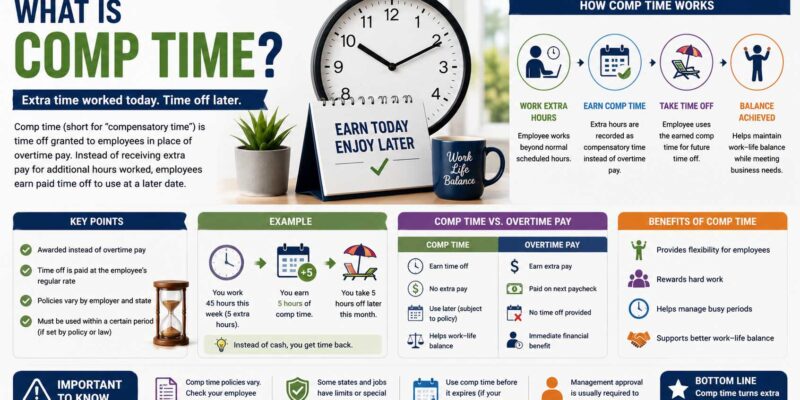
An employee works several extra hours during a busy week and, instead of receiving extra pay, takes time off later. This arrangement raises a common workplace question: what is comp time? Comp time, short for compensatory time off, generally means paid time away from work provided in recognition of extra hours worked. However, whether an employer can legally substitute comp time for overtime pay depends on factors such as the worker’s status, the employer, and applicable labor law.
That distinction matters because comp time is not simply an informal trade of “work late today, leave early tomorrow” in every workplace. In the United States, federal rules under the Fair Labor Standards Act (FLSA) place significant restrictions on compensatory time for covered nonexempt employees, particularly in the private sector.
For employees, understanding the policy helps prevent confusion about pay and time off. Meanwhile, businesses need clear procedures so managers do not accidentally create wage-and-hour problems.
Understanding Compensatory Time at Work
When people ask what is comp time at work, they are usually describing time off earned because an employee worked beyond their normal schedule.
For example, imagine an employee normally works Monday through Friday but stays several extra hours to complete a major project. Under an applicable comp-time arrangement, those extra hours may contribute toward paid time off that the employee can use later.
However, the exact calculation is not always one hour off for every extra hour worked. Under U.S. federal law, eligible state and local government employees who receive compensatory time instead of cash overtime generally accrue it at no less than one and one-half hours for each overtime hour.
Private-sector rules are different. Therefore, employers should not assume that a public-sector arrangement can simply be copied into a private business.
Accurate recordkeeping also matters. Anyone unfamiliar with What Is a Timesheet may find it helpful to understand how employers record working hours, since reliable time records help determine when overtime obligations arise.
What Is Comp Time Off?
So, what is comp time off compared with an ordinary day away from work?
Comp time off is tied to work performed, while many other forms of leave exist for different reasons. For instance, vacation may accrue according to company policy, while sick leave may come from employer policy or applicable law.
Compensatory time is different because it relates to additional working hours and, where legally permitted, serves as time off in place of certain overtime compensation.
Consider a simplified public-sector example. An eligible employee works 42 hours during a workweek in which overtime applies after 40 hours. The two overtime hours could potentially generate three hours of compensatory time because qualifying comp time accrues at one and one-half hours for each overtime hour.
Of course, actual eligibility depends on the applicable rules and circumstances. Therefore, employees should check their employer’s written policy rather than assuming extra hours automatically create a balance.
Comp Time vs Overtime Pay
Comp time and overtime pay can arise from the same basic event: an employee works qualifying overtime hours.
However, the way the employee receives compensation differs.
| Feature | Comp Time | Overtime Pay |
|---|---|---|
| Form of compensation | Paid time off later | Additional wages |
| Trigger | Qualifying extra/overtime work | Qualifying overtime work |
| Availability | Depends heavily on law and employment setting | Required for covered nonexempt workers when overtime rules apply |
| Value | May accrue at an overtime-equivalent rate where required | Generally at least 1.5 times the regular rate under federal overtime rules |
| Main benefit | Future time away from work | Higher current paycheck |
| Recordkeeping | Hours worked and accrued/used comp time | Hours worked and overtime wages |
This is also where understanding the difference between salary and hourly becomes useful. Being paid a salary does not automatically mean an employee is exempt from overtime requirements. Likewise, hourly status does not by itself explain every wage-and-hour rule.
Instead, exemption status generally depends on specific legal requirements involving factors such as job duties and compensation.
Comp Time Rules for Private Companies
This is one of the most important distinctions for U.S. employers.
A private employer generally cannot avoid federal overtime obligations to a covered nonexempt employee simply by replacing required overtime pay with compensatory time off in a later workweek. The U.S. Department of Labor explains that the FLSA’s use of comp time instead of overtime under Section 7(o) applies to qualifying public agencies. For official guidance, employers and employees can review the U.S. Department of Labor’s compensatory time guidance. WEBAPPS
For example, suppose a covered nonexempt private-sector employee works 45 hours in one workweek. The employer generally cannot move those five overtime hours to a future month as time off simply to avoid required overtime compensation.
Federal overtime requirements normally call for overtime compensation at no less than one and one-half times the employee’s regular rate for hours over 40 in a workweek, unless an exemption applies.
Scheduling can sometimes change within the same workweek. For example, an employee might work longer on Monday but fewer hours later in that same workweek and never exceed the applicable overtime threshold. Still, employers must follow applicable federal, state, and local rules.
How Comp Time Works in the Public Sector
Compensatory time has a more clearly defined role for eligible employees of state and local government agencies.
Under the FLSA, qualifying public agencies may provide comp time instead of cash overtime under certain conditions. In general, an agreement or understanding must exist before the employee performs the work, subject to the applicable rules.
Eligible employees generally receive at least 1.5 hours of comp time for every overtime hour.
Accrual limits also apply. Many public employees may accrue up to 240 hours of comp time. However, certain workers in public safety, emergency response, seasonal activities, and specified related categories may have a limit of 480 hours. WEBAPPS
Once an employee reaches the applicable limit, the employer generally must compensate further qualifying overtime with overtime pay rather than additional comp time.
These details show why businesses should never build a policy around the phrase “time off instead of overtime” without first determining which rules apply.
What Is Comp Time for Salaried Employees?
The question what is comp time for salaried employees requires more context because “salaried” and “overtime-exempt” are not interchangeable terms.
Some salaried employees qualify for an exemption from federal overtime requirements. In those workplaces, an employer may voluntarily offer flexible time away after particularly demanding periods, depending on its policies.
For example, a salaried exempt manager who works through a weekend for a product launch might receive a day off later. A company may casually call this comp time, flex time, or recovery time.
However, that company practice differs from statutory compensatory time for eligible public-sector nonexempt workers.
Some salaried workers remain nonexempt and therefore can still have overtime rights. As a result, employers should determine an employee’s legal classification rather than making decisions based solely on whether payroll lists the person as salaried.
There are several benefits of salary from a workplace perspective, such as predictable base pay. However, salary status alone does not settle questions about overtime eligibility.
How It Differs From PTO
Employees sometimes confuse compensatory time with paid time off because both can result in paid hours away from work.
However, they arise differently.
If you’re asking what is PTO, it generally refers to employer-provided paid leave that may cover vacation, personal time, or other approved absences depending on the organization’s policy.
Comp time, by contrast, connects to extra or overtime hours already worked.
For example, an employee might have 80 hours of regular PTO from an employer’s benefits program and a separate comp-time balance earned through an eligible compensatory-time arrangement.
Keeping these balances separate can make payroll records clearer and help employees understand why each type of leave exists.
Benefits of Comp Time for Employees
When employers use it legally and manage it well, compensatory time can offer practical benefits.
More Scheduling Flexibility
Some employees value future time away from work more than immediate additional income.
For instance, a public employee who works overtime during a busy period may appreciate using accrued time later for personal needs.
Recovery After Busy Periods
Extra work can create long or demanding schedules. Therefore, later time away may give employees an opportunity to rest and return with a more sustainable workload.
Choice in Eligible Workplaces
Where regulations permit it, an appropriately designed policy may provide employees with another form of compensation for overtime work.
Still, these advantages do not override wage-and-hour requirements.
Potential Disadvantages and Management Challenges
Compensatory time can become confusing when policies are vague.
Employees may not know when hours qualify, how quickly time accrues, when they can use it, or how the employer handles unused hours.
Managers can also create problems by making informal promises that conflict with payroll rules.
Another challenge involves staffing. If several employees build large balances during a busy period, allowing everyone to use those hours later can make scheduling difficult.
For this reason, businesses need accurate tracking, clear approval procedures, and policies that comply with all applicable requirements.
Creating a Clear Comp-Time Policy
Organizations that can legally offer compensatory time should avoid relying on informal arrangements between individual managers and employees.
A written policy should explain who is eligible, how time accrues, how the organization records balances, and how employees request time off.
The policy should also address applicable accrual limits and explain what happens when an employee reaches them.
Employers should train supervisors as well. A well-written policy offers limited protection if managers routinely tell employees to work unrecorded hours or make unauthorized hour-for-hour arrangements.
Finally, businesses should review state and local requirements in addition to federal rules. Wage-and-hour laws can vary. Therefore, a policy that works in one jurisdiction may not satisfy every requirement elsewhere.
Common Comp-Time Mistakes
One common mistake is assuming that every extra hour creates comp time. An employee’s normal schedule, overtime eligibility, applicable workweek, and employer type all matter.
Another mistake is treating time off as an automatic replacement for overtime pay. For many private-sector nonexempt employees, that approach can conflict with federal wage law.
Employers also sometimes focus too heavily on job titles. Calling someone a “manager” or paying a salary does not automatically make the person exempt.
Poor recordkeeping creates another risk. Employers should accurately record compensable working time rather than asking employees to move hours between weeks on paper.
Employees, meanwhile, should avoid assuming that a manager’s casual promise represents the official company policy. When compensation is involved, checking written rules with HR or payroll can prevent misunderstandings.
Frequently Asked Questions
Is compensatory time the same as overtime?
No. Overtime describes qualifying extra working hours and their required compensation. Comp time, on the other hand, is paid time off that may replace cash overtime in situations where the law permits it.
Is this type of time off paid?
It generally refers to paid time away from work earned through an eligible arrangement. However, the rules governing it depend on the employment situation and applicable law.
Is compensatory time legal?
Yes, compensatory time is legal in certain circumstances. For example, eligible U.S. state and local government employees can receive it under FLSA rules. However, private-sector employers generally cannot use future comp time to replace required overtime pay for covered nonexempt employees.
Does one overtime hour equal one hour off?
Not necessarily. Under federal rules for eligible public-sector employees, qualifying overtime generally earns at least one and one-half hours of compensatory time for each overtime hour. U.S. Department of Labor
Can an employer require an employee to use accrued time?
The answer depends on the employment setting, applicable laws, agreements, and the employer’s policy. Employees with questions about their own situation should review their workplace policy or speak with HR, payroll, a union representative where applicable, or a qualified employment-law professional.
Does unused compensatory time expire?
Rules can vary based on the type of employment, governing law, collective bargaining agreements, and employer policies. Therefore, employees should check the rules that apply to their specific workplace rather than assuming all balances receive the same treatment.
Key Points for Employers and Employees
Understanding what is comp time starts with recognizing that it is more than an informal workplace perk. In appropriate settings, compensatory time gives employees paid time away from work based on extra hours they previously worked. However, U.S. wage-and-hour rules determine when it can substitute for overtime compensation.
For employers, a practical approach is to classify employees correctly, maintain accurate time records, establish clear written policies, and check federal as well as applicable state and local requirements before using compensatory time.
For employees, keep track of the hours you work and understand whether you are exempt or nonexempt. Then, check how your employer defines compensatory time, how it accrues, and when you can use it. When something about your pay or overtime rights seems unclear, HR, payroll, a union representative where applicable, or a qualified employment professional can provide guidance based on your specific situation.