
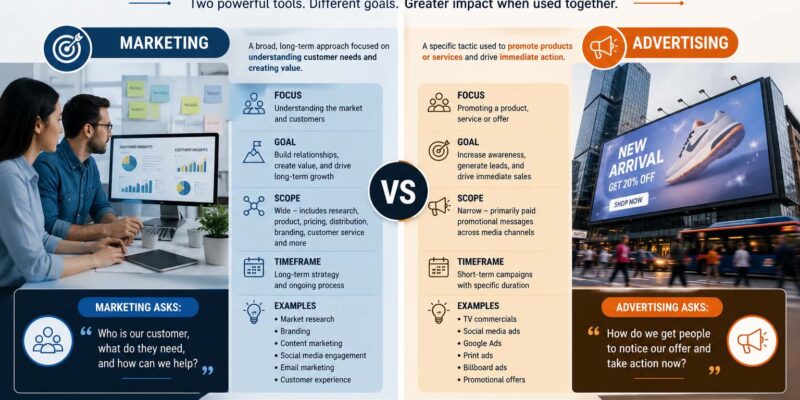
Many people use the terms interchangeably, but the difference between marketing and advertising is much bigger than it first appears. Advertising is only one part of marketing. Marketing is the broader strategy that helps businesses understand customers, build a brand, promote products, and drive long-term growth.
Whether you’re launching a startup, managing a small business, or studying business fundamentals, understanding what is the difference between marketing and advertising will help you make smarter decisions about where to invest your time and budget.
What Is Marketing?
Marketing is the process of identifying customer needs and creating value through products, services, pricing, promotion, and customer relationships.
Rather than focusing only on selling, marketing looks at the entire customer journey—from discovering a problem to becoming a loyal customer.
A complete marketing strategy often includes:
- Market research
- Customer segmentation
- Branding
- Product positioning
- Pricing strategy
- Content marketing
- Social media
- Search engine optimization (SEO)
- Email marketing
- Customer retention
In other words, marketing answers the question:
“How do we attract, satisfy, and keep customers?”
What Is Advertising?
Advertising is one promotional activity within a larger marketing plan.
Its primary goal is to communicate a message that encourages people to take a specific action, such as purchasing a product, visiting a website, or requesting more information.
Advertising channels include:
- Google Ads
- Television commercials
- Social media ads
- Print advertisements
- Billboards
- Radio
- Display advertising
- YouTube ads
Advertising is designed to increase visibility and generate demand, but it works best when supported by a strong marketing strategy.
Difference Between Marketing and Advertising Explained
The easiest way to understand the difference between advertising and marketing is to think of marketing as the overall business strategy and advertising as one of the tools used to achieve that strategy.
Marketing begins long before an advertisement is created.
It starts with questions such as:
- Who is our ideal customer?
- What problems do they have?
- How does our product solve those problems?
- What pricing makes sense?
- Which channels should we use?
Only after answering these questions does advertising become part of the plan.
Marketing vs Advertising Comparison
| Marketing | Advertising |
|---|---|
| Broad business strategy | Promotional activity |
| Covers the full customer journey | Focuses on awareness and sales |
| Includes research, branding, pricing, and customer relationships | Focuses on delivering promotional messages |
| Long-term approach | Often campaign-based |
| Uses many different tactics | Uses paid promotional channels |
This comparison highlights why businesses should never treat advertising as a replacement for marketing.
A Simple Real-World Example
Imagine a company launching a new reusable water bottle.
The marketing team first researches customer preferences, studies competitors, chooses pricing, develops packaging, identifies target audiences, and creates the brand story.
Only after those steps are complete does the advertising team launch:
- Facebook ads
- Google Search campaigns
- Instagram videos
- Display banners
- Sponsored content
The advertisements introduce the product, but the marketing strategy determines why those ads exist, who they target, and what message they deliver.
Why Businesses Need Both
Some new business owners believe advertising alone will generate sales.
In reality, even expensive advertising campaigns struggle when the underlying marketing strategy is weak.
Strong marketing helps businesses:
- Understand customers
- Build trust
- Improve products
- Increase customer loyalty
- Create consistent messaging
Advertising then amplifies those efforts by putting the message in front of the right audience.
Marketing Covers More Than Promotion
Promotion is only one element of marketing.
A traditional marketing framework includes the famous Four Ps:
Product
What are you selling?
The product should solve a real customer problem.
Price
How much should customers pay?
Pricing affects brand perception, profitability, and competitiveness.
Place
Where will customers buy the product?
This could include retail stores, online marketplaces, company websites, or distributors.
Promotion
How will customers learn about it?
Advertising belongs within this category alongside public relations, email marketing, events, influencer partnerships, and content marketing.
Marketing Builds Brands Over Time
One major difference between marketing and advertising is the time horizon.
Advertising campaigns often run for days, weeks, or months.
Marketing, however, is continuous.
Businesses constantly evaluate:
- Customer feedback
- Market trends
- Competitor activity
- Product improvements
- Brand perception
This long-term focus helps companies remain competitive even after individual advertising campaigns end.
Creating a structured plan before launching campaigns is much easier when you begin with a Marketing Strategy Template, which helps organize business goals, target audiences, messaging, and promotional activities.
Advertising Focuses on Immediate Action
Most advertisements encourage a measurable response.
Examples include:
- Buy now
- Start your free trial
- Book a consultation
- Download our app
- Request a quote
Because of this, advertising performance is often measured using metrics such as:
- Click-through rate
- Cost per click
- Conversion rate
- Return on ad spend
- Customer acquisition cost
Marketing also tracks these metrics, but it looks beyond them to evaluate long-term customer relationships and brand growth.
Branding Connects the Two
Branding sits at the intersection of marketing and advertising.
Marketing defines the brand.
Advertising communicates it.
For example, before designing an advertisement, a business needs a consistent brand identity that includes its voice, colors, messaging, and personality. Even something as simple as What Is a Tagline can play an important role in helping customers recognize and remember a brand across multiple advertising campaigns.
Strategy Before Execution
Many businesses spend too much time discussing advertising channels before deciding on their overall business direction.
That often leads to inconsistent messaging and disappointing results.
A better approach is to develop the strategy first, then choose the appropriate promotional tactics.
This is why understanding Strategy vs Tactics is so valuable. Marketing provides the strategic direction, while advertising represents one of the tactical methods used to achieve specific business objectives.
Can a Business Succeed Without Advertising?
Sometimes.
Businesses with strong word-of-mouth referrals, loyal customer communities, or exceptional search engine visibility may spend very little on paid advertising.
However, they are still practicing marketing.
They continue to:
- Understand customer needs.
- Improve products.
- Strengthen branding.
- Build customer relationships.
- Create valuable content.
Advertising may come and go, but marketing remains an ongoing business function that supports sustainable growth.
Advantages of Marketing
Marketing creates the foundation for long-term business success. Rather than focusing only on making the next sale, it helps businesses build lasting relationships with customers.
Some of the biggest advantages include:
- Better understanding of customer needs
- Stronger brand recognition
- Higher customer loyalty
- More consistent business growth
- Improved product development
- Smarter pricing decisions
- Better positioning against competitors
Since marketing looks at the entire customer journey, it helps businesses make informed decisions across every department, not just sales.
Advantages of Advertising
Advertising plays a different but equally valuable role.
A well-planned advertising campaign can:
- Increase brand awareness quickly
- Generate leads
- Drive website traffic
- Promote new products
- Boost seasonal sales
- Reach highly targeted audiences
Modern advertising platforms also provide detailed performance data, allowing businesses to adjust campaigns based on real customer behavior.
Marketing vs Advertising: Which Is More Important?
A common question is, “What’s the difference between marketing and advertising, and which matters more?”
The truth is that one is not better than the other.
Marketing provides the strategy.
Advertising delivers the message.
Without marketing, advertisements may reach the wrong audience or communicate the wrong value.
Without advertising, even an excellent marketing strategy may struggle to gain visibility in competitive markets.
The strongest businesses combine both.
Common Mistakes Businesses Make
Many organizations confuse marketing with advertising. That misunderstanding often leads to wasted budgets and disappointing results.
Here are some of the most common mistakes.
Running Ads Without Research
Some businesses launch paid campaigns before understanding who their ideal customers are.
Without customer research, advertising becomes guesswork instead of a targeted investment.
Focusing Only on Sales
Marketing is about more than immediate revenue.
Companies that only chase short-term sales often overlook customer experience, brand reputation, and long-term loyalty.
Ignoring Brand Consistency
Customers expect the same voice, visual identity, and message across every platform.
Mixed branding can reduce trust and make advertising less effective.
Measuring the Wrong Metrics
Advertising metrics like clicks and impressions are useful, but they don’t tell the whole story.
Marketing also evaluates:
- Customer retention
- Lifetime customer value
- Brand awareness
- Customer satisfaction
- Market share
Looking at both short-term and long-term performance creates a clearer picture of business success.
How Marketing and Advertising Work Together
Instead of thinking of marketing and advertising as separate activities, imagine them as parts of one system.
A simplified process looks like this:
- Research the market.
- Identify the target audience.
- Develop the product or service.
- Create the brand message.
- Choose marketing channels.
- Launch advertising campaigns.
- Measure results.
- Improve future campaigns using customer feedback.
Each step supports the next, creating a continuous cycle of improvement.
Choosing the Right Advertising Channels
The best advertising channel depends on your audience, budget, and business goals.
For example:
- Search ads work well for customers actively looking for solutions.
- Social media advertising helps increase awareness and engagement.
- Video advertising can demonstrate products effectively.
- Email campaigns often support customer retention.
- Print advertising may still be valuable for certain local businesses.
There is no universal solution. Successful businesses choose channels based on customer behavior rather than trends.
Businesses expanding into new markets sometimes work with an Agencia de Marketing Digital to develop localized campaigns, improve online visibility, and adapt advertising strategies for specific audiences.
Real-World Industry Example
Consider two businesses:
Business A spends thousands of dollars on online advertisements without defining its target audience.
Business B first researches customer needs, develops a clear brand identity, creates valuable content, and then launches carefully targeted advertising campaigns.
Although both companies advertise, Business B is much more likely to generate consistent growth because its advertising is supported by a complete marketing strategy.
This example shows what is the difference between advertising and marketing in practice. Marketing guides every business decision, while advertising communicates those decisions to potential customers.
Best Practices for Business Owners
Whether you’re managing a startup or an established company, these practices can improve your results:
- Start with customer research.
- Define clear business goals.
- Build a recognizable brand.
- Create consistent messaging.
- Choose advertising channels based on audience behavior.
- Track meaningful performance metrics.
- Review and improve campaigns regularly.
These habits help businesses avoid reactive decision-making and build sustainable growth over time.
Frequently Asked Questions
Is marketing the same as advertising?
No.
Marketing is the overall strategy for attracting, serving, and retaining customers. Advertising is one promotional tool used within that strategy.
Can advertising exist without marketing?
Technically, yes.
A business can purchase advertisements without developing a complete marketing strategy. However, those campaigns are usually less effective because they lack clear positioning and audience research.
Which comes first: marketing or advertising?
Marketing comes first.
Businesses should understand their customers, goals, products, and messaging before creating advertisements.
Is digital marketing the same as online advertising?
Not exactly.
Digital marketing includes SEO, email marketing, content marketing, social media, analytics, and online advertising. Paid advertising is only one part of digital marketing.
For example, a specialized service like Digital Marketing for Dentists often combines search engine optimization, educational content, reputation management, and paid advertising to help dental practices attract and retain patients.
Why do people confuse marketing and advertising?
Advertising is the most visible part of marketing.
Customers see commercials, social media ads, and billboards every day, while activities like market research, pricing, and customer analysis happen behind the scenes.
Key Takeaways
Understanding the difference between marketing and advertising helps businesses make smarter decisions about growth, branding, and customer engagement.
Marketing is the complete strategy that shapes how a business creates value, reaches its audience, and builds lasting relationships. Advertising is one of the many tools used to share that value with potential customers and encourage action.
The most successful organizations don’t choose between marketing and advertising—they use both together. By building a strong marketing foundation first and supporting it with well-planned advertising campaigns, businesses can attract the right customers, strengthen their brand, and create sustainable long-term growth.