
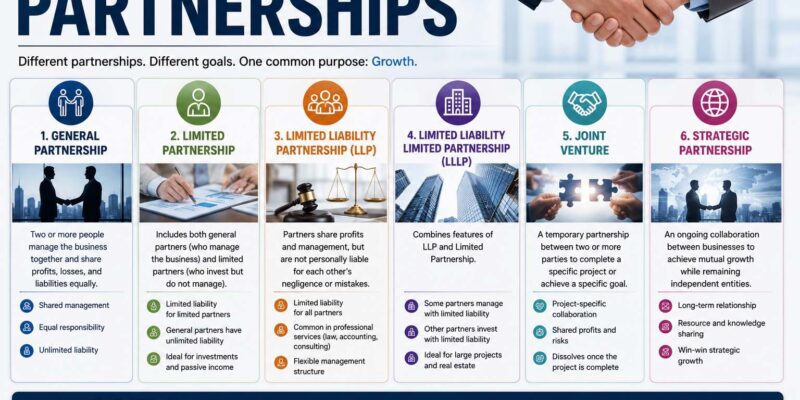
Starting a business with one or more partners can combine skills, experience, and financial resources, but choosing the right partnership structure is one of the first decisions you’ll need to make. Understanding the types of partnerships helps you protect your interests, define responsibilities, and avoid legal or financial surprises later.
Whether you’re launching a small local business, creating a professional practice, or forming a nonprofit collaboration, each partnership model has unique rules, benefits, and risks. This guide explains the most common partnership structures in plain language so you can make a more informed decision.
What Are Partnerships?
A partnership is a business arrangement in which two or more individuals or organizations agree to own and operate a business together. Partners typically share profits, losses, responsibilities, and decision-making according to a partnership agreement.
Unlike corporations, partnerships are generally easier to establish and involve fewer formalities. However, they also require trust, clear communication, and well-defined expectations.
If you’re comparing types of ownership, partnerships are one of several common business structures alongside sole proprietorships, corporations, and limited liability companies (LLCs).
Types of Partnerships Explained
The types of partnerships available depend on your country’s business laws, but several structures are widely recognized.
General Partnership (GP)
A general partnership is the simplest partnership structure.
In this arrangement:
- All partners share ownership.
- Each partner participates in managing the business.
- Every partner is personally responsible for business debts and legal obligations.
Because liability is unlimited, personal assets may be at risk if the business cannot meet its financial obligations.
General partnerships often work well for small businesses where partners actively manage day-to-day operations.
Limited Partnership (LP)
A limited partnership includes two categories of partners:
- General partners
- Limited partners
General partners manage the business and assume unlimited liability.
Limited partners usually contribute capital but have limited involvement in daily management. Their liability is generally restricted to the amount they invest.
Limited Liability Partnership (LLP)
A Limited Liability Partnership provides liability protection for individual partners in many professions.
In an LLP:
- Partners usually participate in management.
- Personal liability is limited in many situations.
- One partner is generally not personally responsible for another partner’s professional negligence.
Law firms, accounting firms, consulting firms, and medical practices commonly choose this model where permitted by law.
Limited Liability Limited Partnership (LLLP)
An LLLP combines elements of both limited partnerships and limited liability protection.
General partners receive liability protection while limited partners maintain limited financial risk.
Comparison of Common Types of Business Partnerships
| Partnership Type | Management | Personal Liability | Best For |
|---|---|---|---|
| General Partnership | All partners | Unlimited | Small businesses |
| Limited Partnership | General partner manages | Limited partner liability is restricted | Investment businesses |
| Limited Liability Partnership | Shared management | Limited in many cases | Professional firms |
| Limited Liability Limited Partnership | General and limited partners | Greater liability protection | Larger investment ventures |
Different Types of Partnerships Beyond Traditional Businesses
Although business partnerships are the most familiar, organizations also create partnerships for specific goals.
Examples include:
- Strategic partnerships
- Joint ventures
- Public-private partnerships
- Educational partnerships
- Research collaborations
- International partnerships
These arrangements may not create a new legal entity, but they allow organizations to share expertise and resources while pursuing common objectives.
Types of Nonprofit Partnerships
The types of nonprofit partnerships often focus on achieving community goals rather than generating profits.
Examples include:
- Charity and corporate partnerships
- Nonprofit collaborations
- Government partnerships
- University partnerships
- Healthcare alliances
- Community organization networks
These partnerships allow nonprofits to increase funding opportunities, expand outreach, and share operational resources while serving their missions more effectively.
Advantages of Business Partnerships
Partnerships offer several practical benefits.
Shared Financial Investment
Starting a business often requires significant capital.
Multiple partners can contribute funds, making it easier to launch or expand operations.
Broader Skill Sets
Partners often bring different strengths.
One partner may specialize in sales while another manages finances or operations.
This combination improves decision-making.
Shared Responsibilities
Running a business involves many daily tasks.
Sharing responsibilities reduces workload and allows partners to focus on their expertise.
Easier Business Formation
Compared with corporations, partnerships generally require less paperwork and fewer ongoing formalities.
If you’re evaluating partnership advantages and disadvantages, these operational benefits are usually among the strongest reasons entrepreneurs choose this structure.
Challenges to Consider
Partnerships also come with potential risks.
Some common challenges include:
- Personal liability in certain structures
- Disagreements between partners
- Unequal workloads
- Profit-sharing conflicts
- Decision-making delays
- Difficult partner exits
Many of these issues can be minimized with a detailed partnership agreement.
Essential Elements of a Partnership Agreement
A written agreement protects everyone involved.
A strong partnership agreement should address:
- Ownership percentages
- Capital contributions
- Profit distribution
- Voting rights
- Management responsibilities
- Dispute resolution
- Partner withdrawal procedures
- Business dissolution process
Although verbal agreements may be legally recognized in some places, written contracts provide much greater clarity.
Name Two Types of Partnerships
People frequently ask, name two types of partnerships.
The simplest answer is:
- General Partnership (GP)
- Limited Partnership (LP)
These are two of the most common partnership structures and form the foundation for many business partnerships around the world.
Choosing the Right Partnership Structure
Selecting among the different types of business partnerships depends on your goals.
Consider these questions before deciding:
- Will every partner manage the business?
- Do some investors only want to provide funding?
- How much personal liability are you comfortable accepting?
- Will you need outside investors later?
- What are the tax implications in your location?
- Does your profession qualify for an LLP?
Speaking with an attorney or accountant can help clarify which structure fits your situation.
Real-World Partnership Examples
Many businesses operate successfully through partnerships.
Examples include:
| Business Type | Common Partnership Structure |
|---|---|
| Law Firm | LLP |
| Accounting Firm | LLP |
| Family Restaurant | General Partnership |
| Real Estate Investment | Limited Partnership |
| Medical Practice | LLP |
| Consulting Agency | General Partnership or LLP |
If you’re looking for additional Partnership Business Examples, reviewing businesses in your local community can help you see how different partnership structures are used in practice.
Partnerships vs. Sole Proprietorships
Entrepreneurs often compare partnerships with sole proprietorships.
| Feature | Partnership | Sole Proprietorship |
|---|---|---|
| Owners | Two or more | One |
| Decision-Making | Shared | Individual |
| Capital | Multiple contributors | Owner-funded |
| Profit Sharing | Shared | Owner keeps profits |
| Liability | Depends on structure | Owner responsible |
Reviewing Sole Proprietorship Examples can make it easier to understand when operating alone may be a better choice than bringing in partners.
Common Mistakes New Partners Make
Many partnership problems begin long before the business opens.
Avoid these common mistakes:
- Starting without a written agreement
- Choosing partners based only on friendship
- Failing to define responsibilities
- Ignoring exit planning
- Overlooking tax obligations
- Not discussing long-term goals
- Assuming profits will always be shared equally
Clear communication early on prevents many future conflicts.
Tax Considerations
Partnership taxation varies by country and business structure.
In many jurisdictions, partnerships themselves do not pay income tax. Instead, profits pass through to the partners, who report their individual shares on personal tax returns.
Business owners sometimes compare partnerships with LLCs because both can offer pass-through taxation under certain circumstances. While researching legal structures, you may also come across What Is a Disregarded Entity, which explains how some single-owner LLCs are treated for tax purposes.
Because tax rules differ by location, professional advice is recommended before choosing a structure.
Best Practices for Successful Partnerships
Strong partnerships usually share several habits.
- Define roles clearly.
- Hold regular business meetings.
- Document important decisions.
- Review financial reports together.
- Update partnership agreements when needed.
- Resolve disagreements early.
- Communicate openly and honestly.
- Plan for future growth.
Successful partnerships are built on transparency just as much as shared ownership.
Frequently Asked Questions
What are the main types of partnerships?
The primary partnership structures are General Partnerships (GP), Limited Partnerships (LP), Limited Liability Partnerships (LLP), and Limited Liability Limited Partnerships (LLLP), depending on local laws.
What are different types of partnerships used in business?
The most common different types of partnerships include general, limited, and limited liability partnerships. Businesses choose among them based on liability protection, management roles, and investment needs.
Which partnership offers the most liability protection?
An LLP or LLLP generally provides more liability protection than a general partnership, although regulations vary by jurisdiction.
Can a partnership have unequal ownership?
Yes. Partners may own different percentages of the business if the partnership agreement specifies those ownership interests.
Is a written partnership agreement required?
Requirements vary by location, but having a written agreement is strongly recommended because it defines expectations and helps prevent disputes.
Key Takeaways Before Forming a Partnership
Choosing the right partnership structure affects ownership, liability, taxes, decision-making, and the future of your business. Rather than selecting the simplest option by default, take time to evaluate your goals, the level of involvement each partner wants, and the amount of financial risk everyone is prepared to accept.
A well-planned partnership begins with honest conversations and a detailed written agreement. When roles, responsibilities, and expectations are clearly defined from the start, partners are better positioned to build a business that can grow while handling challenges with confidence.