
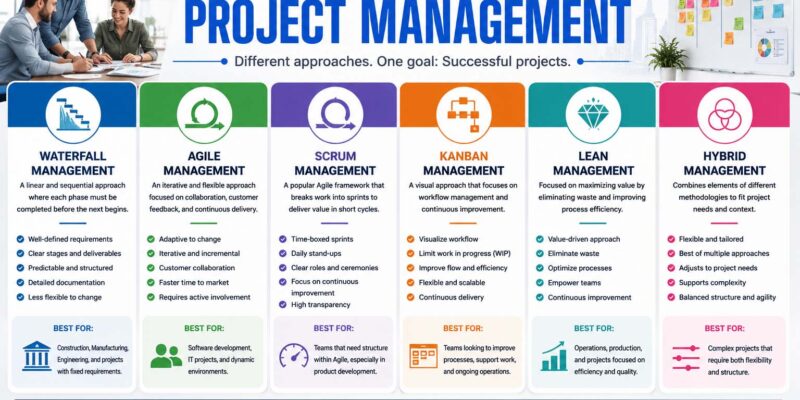
Every project has a goal, but not every project follows the same path. Understanding the types of project management helps businesses choose the right approach for planning, organizing, and delivering successful results. Whether you’re launching a new product, building software, managing a construction project, or coordinating a marketing campaign, selecting the right project management method can improve efficiency, communication, and overall outcomes.
Modern organizations often use several project management styles depending on the size, complexity, and goals of each project. Knowing when each approach works best helps teams reduce delays, manage resources wisely, and adapt to changing priorities.
Types of Project Management at a Glance
The table below highlights some of the most widely used project management approaches.
| Project Management Type | Best For | Flexibility |
|---|---|---|
| Waterfall | Predictable projects | Low |
| Agile | Fast-changing projects | High |
| Scrum | Software development | High |
| Kanban | Continuous workflows | High |
| Lean | Process improvement | Medium |
| PRINCE2 | Large structured projects | Medium |
| Hybrid | Mixed business needs | High |
Each method has strengths and limitations, so the best choice depends on the project rather than following a single system for every situation.
What Are the Types of Project Management?
The phrase types of project management refers to the different frameworks and methodologies businesses use to plan, execute, monitor, and complete projects.
Each approach defines how teams:
- Plan work
- Assign responsibilities
- Manage schedules
- Track progress
- Handle risks
- Deliver final results
Some methods prioritize detailed planning before work begins, while others encourage continuous improvement throughout the project.
Successful project managers understand several approaches and select the one that best fits the project rather than relying on a single method every time.
Waterfall Project Management
Waterfall is one of the oldest and most structured project management methods.
Work moves through a series of clearly defined phases, with each stage completed before the next begins.
Typical phases include:
- Planning
- Requirements
- Design
- Development
- Testing
- Delivery
Because every phase follows a logical sequence, Waterfall works well for projects with stable requirements and limited changes.
Advantages
- Easy to understand
- Clear timelines
- Detailed documentation
- Predictable budgeting
Limitations
- Difficult to adapt after work begins
- Changes may become expensive later in the project
- Less suitable for rapidly changing industries
Businesses that rely on standardized processes often document every project stage through detailed procedures. Creating consistent documentation becomes much easier when teams understand What Is SOP and how standard operating procedures support repeatable workflows.
Agile Project Management
Agile is one of the most popular types of project management methodologies used today.
Instead of completing an entire project at once, Agile breaks work into smaller cycles called iterations or sprints.
Teams regularly gather feedback and make adjustments throughout the project.
This flexibility makes Agile especially valuable when customer needs or market conditions change quickly.
Benefits
- Faster feedback
- Greater flexibility
- Continuous improvement
- Strong customer involvement
Challenges
- Requires active communication
- Scope may evolve frequently
- Less predictable timelines compared with Waterfall
Agile has become common in software development, product design, marketing, and many other industries where priorities shift during execution.
Scrum
Rather than managing an entire project as one large task, Scrum organizes work into short development cycles called sprints.
A typical Scrum team includes:
- Product Owner
- Scrum Master
- Development Team
Daily meetings, sprint planning, reviews, and retrospectives help teams stay aligned while identifying opportunities to improve future work.
Scrum works best when projects require frequent collaboration and ongoing customer feedback.
Kanban
Kanban focuses on visual workflow management.
Tasks move across a board through stages such as:
- To Do
- In Progress
- Review
- Completed
This simple system helps teams identify bottlenecks before they slow down the entire project.
Kanban is especially useful for:
- IT support
- Marketing departments
- Customer service
- Content production
- Operations teams
Many organizations combine Kanban with Agile to create an even more flexible workflow.
Lean Project Management
Lean project management emphasizes maximizing value while minimizing waste.
Instead of asking how teams can work harder, Lean asks how they can work smarter.
Common Lean principles include:
- Eliminating unnecessary work
- Reducing delays
- Improving quality
- Simplifying processes
- Encouraging continuous improvement
Although Lean originated in manufacturing, businesses across many industries now apply its principles to improve efficiency.
PRINCE2
PRINCE2 stands for Projects IN Controlled Environments.
It provides a structured framework with clearly defined roles, responsibilities, documentation requirements, and approval stages.
Large organizations and government agencies frequently use PRINCE2 because it emphasizes governance, accountability, and risk management.
Projects managed under PRINCE2 often include detailed planning before execution begins, making it suitable for complex initiatives involving multiple stakeholders.
Hybrid Project Management
Many businesses don’t follow just one methodology.
Instead, they combine multiple approaches to fit specific projects.
Hybrid project management blends elements from different types of project management, often mixing Waterfall’s planning structure with Agile’s flexibility.
For example:
- Planning may follow Waterfall.
- Development may use Scrum.
- Daily task tracking may rely on Kanban.
This combination allows organizations to balance structure with adaptability.
Choosing Between Different Types of Project Management
No single methodology is perfect for every business.
When selecting among the different types of project management, consider several key questions:
- Are project requirements likely to change?
- How involved will stakeholders be?
- Does the project require strict regulatory compliance?
- How quickly must results be delivered?
- Does the team already have experience with a particular methodology?
Answering these questions often narrows the options considerably.
Project managers also need to distinguish long-term business direction from day-to-day execution. Understanding Strategy vs Tactics helps teams connect project activities with broader organizational goals instead of focusing only on short-term tasks.
Common Factors That Influence Method Selection
Several factors affect which project management method performs best.
Project Size
Small internal projects often benefit from lightweight frameworks such as Kanban.
Large enterprise initiatives usually require more detailed planning and documentation.
Industry Requirements
Construction projects often favor Waterfall because designs and regulations are established early.
Software companies frequently prefer Agile or Scrum because customer requirements evolve throughout development.
Team Experience
Experienced teams may work effectively with highly flexible methods.
Newer teams often perform better with structured frameworks that provide clearer guidance.
Types of Project Management Software
The project management method you choose is only part of the equation. The right software helps teams organize work, communicate effectively, and monitor progress from start to finish.
Common types of project management software include:
- Task management tools
- Agile and Scrum platforms
- Kanban board software
- Enterprise project management systems
- Collaboration and communication tools
- Resource planning software
- Time tracking applications
The best platform depends on your team’s size, workflow, and reporting needs.
Types of Contracts in Project Management
Projects involving external vendors or consultants often require formal agreements. Understanding the common types of contracts in project management helps businesses manage expectations and reduce disputes.
Some of the most common contract types include:
Fixed-Price Contracts
The vendor agrees to complete the project for a predetermined amount.
These contracts work well when project requirements are clearly defined before work begins.
Time and Materials Contracts
Clients pay based on hours worked and materials used.
This option provides greater flexibility when project scope may change over time.
Cost-Reimbursable Contracts
The client reimburses approved project costs and may also pay an agreed-upon fee.
These contracts are often used for complex projects where costs are difficult to estimate in advance.
Selecting the right contract depends on project complexity, budget certainty, and the level of risk both parties are willing to accept.
Essential Documents That Support Every Project
Successful projects rely on more than schedules and deadlines.
Clear documentation keeps teams aligned and reduces misunderstandings throughout the project lifecycle.
For example, many organizations prepare One Pager Examples to summarize project goals, timelines, key stakeholders, and expected outcomes before work begins. A concise overview allows everyone to understand the project’s purpose without reading lengthy documentation.
As projects progress, regular records also become valuable. Learning How to Write Meeting Minutes helps teams capture decisions, assigned tasks, and follow-up actions so important details aren’t forgotten after meetings.
For projects involving hourly work or billable services, understanding What Is a Timesheet can also improve resource tracking and project cost management.
Advantages of Choosing the Right Methodology
Selecting the appropriate project management approach creates benefits that extend beyond completing a single project.
Organizations often experience:
- Better communication
- Improved collaboration
- More accurate scheduling
- Clearer accountability
- Reduced project risk
- Higher customer satisfaction
- More efficient resource allocation
Matching the methodology to the project’s needs allows teams to work more effectively instead of forcing every project into the same framework.
Common Mistakes Businesses Make
Even experienced organizations occasionally choose the wrong project management approach.
Avoiding these common mistakes improves the likelihood of project success.
Using One Method for Every Project
Different projects have different requirements.
A software launch may benefit from Agile, while a building renovation often works better with Waterfall.
Ignoring Team Experience
A methodology is only effective if the team understands how to apply it.
Introducing a complex framework without proper training can create confusion rather than improving efficiency.
Focusing Only on Tools
Software supports project management, but it doesn’t replace good planning, communication, or leadership.
Successful projects combine capable people with appropriate processes and technology.
Poor Communication
Even the best methodology struggles when stakeholders don’t receive regular updates.
Consistent communication keeps expectations realistic and helps identify problems before they grow.
Best Practices for Managing Projects
Regardless of the methodology you choose, several practices consistently improve project outcomes.
- Define project goals before work begins.
- Assign clear roles and responsibilities.
- Create realistic timelines.
- Monitor progress regularly.
- Communicate with stakeholders consistently.
- Manage risks throughout the project.
- Review lessons learned after completion.
- Adjust processes based on experience.
These habits help organizations improve performance across future projects as well.
Real-World Example
Imagine a company developing a new mobile application.
The leadership team uses Waterfall planning to define the budget, timeline, and overall business objectives.
The development team follows Scrum to release new features every two weeks.
Designers manage creative requests through a Kanban board, while project leaders use enterprise software to monitor budgets and resource allocation.
This combination allows different departments to work efficiently while supporting the same business objective.
Frequently Asked Questions
What are the main types of project management?
The most common approaches include Waterfall, Agile, Scrum, Kanban, Lean, PRINCE2, and Hybrid project management.
Which project management method is best?
There isn’t a universal best choice.
The ideal method depends on project complexity, team experience, industry requirements, and how often project requirements are expected to change.
Is Agile better than Waterfall?
Neither method is inherently better.
Agile performs well when flexibility is essential, while Waterfall suits projects with clearly defined requirements and predictable timelines.
Can businesses combine multiple methodologies?
Yes.
Many organizations use Hybrid project management by combining structured planning with flexible execution to meet their specific needs.
Do small businesses need formal project management?
Even small teams benefit from basic project management practices. Clear planning, communication, and progress tracking help prevent delays and improve accountability.
Putting the Right Framework Into Practice
Understanding the different types of project management helps businesses choose a framework that fits their goals rather than forcing every project into the same process. Whether your team prefers the structured planning of Waterfall, the adaptability of Agile, the visual workflow of Kanban, or a Hybrid approach, success depends on selecting a method that matches the project’s scope, timeline, and stakeholders.
Start by evaluating your team’s experience, the complexity of the work, and how much flexibility the project requires. Pair the right methodology with clear communication, practical documentation, and regular progress reviews, and you’ll build a stronger foundation for delivering projects on time and meeting business objectives.