
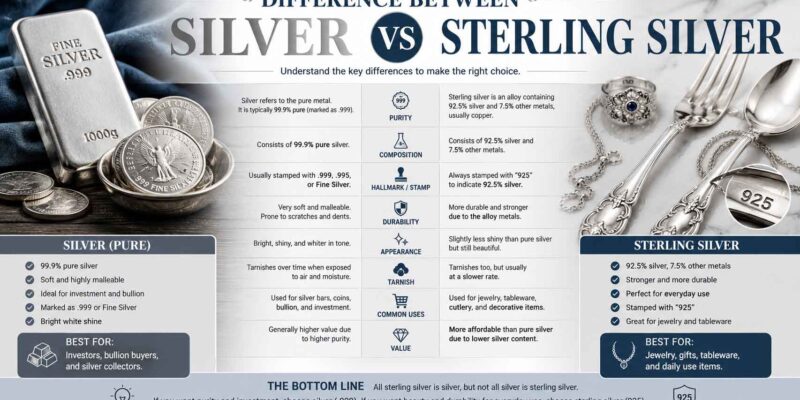
If you sell jewelry, source precious metals, or simply want to make a smarter purchase, understanding the difference between silver and sterling silver is essential. Pure contains about 99.9% , while usually contains 92.5% and 7.5% other metals. That small change in composition has a major effect on strength, price, tarnish, manufacturing, and everyday use.
Pure silver is softer and easier to bend or scratch. , however, is stronger because manufacturers mix with other metals, commonly copper. As a result, is generally more practical for jewelry, flatware, decorative products, and items that need to withstand regular handling.
For businesses, the difference also affects sourcing, product descriptions, pricing, inventory value, and customer expectations.
What Is the Difference Between Silver and Sterling Silver?
The simplest answer to what is the difference between silver and sterling silver comes down to metal purity.
Pure silver, often called fine silver, is typically 99.9% silver.
meanwhile, normally contains 92.5% silver. The remaining 7.5% consists of another metal or combination of metals.
Copper is one of the most common choices because it increases hardness without dramatically changing the appearance.
This difference is necessary because pure silver is relatively soft. Although that softness makes it useful for certain applications, it can be inconvenient for products that face daily wear.
Sterling silver solves that problem by sacrificing a small amount of purity for greater durability.
Silver vs Sterling Silver at a Glance
| Feature | Fine Silver | Sterling Silver |
|---|---|---|
| Typical silver content | 99.9% | 92.5% |
| Common marking | 999 or .999 | 925 or Sterling |
| Hardness | Softer | Harder |
| Scratch resistance | Lower | Better |
| Jewelry use | Less common for everyday pieces | Very common |
| Tarnishing tendency | Generally lower | Often higher |
| Material value per equal weight | Higher silver content | Slightly lower |
| Manufacturing flexibility | Useful for specialized work | Highly practical |
Neither metal is automatically “better.”
Instead, the right choice depends on whether purity, durability, price, appearance, or everyday usability matters most.
Why Pure Silver Is Usually Too Soft for Everyday Jewelry
Fine silver has a beautiful bright appearance, but its softness creates practical limitations.
A pure ring can bend more easily than a ring. Likewise, a bracelet or clasp made from very soft metal may deform repeated wear.
For collectors, bullion buyers, or specialized artisans, that softness may not be a serious problem.
For everyday jewelry businesses, however, durability matters because customers expect rings, necklaces, bracelets, and earrings to survive normal use.
That is why became such a widespread material.
The same principle appears with other precious metals. For example, understanding difference between 10k and 14k gold shows how alloy content can change hardness, purity, color, and price even when both products are legitimately sold as gold.
In both cases, manufacturers balance precious-metal content with the physical properties needed for the finished product.
What’s the Difference Between Silver and Sterling Silver in Value?
When buyers ask what’s the difference between silver and sterling silver in price, purity provides the starting point.
If two pieces weigh exactly the same, fine contains more actual than Therefore, its underlying silver content is higher.
However, retail value is not determined by metal purity alone.
A sterling silver designer necklace can sell for far more than an equivalent weight of fine because customers also pay for craftsmanship, design, gemstones, brand reputation, finishing, labor, packaging, and retail markup.
For businesses, this distinction between raw material value and finished-product value is essential.
Precious-metal markets also change continuously. Therefore, companies that manufacture or sell silver goods may adjust prices when silver costs rise or fall.
A business should never value finished jewelry solely by multiplying its weight by the current metal price.
Why Sterling Silver Uses the 925 Mark
One of the easiest ways to identify is the 925 stamp.
The number means the product contains 925 parts silver per 1,000 parts, or 92.5%.
Common markings can include:
- 925
- .925
- Sterling
- Sterling Silver
- Ster
However, a stamp alone does not prove authenticity.
Counterfeit products can carry false markings, while older or handmade genuine pieces may use different marks.
Therefore, retailers sourcing silver products should combine markings with supplier documentation, testing when appropriate, and reliable quality-control procedures.
Accurate descriptions also protect customer trust. A seller should not advertise -plated merchandise as sterling silver simply because both products have a -colored appearance.
Sterling Silver vs Silver-Plated Products
Silver plating is very different from sterling silver.
A silver-plated item generally consists of another base metal covered with a thin layer of silver.
Because only the exterior contains , its precious-metal content can be far lower than that of a solid product.
The plating can also wear away over time, revealing the underlying metal.
Sterling silver, by comparison, contains throughout the alloy.
This difference matters greatly for retailers because customers may see two visually similar products with very different prices.
Clear product descriptions should therefore identify whether an item is:
- Fine silver
- Silver plated
- Silver filled
- Another silver-colored metal
Transparent labeling reduces returns and helps buyers understand what they are paying for.
Difference Between Sterling Silver and Silver in Durability
The difference between sterling silver and silver becomes especially noticeable when the material is used regularly.
Fine silver is softer. Consequently, it scratches, bends, and dents more easily.
Sterling silver is harder because of its alloy content.
That extra strength makes suitable for products such as rings, chains, clasps, serving pieces, decorative accessories, and other items exposed to frequent handling.
However, is still softer than many industrial metals.
It can scratch, and thin pieces can bend. Therefore, product thickness and construction quality matter alongside metal composition.
Metal thickness is also a major consideration in commercial fabrication. Businesses working with industrial materials often use references such as a Sheet Metal Gauge Chart because material thickness can affect weight, strength, manufacturing processes, and final product performance.
For jewelry, similar thinking applies even though measurements are much smaller.
Why Sterling Silver Tarnishes
Sterling silver can darken over time because the metals in the alloy react with substances in the environment.
Sulfur-containing compounds in the air are a common contributor to tarnish. Humidity, cosmetics, skin products, perspiration, storage conditions, and certain chemicals can also affect appearance.
Pure silver generally resists tarnish better than traditional because it contains less reactive alloy metal.
However, tarnish does not automatically mean a item is fake or damaged.
In many cases, it is simply a surface reaction that can be removed through appropriate cleaning.
Businesses should explain this clearly because shoppers sometimes interpret normal tarnishing as evidence of poor product quality.
Keeping dry, limiting unnecessary chemical exposure, and storing pieces in suitable bags or containers can slow discoloration.
What’s the Difference Between Sterling Silver and Silver for Business Buyers?
For a retailer or manufacturer, what’s the difference between sterling silver and silver involves more than chemical composition.
The decision affects cost, product positioning, customer expectations, and manufacturing.
Fine silver can make sense for bullion, collectible products, specialized crafts, and applications where high purity is a selling point.
works better for much of the jewelry market because it combines significant content with practical durability.
Retailers should therefore choose inventory based on customer intent.
A buyer shopping for an investment-oriented silver bar has different priorities from someone shopping for an engagement accessory, bracelet, or serving set.
Likewise, businesses must consider supplier reliability.
Precious metals carry meaningful material value, so unclear sourcing can expose companies to purity disputes, counterfeit products, inconsistent alloys, and customer complaints.
Understanding Silver as a Business Commodity
Silver is both a precious metal and an industrial material.
Unlike many jewelry-only materials, silver has applications in electronics, electrical contacts, solar technology, specialized manufacturing, chemical processes, investment products, and decorative goods.
That diversity can influence demand.
For businesses comparing precious-metal markets, learning What Is Gold Used For provides a useful parallel because gold also serves jewelry, investment, electronics, manufacturing, and other commercial markets.
Silver, however, often has a stronger connection with industrial demand relative to its market size.
Businesses dealing in silver therefore need to distinguish between spot metal prices and finished-product economics.
A rise in silver prices can increase input costs for jewelry makers, yet the final retail price still depends on labor, design, distribution, overhead, and margins.
Scrap Silver and Metal Recycling
Silver products can retain material value even after they become damaged or unwanted.
Manufacturers, recyclers, jewelers, and precious-metal dealers may collect scrap for refining.
However, the price offered for scrap usually depends on purity, weight, current market conditions, refining costs, and dealer margins.
The same business principles apply across other recyclable metals. For instance, people researching best prices scrap brass shells encounter a market where alloy composition, weight, local demand, contamination, and buyer terms affect the price paid for scrap.
Silver simply carries a higher precious-metal value per unit of weight than many common base metals.
Before selling valuable scrap, businesses should confirm weighing procedures and understand how purity affects settlement.
How Businesses Should Price Sterling Silver Products
Retail pricing should begin with the complete cost of bringing a product to market.
That includes much more than silver.
A jewelry company’s cost may include:
- Raw silver or finished wholesale cost
- Gemstones
- Manufacturing labor
- Design
- Casting or fabrication
- Polishing and finishing
- Quality control
- Packaging
- Shipping
- Insurance
- Import duties where applicable
- Marketing
- Retail overhead
- Payment-processing fees
- Returns
- Profit margin
As a result, two rings of identical weight can have completely different retail prices.
One may be mass-produced with a simple design, while another requires hand finishing, complex stone setting, or premium branding.
Customers benefit when businesses clearly explain these differences instead of suggesting that precious-metal weight alone determines quality.
Common Mistakes When Buying Silver
One common mistake is assuming anything described simply as “” must be solid sterling silver.
Always look for a clear material description.
Another mistake is believing 925 silver is low quality because it is not pure.
In reality, the 92.5% standard exists partly because alloying makes silver far more practical for everyday products.
Buyers can also confuse tarnish with permanent damage.
Tarnish often affects only the surface and can usually be cleaned with methods appropriate for the item.
Finally, don’t judge value solely by weight.
Craftsmanship, condition, design, brand, age, gemstones, collectibility, and market demand can all influence what an item is worth.
Fine Silver vs Sterling Silver: Which Should a Business Sell?
The answer depends on the target customer.
A traditional jewelry retailer will probably find more practical for most inventory because customers want wearable pieces at accessible price points.
A bullion dealer, meanwhile, may focus heavily on fine silver because purity is central to investment products.
Artisan businesses may carry both.
For example, fine may work for selected handmade components, while provides durability in parts exposed to stress.
Rather than choosing one metal for every product, match the material to its intended function.
This approach improves product quality and makes marketing claims easier to justify.
FAQs About Silver and Sterling Silver
Is sterling silver real silver?
Yes. Sterling silver is real . It normally contains 92.5% silver and 7.5% other metals.
Is pure silver worth more than sterling silver?
By equal weight and based only on silver content, fine silver contains more silver and therefore has more underlying precious-metal content. However, a finished product can have a higher retail value because of craftsmanship, brand, design, or gemstones.
Does 925 mean sterling silver?
Generally, 925 indicates a composition of 92.5% silver, which corresponds to sterling silver. However, buyers should still consider seller reliability because markings can be counterfeited.
Does sterling silver turn green?
Sterling silver itself commonly tarnishes darker rather than turning bright green. However, alloy metals, skin chemistry, moisture, cosmetics, or other factors can sometimes cause discoloration on the skin or product.
Is sterling silver better for jewelry than pure silver?
For many everyday jewelry applications, yes. is harder and more resistant to deformation than fine . However, fine silver can still be appropriate for certain designs.
Can sterling silver get wet?
Occasional contact with clean water is not necessarily disastrous, but repeated exposure to moisture, chlorine, salt water, cosmetics, or household chemicals can accelerate tarnishing or affect other components of the jewelry.
Choosing the Right Type of Silver
The difference between silver and sterling silver is straightforward once you understand purity. Fine is about 99.9% silver, while sterling silver generally contains 92.5% silver combined with other metals for greater strength.
For investors and bullion buyers, higher purity may be the priority. For jewelry customers, often provides the better balance of appearance, durability, and cost.
Businesses should look beyond purity alone as well. Supplier reliability, craftsmanship, accurate labeling, manufacturing quality, customer expectations, and market pricing all influence whether a silver product represents good value.
Before buying or selling, check the markings, understand whether the item is solid or plated, and evaluate the complete product rather than relying only on its color. That simple approach makes comparing silver products much easier and helps both businesses and consumers make more informed decisions.