
Walk through a shopping district, office building, warehouse, or parking lot and you will see dozens of signs doing different jobs. Some advertise businesses, while others provide directions, communicate rules, or warn people about hazards. Understanding the types of signs helps business owners choose signage that communicates clearly instead of simply adding more visual clutter.
For businesses, signs can influence visibility, customer experience, safety, and brand recognition. However, signs also appear far beyond commercial settings. Road signs manage traffic, safety signs communicate hazards, and informational signs help people understand where to go.
This guide explains the different types of signs, what they mean, and where each type works best.
What Are the Main Types of Signs?
A sign is a visual communication tool designed to provide information, instructions, identification, warnings, or promotional messages. Although signs vary greatly in appearance, their purpose should always be easy to understand.
For businesses, the most common categories include identification signs, advertising signs, directional signs, informational signs, regulatory signs, safety signs, digital signs, and temporary promotional signs.
Meanwhile, public spaces rely heavily on traffic, regulatory, warning, and wayfinding signage.
Here is a quick overview:
| Sign Type | Main Purpose | Common Example |
|---|---|---|
| Identification | Identify a place | Storefront sign |
| Advertising | Promote something | Promotional banner |
| Directional | Guide people | Entrance arrow |
| Informational | Provide details | Opening-hours sign |
| Safety | Warn of hazards | Wet floor sign |
| Regulatory | Communicate rules | No smoking sign |
| Digital | Display changing content | LED display |
| Road | Control or guide traffic | Speed limit sign |
Although these categories sometimes overlap, knowing the primary purpose makes choosing the right format much easier.
Types of Signs Used by Businesses
Commercial signage often creates one of the first interactions between a company and a potential customer. Therefore, businesses should think about more than appearance when selecting signs.
Identification and Storefront Signs
Identification signage tells customers who you are and where your business is located. Examples include building-mounted lettering, illuminated logo signs, monument signs, and entrance displays.
For instance, a clothing retailer might place its brand name above the entrance so pedestrians can identify the store from across the street. Anyone learning how to start a clothing brand should consider physical signage alongside packaging, online branding, and store design if a retail location is part of the plan.
Good identification signage should remain readable at the distance from which customers normally see it. As a result, letter size, contrast, placement, and lighting all matter.
Promotional and Advertising Signs
Advertising signs encourage people to notice an offer, product, event, or business. Common formats include banners, posters, window graphics, billboards, sidewalk boards, and point-of-sale displays.
Unlike an identification sign, an advertising sign usually asks the viewer to take some kind of action. For example, it might promote a seasonal sale or announce a new service.
The message should stay focused. Too much text forces customers to work harder to understand the promotion, especially when they are walking or driving past it.
This is also where understanding What Is a Tagline can help. A short, memorable phrase can sometimes communicate a brand idea more effectively than several lines of promotional copy.
Directional and Wayfinding Signs
Directional signs help people move through physical spaces without confusion. You commonly see them in hospitals, shopping centers, airports, office complexes, universities, hotels, and large retail stores.
Typical examples include:
“Entrance”
“Exit”
“Customer Parking”
“Restrooms”
“Reception”
“Floor 2”
“Checkout”
Clear wayfinding improves customer experience because visitors spend less time wondering where to go. Consequently, it becomes especially valuable in large or unfamiliar environments.
Businesses should place directional signage near decision points. For example, if a corridor splits into two directions, that location usually needs guidance more than a straight hallway does.
Consistency also helps. Using similar fonts, symbols, colors, and terminology across a property makes the navigation system easier to understand.
Informational Signs for Customers and Employees
Informational signs communicate useful details without necessarily directing movement or promoting a sale.
A restaurant may display its opening hours, while a retail store may explain its return policy near the checkout counter. Similarly, an office might display visitor instructions at reception.
These signs often answer common questions before customers need to ask employees. Therefore, they can reduce confusion while making operations more efficient.
However, businesses should avoid turning informational signs into walls of text. Instead, place the most necessary information first and use headings or symbols when they make the message easier to scan.
Safety and Warning Signs
Safety signs communicate hazards or actions people should avoid. You may see them in factories, construction areas, warehouses, commercial kitchens, laboratories, and even ordinary offices.
Examples include:
- Caution: Wet Floor
- High Voltage
- Emergency Exit
- Protective Equipment Required
- Authorized Personnel Only
- Flammable Materials
Colors and symbols often carry standardized meanings, although exact requirements depend on the country, industry, and applicable regulations.
Therefore, businesses should not design legally required safety signage based only on aesthetics. Instead, they should check relevant workplace, fire, accessibility, building, and occupational safety rules.
A stylish sign is useful only when people can quickly understand its message.
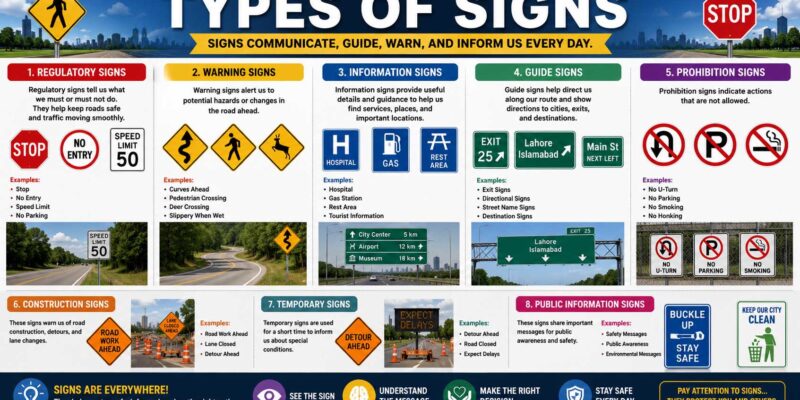
Different Types of Road Signs
Although road signage is not primarily a marketing tool, understanding it helps explain how visual communication works effectively. Drivers often have only seconds to recognize a message, so traffic signage relies heavily on consistent shapes, symbols, colors, and placement.
The main types of road signs generally fall into regulatory, warning, and guide or informational categories, although classifications vary by jurisdiction.
Regulatory Road Signs
Regulatory signs communicate traffic laws and restrictions. Examples can include speed limits, stop signs, parking restrictions, and prohibited turns.
Their effectiveness depends on immediate recognition. Therefore, unnecessary decoration would make them less useful.
Warning Road Signs
Warning signs alert drivers to upcoming conditions or hazards, such as curves, intersections, pedestrian crossings, roadwork, or changes in the roadway.
Because drivers need time to respond, these signs generally appear before the hazard.
Guide and Information Signs
Guide signs help motorists identify destinations, routes, exits, services, and locations.
The different types of road signs demonstrate an idea businesses can also use: visual consistency makes communication faster. When people recognize a format, they can often understand its purpose before reading every word.
Digital Signs and Electronic Displays
Digital signage has become common in retail stores, restaurants, hotels, transportation hubs, offices, and entertainment venues.
Instead of printing a new poster whenever information changes, businesses can update content electronically. Therefore, one screen might show promotions in the morning, product information later, and an event announcement in the evening.
Digital signs work particularly well for frequently changing messages. However, they are not automatically better than printed signage.
Screens usually cost more upfront, require power, and may need software or maintenance. Meanwhile, a simple printed sign can be cheaper and perfectly effective for information that rarely changes.
A business should choose the format according to the communication goal rather than buying technology simply because it looks modern.
Signs as Part of a Marketing Strategy
A sign should rarely exist separately from the rest of a company’s branding. Instead, its wording, typography, imagery, and overall tone should support the brand customers see elsewhere.
That connection becomes clearer when looking at the difference between marketing and advertising. Advertising promotes specific products or messages, while marketing covers the broader process of reaching, serving, and retaining customers. Signage can support both.
For example, a storefront logo strengthens recognition, while a window poster advertising a 20% discount supports a specific promotion.
Businesses planning campaigns can use a Marketing Strategy Template to decide the audience, message, objective, channels, and measurement approach before producing promotional materials. As a result, signage becomes part of a coordinated campaign instead of an isolated design decision.
Temporary Signs and Event Signage
Not every business sign needs to last for years. Temporary signs are useful for events, sales, construction work, openings, pop-up stores, and short-term announcements.
Common options include banners, yard signs, window posters, floor graphics, and portable sidewalk boards.
Because the sign has a short lifespan, businesses can often use less expensive materials. Still, weather resistance matters for anything placed outdoors.
For campaign-specific signage, reviewing Creative Brief Examples can also help teams communicate the required message, audience, dimensions, branding, and call to action before a designer begins the work.
That preparation reduces revisions and helps the final sign match the campaign.
How to Choose the Right Type of Sign
Start by asking what the sign needs to accomplish.
If customers cannot find your business, identification signage may be the priority. However, if customers enter successfully but struggle to navigate the building, directional signage could provide more value.
Next, consider viewing distance. A roadside sign needs larger lettering than a countertop display because people encounter it differently.
Location matters as well. Outdoor signage needs materials suited to sunlight, rain, wind, and temperature changes. Indoor signs usually face fewer environmental challenges, so buyers may have more flexibility.
Then consider whether the message changes frequently. Permanent branding deserves durable materials, while weekly promotions may work better on interchangeable or digital displays.
Finally, check local requirements. Municipal rules can regulate sign dimensions, lighting, placement, permits, and installation. Therefore, confirming local regulations before ordering a large custom sign can prevent expensive mistakes.
Materials Commonly Used for Business Signs
Sign materials affect appearance, durability, weight, installation, and price.
Acrylic offers a clean appearance and works well for many indoor displays. Aluminum is lightweight and resistant to corrosion, so businesses often use it outdoors. Meanwhile, PVC and other plastic materials can provide affordable options for indoor and temporary applications.
Wood can create a warmer or more traditional look, while illuminated channel letters offer high visibility for storefronts.
Vinyl is another flexible option. Businesses use it for windows, walls, vehicles, banners, and temporary promotional graphics.
Prices vary widely depending on size, material, printing method, illumination, installation requirements, customization, retailer, and location. For that reason, businesses should compare quotes based on equivalent specifications rather than price alone.
Common Mistakes Businesses Make With Signs
One frequent mistake is including too much information. People rarely stop to read a long paragraph on a storefront sign or billboard.
Poor contrast creates another problem. Stylish color combinations may look attractive on a computer screen yet become difficult to read from a distance.
Businesses also sometimes choose fonts that prioritize personality over clarity. Decorative typography can support branding, but the main message still needs to remain readable.
Another mistake is poor placement. Even a professionally designed sign provides little value if furniture, trees, parked vehicles, or other displays block it.
Finally, some businesses create every sign independently. Consequently, the storefront, directional displays, promotional banners, and interior signage may look as though they belong to different companies. A consistent visual system usually creates a more professional experience.
What About Other Meanings of “Types of Signs”?
The word “signs” has several meanings, so searchers may occasionally be looking for something outside business signage.
For example, types of zodiac signs refers to the 12 astrological signs commonly grouped by elements such as fire, earth, air, and water. That subject is unrelated to commercial signage.
Similarly, medical “signs” describe observable indications of a condition, while mathematical signs represent operations or relationships.
For business purposes, however, signage usually means visual communication used for identification, navigation, safety, information, regulation, or promotion.
FAQs About Types of Signs
What are the most common types of signs for businesses?
Common options include storefront signs, promotional signs, directional signs, informational signs, safety signs, regulatory signs, temporary signs, and digital displays. The best choice depends on what the business needs to communicate.
What type of sign is best for a storefront?
A clearly readable identification sign is usually the starting point. Depending on the location, businesses may use channel letters, illuminated signs, monument signs, window graphics, or wall-mounted lettering.
Are digital signs better than printed signs?
Not always. Digital displays work well when content changes regularly, while printed signage can be simpler and cheaper for permanent information. The better option depends on the message, location, budget, and update frequency.
What makes a business sign effective?
An effective sign communicates one clear purpose quickly. Strong readability, appropriate sizing, good contrast, sensible placement, and consistent branding usually matter more than complicated design.
How are road signs different from business signs?
Road signs primarily regulate, warn, and guide road users. Business signs may identify locations, promote products, provide directions, communicate information, or support safety. Both depend on quick visual recognition.
Making Signage Work Harder for Your Business
The best signage starts with purpose rather than design. First decide what customers, visitors, or employees need to know. Then choose the format, size, material, placement, and message that communicates that information with the least confusion.
Among all the types of signs, no single option works for every business. A storefront may need strong identification, a warehouse may depend heavily on safety signage, and a large office may benefit most from clear wayfinding.
When every sign has a specific job and fits the surrounding environment, signage becomes more than decoration. It becomes a practical communication system that helps people notice, understand, navigate, and interact with a business.