
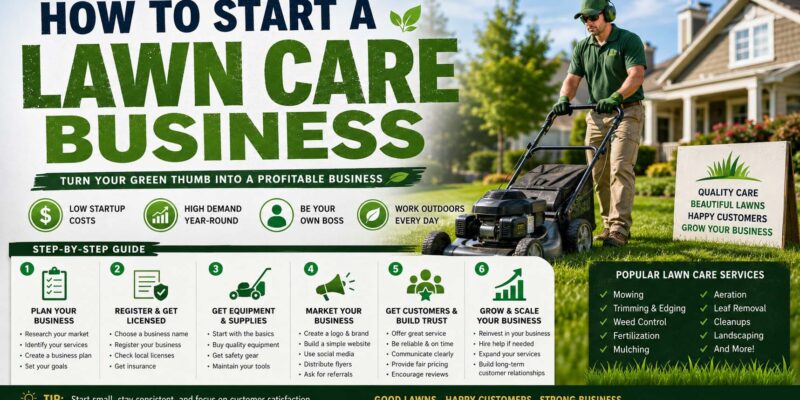
Learning how to start a lawn care business can be a practical way to enter the service industry without needing a large office or expensive inventory. With basic equipment, reliable transportation, good customer service, and a clear plan, you can begin with a few local customers and gradually build a dependable business.
In fact, many lawn care businesses can start on a relatively small scale. Instead of purchasing every possible tool immediately, beginners can focus on essential services such as mowing, edging, and trimming. Then, as revenue grows, they can reinvest in better equipment and additional services.
This guide explains how to start a lawn care business, including market research, a lawn care business plan, legal considerations, equipment, pricing, marketing, management, and long-term growth.
Why Start a Lawn Care Business?
People want attractive, healthy lawns, but many homeowners do not have the time, equipment, or physical ability to maintain them.
Therefore, a lawn care company can solve a recurring problem for homeowners, landlords, property managers, and other customers.
Common services include:
- Lawn mowing
- Weed trimming
- Edging
- Leaf removal
- Seasonal cleanup
- Fertilizing
- Mulching
- Shrub trimming
In addition, many of these services can be offered on a recurring schedule. Weekly or biweekly customers can make revenue more predictable than relying entirely on one-time projects.
How to Start a Lawn Care Business: Quick Checklist
If you are starting a lawn care business, the basic process can be organized into a few manageable steps:
- Research your local market.
- Choose the services you will offer.
- Create a lawn care business plan.
- Choose and register your business structure where required.
- Check licenses, permits, and insurance requirements.
- Purchase essential equipment.
- Calculate your costs and set prices.
- Market your services locally.
- Build recurring customer relationships.
- Track your finances and operations.
- Expand services as demand grows.
Although the exact requirements depend on your location, this checklist provides a practical starting framework.
Research the Local Lawn Care Market
First, learn what is already happening in your local market before investing heavily in equipment.
Ask questions such as:
- How many lawn care companies operate nearby?
- What services do they offer?
- What prices do they charge?
- Which neighborhoods appear to have strong demand?
- Are competitors focused on residential or commercial properties?
- Which services appear underserved?
For example, neighborhoods with many homeowners, rental properties, or busy professionals may provide opportunities for recurring lawn maintenance.
Additionally, competitor research can help you determine how to differentiate your business. You might compete through reliability, convenient scheduling, specialized services, clear communication, or maintenance packages rather than simply offering the lowest price.
Choose Your Lawn Care Services
Next, decide exactly what customers will be able to purchase from you.
Many beginners start with a limited range of services because this keeps equipment requirements and operating complexity manageable.
Basic Lawn Mowing
Lawn mowing is often the foundation of a new lawn service. Furthermore, recurring mowing schedules can help create predictable work.
Edging
Edging creates cleaner borders around sidewalks, driveways, garden beds, and other areas. As a result, it can improve the finished appearance of a maintained lawn.
Weed Trimming
String trimming helps reach areas that a mower cannot easily access. For example, trimming may be needed around fences, trees, walls, and landscaping features.
Leaf and Seasonal Cleanup
Leaf removal and seasonal yard cleanup can provide additional work at different times of the year.
Shrub Trimming
Shrub and hedge trimming can also complement regular lawn maintenance. However, make sure you have suitable tools and understand how to perform the work safely.
As your experience grows, you can expand into landscaping, irrigation, fertilization, or tree care where appropriate and legally permitted. If you later want to offer larger outdoor projects, learning How to Start a Landscaping Business can help you understand additional service opportunities.
How to Start a Lawn Care Business Legally
Another important part of learning how to start a lawn care business is understanding the legal and administrative requirements.
Requirements vary by jurisdiction. Therefore, research the rules that apply where your business will actually operate.
Depending on your location and services, you may need to:
- Choose a business name.
- Select an appropriate business structure.
- Register the business with the relevant government authority.
- Obtain applicable tax identification numbers.
- Open a separate business bank account.
- Obtain required licenses or permits.
- Purchase appropriate business insurance.
- Keep accurate financial and tax records.
In addition, specialized lawn treatments can have extra requirements. For example, applying certain pesticides or regulated products may require specific licensing, certification, or training.
Therefore, check your local and state requirements before advertising specialized services.
Create a Lawn Care Business Plan
A lawn care business plan does not necessarily need to be dozens of pages long. For a small owner-operated service, a simple plan can help organize the most important decisions.
The U.S. Small Business Administration explains that a business plan can guide how a company is structured, operated, and grown, and that entrepreneurs can choose between more detailed traditional plans and lean startup formats depending on their needs. Small Business Administration
For additional guidance, review the U.S. Small Business Administration’s business planning resources.
At minimum, consider including:
- Target customers
- Services offered
- Startup budget
- Monthly revenue goals
- Equipment requirements
- Pricing strategy
- Marketing plan
- Operating expenses
- Growth goals
For example, your plan might initially focus on residential mowing within a small service area. Later, you could add seasonal cleanup, shrub trimming, or other complementary services.
In addition, many new owners use a Marketing Strategy Template to organize how they will attract and retain customers before launching.
How Much Does It Cost to Start a Lawn Care Business?
The amount required to start a lawn care business depends on the equipment you already own, the services you plan to offer, your location, and the scale of the operation.
For example, someone who already owns a suitable vehicle and basic mower may need much less startup capital than someone purchasing commercial equipment from the beginning.
Common startup expenses may include:
| Item | Example Cost Range |
|---|---|
| Lawn mower | $300–$2,000+ |
| String trimmer | $100–$300 |
| Leaf blower | $100–$400 |
| Hand tools | $50–$200 |
| Safety gear | $50–$150 |
| Fuel and maintenance | $100–$300 |
| Business registration | Varies |
| Insurance | Varies |
These figures are only rough planning estimates rather than guaranteed market prices. Therefore, check current prices and local fees before creating your actual startup budget.
Most importantly, avoid buying equipment simply because you may need it someday. Instead, prioritize tools required for the services you can realistically sell now.
Essential Lawn Care Equipment
Reliable equipment can save time and help you deliver consistent service.
Initially, basic equipment might include:
- Push mower or riding mower
- String trimmer
- Leaf blower
- Rake
- Shovel
- Hedge trimmer
- Fuel containers
- Safety glasses
- Hearing protection
- Work gloves
However, your exact equipment list should match your services. If you only offer mowing and trimming at first, you may not need specialized landscaping equipment.
As your customer list expands, upgrading selected tools to commercial-grade equipment may improve efficiency. Some entrepreneurs also diversify into other property services by learning How to Start a Cleaning Business.
How to Start a Lawn Care Business With No Money
Many people searching for how to start a lawn service business also want to know whether it can be started with little or no money.
In practice, completely eliminating startup expenses can be difficult because equipment, fuel, transportation, registration, insurance, and maintenance may cost money.
However, you can reduce the initial investment.
For example, you could:
- Use equipment you already own.
- Borrow suitable equipment where practical.
- Purchase used tools instead of new ones.
- Start with mowing and trimming only.
- Serve a small local area to reduce travel.
- Reinvest early profits into equipment.
- Use free or inexpensive local marketing methods.
Additionally, growing gradually can reduce financial pressure. Instead of purchasing a full commercial setup immediately, add equipment when customer demand justifies the expense.
Set Competitive Lawn Care Prices
Once you understand your expenses, determine what you need to charge.
Pricing too low can make the business difficult to sustain. On the other hand, pricing too high without providing corresponding value can make customer acquisition harder.
Consider factors such as:
- Lawn size
- Time required
- Labor
- Fuel
- Equipment wear
- Grass height
- Property condition
- Travel distance
- Disposal costs
- Desired profit margin
For example, a small regularly maintained lawn may require less time than an overgrown property of similar size.
In addition, weekly or biweekly maintenance packages can make scheduling and revenue more predictable.
Avoid competing solely on price. Instead, reliable scheduling, clear communication, professional work, and consistent results can help distinguish your business.
How to Find Your First Lawn Care Customers
After setting up your services and pricing, the next challenge is finding customers.
Fortunately, local lawn care marketing does not always require a large advertising budget.
Door Hangers and Flyers
First, focus marketing on neighborhoods you can serve efficiently. This reduces travel while helping you build a concentrated customer base.
Customer Referrals
Next, ask satisfied customers to recommend your service to neighbors, friends, and family.
Google Business Profile
A properly maintained business profile can help eligible local businesses appear when nearby customers search for lawn care services.
Social Media
For example, before-and-after photos can demonstrate the visible results of your work.
Local Community Groups
In addition, neighborhood groups can help residents discover local service providers. Follow each group’s promotional rules before posting.
Vehicle Signage
Finally, simple professional signage can increase local awareness while you travel between jobs.
How to Manage a Lawn Care Business
Knowing how to manage a lawn care business becomes increasingly important as your customer list grows.
Running the company involves much more than mowing grass. Therefore, create simple systems before your schedule becomes difficult to manage.
Track:
- Customer contact information
- Appointments
- Income
- Expenses
- Fuel costs
- Equipment maintenance
- Invoices
- Payments
- Taxes and financial records
- Recurring service schedules
For example, a spreadsheet may be sufficient when you have only a few customers. However, scheduling or field-service software may become more useful as the operation expands.
In addition, separate business and personal finances where appropriate. Clear financial records make it easier to understand whether your pricing and services are actually profitable.
How to Start a Small Lawn Care Business
If you want to begin small, you do not need to serve an entire city immediately.
Instead, consider starting with:
- One neighborhood
- A small service radius
- Weekend customers
- Friends and family
- A limited number of recurring clients
As a result, you can learn how long jobs actually take, how much fuel you use, which equipment needs frequent maintenance, and what customers expect.
Then, use that information to improve your pricing and operating procedures before expanding.
Create an Efficient Lawn Care Schedule
Scheduling can directly affect profitability because excessive driving wastes both time and fuel.
Therefore, try to group customers geographically when possible.
For example, you might schedule several properties in the same neighborhood on one day rather than repeatedly driving across town.
Additionally, allow some flexibility for weather delays, equipment problems, or unusually demanding jobs.
As your schedule fills, keep track of actual job duration rather than relying only on estimates. Consequently, future scheduling and pricing decisions can become more accurate.
Common Lawn Care Business Mistakes
New owners can avoid unnecessary problems by recognizing common mistakes early.
Underpricing Services
First, calculate more than just the time spent mowing. Fuel, travel, maintenance, insurance, administrative work, and equipment replacement can also affect profitability.
Ignoring Equipment Maintenance
Second, maintain your equipment consistently. A breakdown during a busy period can disrupt multiple customer appointments.
Poor Communication
In addition, tell customers when schedules change because of weather or other unavoidable problems.
Taking Too Many Customers Too Quickly
Growth is useful only when you can continue delivering reliable service. Therefore, avoid adding more work than your current equipment, schedule, or team can handle.
Mixing Personal and Business Finances
Where appropriate, keep clear business financial records instead of mixing every transaction together.
Ignoring Reviews and Referrals
Finally, satisfied customers can become a valuable source of future business. Ask for feedback and referrals when appropriate.
How to Grow a Lawn Care Business
Once your core operation is stable, you can focus on how to grow a lawn care business without sacrificing service quality.
First, consider increasing revenue from existing customers by offering complementary services such as:
- Fertilization
- Mulching
- Aeration
- Seasonal cleanup
- Gutter cleaning
- Landscape maintenance
- Garden cleanup
- Snow removal in suitable climates
However, only add services that you can perform safely, legally, and profitably.
Next, examine your existing service area. If customers are spread across a large geographic area, adding more clients nearby may improve route efficiency more than expanding into distant neighborhoods.
In addition, track which services generate the strongest margins and repeat demand. This information can help guide future investments.
Should You Hire Employees?
Eventually, a full schedule may create a choice between remaining a solo operator and building a team.
Before hiring, ask:
- Is customer demand consistent?
- Can the business support payroll and related costs?
- Is enough equipment available?
- Can new workers be trained properly?
- Are appropriate employment requirements understood?
- Will hiring actually increase profitable capacity?
Therefore, do not hire simply because the business feels busy. Instead, consider whether additional labor supports a sustainable operating plan.
Build Long-Term Customer Relationships
Lawn care is often a recurring service. As a result, customer retention can be particularly valuable.
Simple retention practices include:
- Sending appointment reminders
- Arriving when promised
- Communicating schedule changes
- Offering recurring maintenance plans
- Providing consistent service
- Following up after larger projects
- Thanking customers for referrals
In addition, learn individual customer preferences. Small details, such as remembering access instructions or preferred service days, can make recurring service easier for both parties.
Over time, a base of recurring customers can provide greater stability than constantly replacing one-time jobs.
Advantages and Challenges of Starting a Lawn Care Business
Like any business, lawn care has both potential advantages and practical challenges.
| Advantages | Challenges |
|---|---|
| Relatively accessible startup | Weather can affect scheduling |
| Potential recurring customers | Physically demanding work |
| Flexible scheduling | Equipment requires maintenance |
| Can start on a small scale | Seasonal demand in some locations |
| Opportunity to expand services | Fuel and repair expenses |
| Local customer base | Route efficiency matters |
Therefore, consider both sides before investing heavily. Understanding the challenges early makes it easier to plan equipment, pricing, scheduling, and cash flow.
Frequently Asked Questions
Is Starting a Lawn Care Business Difficult?
Starting on a small scale can be relatively straightforward, but building a dependable business requires more than lawn maintenance skills. For example, you also need to manage pricing, scheduling, customer communication, equipment, finances, and marketing.
Do I Need Experience to Start a Lawn Care Business?
Not necessarily. Basic lawn maintenance skills may be enough for simple services. However, you should know how to use your equipment safely and perform each advertised service competently.
How Much Can a Lawn Care Business Earn?
Income varies considerably depending on location, pricing, operating expenses, customer volume, seasonality, and the services offered. Therefore, create projections based on your own market and costs rather than assuming a particular income level.
Do I Need Insurance?
Insurance requirements vary by jurisdiction and business circumstances. However, many business owners consider coverage such as general liability insurance because lawn work can involve property damage and injury risks. Check the requirements and appropriate coverage for your operation.
Can I Start a Lawn Care Business Part-Time?
Yes. For example, some owners begin with evening or weekend customers while building demand. However, make sure you can provide reliable service at the times promised to customers.
What Equipment Should I Buy First?
Start with equipment required for the services you actually intend to sell. For a basic mowing service, this could include a reliable mower, string trimmer, blower, fuel containers, and appropriate safety equipment.
How Do I Get Repeat Lawn Care Customers?
First, provide reliable service. Then, communicate clearly, arrive as scheduled, and make recurring service convenient. In addition, weekly or biweekly maintenance options may encourage longer-term customer relationships.
How Do I Run a Successful Lawn Care Business?
Focus on consistent service, sensible pricing, route efficiency, financial recordkeeping, customer retention, and equipment maintenance. Furthermore, monitor which services and customers are most profitable so that future growth decisions are based on actual business performance.
Your Next Steps
Learning how to start a lawn care business is only the beginning. First, research your local market and decide which services you can provide effectively. Next, create a simple business plan, understand local requirements, calculate startup costs, and purchase only the equipment you genuinely need.
After launching, focus on reliability, customer communication, accurate financial records, and efficient scheduling. Then, as recurring demand grows, reinvest carefully in better equipment, additional services, or staff.
Ultimately, a lawn care business can start small and develop gradually. By combining practical planning with dependable service and disciplined management, you can create a stronger foundation for sustainable growth.