
Whether you’re launching a startup or managing an established company, there may come a point when outside expertise becomes valuable. That’s where the different types of consulting come in. Consultants help businesses solve problems, improve performance, develop strategies, and navigate complex decisions without becoming permanent employees.
From management and technology to finance and healthcare, consulting covers a wide range of specialties. Understanding these services makes it easier to hire the right expert and get the best return on your investment.
What Are the Main Types of Consulting?
Consulting is a professional service where experts provide advice, analysis, and recommendations to help organizations achieve specific business goals.
Although every consultant has a unique approach, most specialize in one or more industries or business functions.
The most common types include:
- Management consulting
- Strategy consulting
- IT consulting
- Marketing consulting
- Human resources consulting
- Financial consulting
- Operations consulting
- Sales consulting
- Healthcare consulting
- Legal consulting
- Environmental consulting
- Supply chain consulting
Each specialty addresses different business challenges.
Types of Consulting for Business Growth
The best consulting service depends on what your business needs to accomplish.
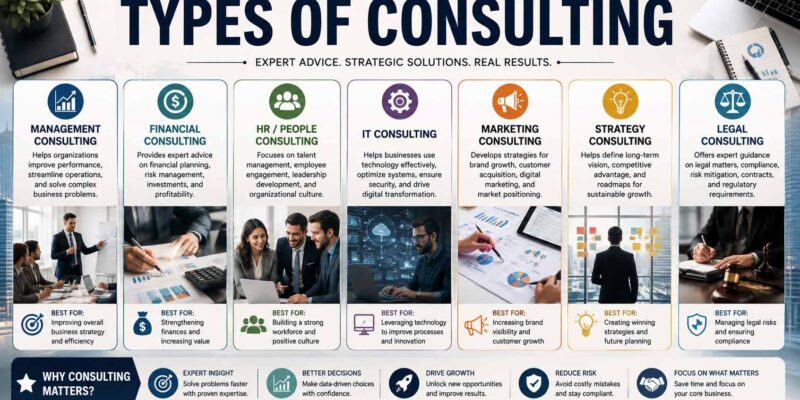
Management Consulting
Management consultants help organizations improve overall performance.
Typical projects include:
- Improving efficiency
- Organizational restructuring
- Cost reduction
- Process improvement
- Business transformation
These consultants often work with executives to identify problems and implement practical solutions across multiple departments.
Strategy Consulting
Strategy consultants focus on long-term planning.
Their work often includes:
- Market expansion
- Competitive positioning
- Business growth plans
- Corporate restructuring
- New product strategies
Business leaders frequently compare Strategy vs Tactics when developing growth plans, and strategy consultants help organizations focus on long-term direction before deciding on short-term execution.
IT Consulting
Technology consultants help businesses choose, implement, and manage technology solutions.
Projects may involve:
- Cloud migration
- Cybersecurity
- Software selection
- Network improvements
- Artificial intelligence
- Data management
Many companies also invest in Digital Transformation Consulting when modernizing legacy systems, improving customer experiences, or adopting new digital technologies across the organization.
Marketing and Sales Consulting
Growing revenue often requires specialized expertise.
Marketing Consulting
Marketing consultants assist with:
- Brand positioning
- Market research
- Campaign planning
- Customer acquisition
- Content strategy
- Digital marketing
A strong consultant also understands the difference between marketing and advertising, since marketing covers the overall strategy while advertising focuses on promoting products or services through paid channels.
Sales Consulting
Sales consultants improve how businesses generate revenue.
Common responsibilities include:
- Sales training
- Lead generation
- Sales process improvement
- CRM optimization
- Performance measurement
Many organizations hire sales consultants when growth has slowed or conversion rates have declined.
Human Resources Consulting
HR consultants help companies manage their workforce more effectively.
Typical services include:
- Recruitment
- Employee policies
- Compensation planning
- Compliance
- Performance management
- Leadership development
Small businesses often use HR consultants instead of hiring a full in-house HR department.
Financial Consulting
Financial consultants help organizations improve financial performance and make informed business decisions by providing expert guidance on budgeting, forecasting, risk management, investments, and long-term financial planning.
Their work may include:
- Budget planning
- Cash flow management
- Investment analysis
- Financial forecasting
- Risk management
- Business valuation
Financial consulting is especially valuable during periods of rapid growth or economic uncertainty.
Operations Consulting
Operations consultants improve how businesses function on a day-to-day basis.
Projects often focus on:
- Workflow optimization
- Manufacturing efficiency
- Supply chain improvements
- Inventory management
- Cost reduction
Many recommendations require structured implementation plans. That’s why understanding different types of project management helps organizations successfully execute operational improvements after the consulting engagement begins.
Types of Healthcare Consulting
Among the fastest-growing specialties are types of healthcare consulting, which support hospitals, clinics, insurance providers, and healthcare technology companies.
Healthcare consultants may specialize in:
- Regulatory compliance
- Revenue cycle management
- Electronic health records
- Operational efficiency
- Patient experience
- Healthcare strategy
- Medical technology implementation
Because healthcare regulations frequently change, organizations often seek outside expertise to maintain compliance and improve operational performance.
Other Specialized Types of Consulting Services
Beyond the most common fields, consultants serve highly specialized industries.
Examples include:
Environmental Consulting
Environmental consultants advise organizations on:
- Sustainability
- Environmental regulations
- Waste management
- Energy efficiency
Legal Consulting
Legal consultants assist businesses with regulatory issues, contracts, and compliance while working alongside attorneys when appropriate.
Supply Chain Consulting
Supply chain consultants help companies improve:
- Procurement
- Warehousing
- Distribution
- Logistics
- Inventory control
Risk Consulting
Risk consultants identify potential threats to business operations and develop strategies to reduce financial, operational, and compliance risks.
Types of Consulting Firms
Businesses also differ in the way consulting firms are structured.
Common types of consulting firms include:
Large Global Firms
These firms typically serve multinational corporations and government organizations.
Advantages include:
- Broad expertise
- Global resources
- Large consulting teams
- Industry specialization
Boutique Consulting Firms
Boutique firms focus on specific industries or business functions.
They often provide:
- Personalized service
- Specialized knowledge
- Greater flexibility
- Direct access to senior consultants
Independent Consultants
Independent consultants usually work alone or with small teams.
They are often ideal for:
- Small businesses
- Startups
- Short-term projects
- Limited budgets
How Consulting Projects Usually Work
Although every engagement is different, most consulting projects follow a similar process.
Step 1: Discovery
The consultant learns about the business through interviews, data analysis, and meetings.
Step 2: Assessment
Current challenges, opportunities, and performance gaps are identified.
Step 3: Recommendations
The consultant presents findings and suggests practical solutions.
Step 4: Implementation
Some consultants help execute recommendations, while others provide guidance for internal teams.
Step 5: Evaluation
Results are measured against the original business objectives to determine success.
How to Choose the Right Consulting Service
Before hiring a consultant, clarify exactly what you want to achieve.
Ask yourself:
- What problem needs solving?
- Do we need strategic advice or hands-on implementation?
- What is our budget?
- What expertise is missing internally?
- How will success be measured?
Answering these questions makes it much easier to select the right consultant.
Questions to Ask Before Hiring a Consultant
Not every consultant is the right fit for every business, so it’s important to choose one whose expertise, experience, and approach align with your organization’s goals, industry, and specific challenges.
Consider asking:
- What industries do you specialize in?
- Can you share relevant case studies?
- How do you measure project success?
- Who will work on the project?
- What deliverables should we expect?
- What is the estimated timeline?
Clear expectations help prevent misunderstandings later.
Benefits of Hiring Consultants
Businesses often bring in consultants because they provide:
- Specialized expertise
- Objective perspectives
- Faster problem-solving
- Industry best practices
- Temporary support without permanent hiring
- Experience across multiple organizations
Outside professionals can often identify opportunities that internal teams overlook because they’re closely involved in daily operations.
Common Mistakes Businesses Make
Companies don’t always get the most value from consulting engagements.
Common mistakes include:
- Hiring before defining objectives
- Choosing based only on price
- Ignoring implementation planning
- Failing to involve key stakeholders
- Expecting immediate results
- Not measuring project outcomes
A successful consulting project requires collaboration from both the consultant and the client.
Leadership and Consulting
Consultants frequently work with senior executives during periods of growth or organizational change.
For example, a Chief Strategy Officer may partner with strategy consultants to evaluate expansion opportunities, assess competitive risks, or develop long-term corporate initiatives. Internal leadership provides business knowledge, while consultants contribute specialized expertise and an outside perspective.
Frequently Asked Questions
What are the main types of consulting?
The most common consulting specialties include management, strategy, IT, marketing, financial, operations, HR, healthcare, sales, legal, and environmental consulting.
Which consulting field is most in demand?
Demand varies by industry and economic conditions. Technology, digital transformation, cybersecurity, healthcare, and management consulting remain among the fastest-growing areas.
What’s the difference between consulting and coaching?
Consultants typically analyze problems and recommend solutions, while coaches focus on developing individual skills and long-term professional growth.
Are consultants hired for short-term projects?
Yes. Many consulting engagements last a few weeks or months, although larger transformation projects may continue for a year or longer.
Can small businesses benefit from consultants?
Absolutely. Small businesses often hire consultants for specialized expertise they don’t need on a full-time basis, such as marketing strategy, financial planning, or technology implementation.
Making the Most of Consulting Expertise
The wide variety of consulting specialties means there’s likely an expert for almost any business challenge. Whether your goal is improving operations, adopting new technology, expanding into new markets, or strengthening leadership, choosing the right consultant starts with understanding your organization’s needs.
Define clear objectives, evaluate experience carefully, and look for consultants who have solved similar problems before. With the right partnership, consulting can provide practical insights, accelerate decision-making, and support sustainable business growth.