
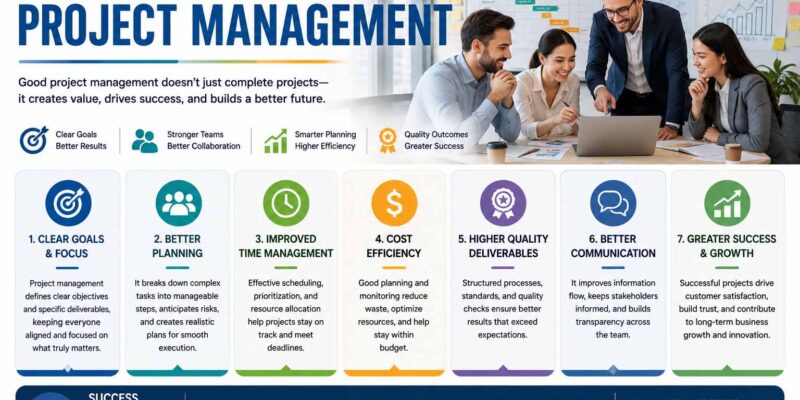
Projects can become complicated surprisingly fast. A simple goal may involve several employees, changing deadlines, limited budgets, outside suppliers, and dozens of tasks that depend on one another. The benefits of project management come from bringing structure to that complexity so teams know what needs to happen, who owns each task, and when the work should be completed.
Good project management isn’t simply about making schedules. Instead, it connects goals, people, budgets, resources, risks, and communication within one organized process. As a result, businesses can make better decisions while giving employees a clearer path from an idea to a finished result.
Whether a company is launching a product, developing software, opening a new location, or running a marketing campaign, the same basic principle applies: organized projects are usually easier to control than improvised ones.
What Is Project Management?
Project management is the process of planning, organizing, executing, monitoring, and completing a temporary piece of work with a defined goal.
For example, imagine a retailer wants to launch an online store. The project may involve web developers, designers, marketers, finance employees, product managers, and outside vendors. Without coordination, one delayed task could affect several other teams.
A project manager helps connect those moving parts. Typically, the process defines the project’s scope, schedule, responsibilities, resources, costs, risks, and expected results.
However, companies don’t all manage projects in exactly the same way. Understanding the types of project management can help a business decide whether approaches such as Agile, Waterfall, Scrum, or hybrid project management better match its work.
The Main Benefits of Project Management
The value of project management becomes easiest to understand when you look at everyday business problems. Teams often struggle because priorities aren’t clear, responsibilities overlap, deadlines move, or problems are discovered too late.
A structured project process addresses many of those issues before they become expensive.
1. Clearer Goals and Priorities
First, project management turns broad ideas into specific outcomes.
“Improve customer service,” for instance, is a business objective rather than a well-defined project. A project plan could turn that goal into measurable work, such as introducing a new support platform within four months and training the customer service team before launch.
Consequently, employees have a clearer definition of success.
This distinction also connects closely with Strategy vs Tactics. Strategy establishes where the organization wants to go, while project planning helps translate that direction into practical actions, milestones, and responsibilities.
2. Better Control of Deadlines
Projects often contain dependent tasks. A designer may need approved specifications before creating a prototype, while manufacturing may need the prototype before production can begin.
Therefore, project managers map dependencies and establish realistic schedules.
They can also identify tasks that threaten the completion date and respond before a small delay affects the whole project.
Lead time matters here as well. Anyone asking What Is Lead Time is essentially looking at how long it takes for an activity or process to move from initiation to completion. Tracking it can help teams create more realistic schedules and spot recurring delays.
3. Smarter Use of People and Resources
Employees have limited time, while companies have limited money, equipment, and specialist expertise. Project management helps businesses allocate those resources deliberately.
For example, assigning one developer to five urgent projects at once may look efficient on paper. In reality, that employee can become a bottleneck.
Resource planning makes these conflicts visible. Managers can then adjust priorities, redistribute tasks, hire outside help, or move deadlines.
As a result, teams are less likely to discover resource shortages halfway through critical work.
Better Budget and Cost Management
Another major benefit of project management is financial visibility.
A project budget can include employee hours, materials, software, contractors, equipment, travel, and contingency funds. Once managers establish a baseline, they can compare planned spending against actual spending throughout the project.
That comparison provides an early warning system.
Suppose a project has used 70% of its budget while completing only 45% of the planned work. Managers can investigate the gap instead of discovering the overrun after the money is gone.
Time tracking can support this analysis because labor is often a significant project expense. Understanding What Is a Timesheet becomes useful when organizations need to connect employee hours with tasks, clients, budgets, or billable work.
Still, tracking every minute isn’t appropriate for every workplace. Businesses should collect enough information to make useful decisions without creating unnecessary administrative work.
Stronger Communication and Accountability
Project management creates defined communication channels.
Instead of employees repeatedly asking who is responsible for a task, the project plan can identify owners, deadlines, dependencies, and approval requirements.
That clarity improves accountability without requiring constant supervision.
Regular project updates also give stakeholders a shared view of progress. For instance, a short weekly review might cover completed work, upcoming milestones, budget status, risks, and decisions that require management input.
Meetings become more valuable when decisions and responsibilities are recorded clearly. A practical guide on How to Write Meeting Minutes can help teams document agreed actions, owners, deadlines, and key decisions instead of relying on everyone’s memory.
Clear records become especially useful when a project lasts several months or involves people from different departments.
Reduced Project Risk
Every project contains uncertainty. Suppliers may miss deadlines, technical problems may appear, costs may increase, or customer requirements may change.
Project management cannot remove uncertainty. However, it can make risks easier to identify and manage.
Teams can maintain a simple risk register containing:
| Risk | Likelihood | Potential Impact | Response |
|---|---|---|---|
| Supplier delay | Medium | High | Identify backup supplier |
| Budget increase | Medium | Medium | Maintain contingency reserve |
| Staff shortage | Low | High | Cross-train team members |
| Scope change | High | Medium | Use change approval process |
This approach encourages teams to think about problems before they occur.
For example, if a critical component comes from only one supplier, the team can identify alternatives before a shortage stops the entire project.
Benefits of Project Management Software
Spreadsheets and email may work for small projects. However, coordination becomes harder as the number of people, tasks, files, and dependencies increases.
The benefits of project management software generally come from centralizing that information.
Depending on the platform, teams may be able to manage task assignments, due dates, calendars, dependencies, files, approvals, workloads, budgets, dashboards, and project discussions from one place.
Therefore, employees spend less time searching through separate email threads or documents.
Another advantage is visibility. A manager can often see which tasks are finished, overdue, blocked, or waiting for approval without requesting individual status reports from every employee.
Still, software doesn’t repair a weak process by itself. A complicated platform can even create extra work if employees don’t understand how or why they should use it.
For that reason, the benefits of using project management software are strongest when the tool supports a clear workflow rather than becoming the workflow.
Benefits of Agile Project Management
Traditional project planning works well when requirements are predictable. Yet some projects change frequently, especially in software development, digital products, marketing, and innovation work.
Agile approaches divide work into smaller cycles and encourage frequent review.
One of the main benefits of Agile project management is adaptability. Instead of waiting until the end of a long project to discover whether the result meets user needs, teams can collect feedback throughout development.
For example, a software team might release a small group of features, gather user feedback, and then use that information when planning the next development cycle.
Agile doesn’t mean working without deadlines or documentation. Rather, teams still need priorities, ownership, and measurable outcomes. The difference is that planning happens continuously instead of treating the original plan as permanent.
Project Management Improves Quality
Speed isn’t useful when the final result doesn’t meet requirements.
Therefore, effective project management includes quality checks throughout the work rather than waiting until delivery.
A construction project might use inspections at specific stages. Meanwhile, a software team may run automated tests and user acceptance testing. Likewise, a marketing team could establish an approval process for brand consistency and factual accuracy.
These checkpoints catch problems earlier.
As a result, quality management can reduce rework while helping the project meet agreed expectations.
Better Decisions Through Project Data
Structured projects generate useful information.
Teams can measure schedule performance, budget variance, workload, defect rates, completion percentages, resource utilization, and other relevant indicators.
However, more data isn’t automatically better. Managers should focus on metrics that help them make decisions.
For example, knowing that 73 tasks have been completed may sound encouraging. Yet the number becomes less useful if the project’s three critical tasks are all overdue.
Good project reporting focuses attention on information that affects the next decision.
Over time, historical project data also improves future estimates. A business may discover that certain tasks consistently take longer than expected, allowing planners to build more realistic schedules for later projects.
Benefits of Project Portfolio Management
Managing one project is different from managing dozens of projects across an organization.
That’s where project portfolio management becomes useful.
The benefits of project portfolio management include helping leaders compare projects based on strategic value, cost, risk, resource requirements, and expected outcomes.
Imagine a company has enough specialists to support only three of seven proposed projects. Without portfolio-level planning, every department may argue that its project deserves priority.
A portfolio approach gives decision-makers a broader view. Therefore, they can prioritize work that best supports business goals rather than simply approving whichever request arrives first.
It can also reveal duplicate projects and resource conflicts that individual project teams might never see.
How Project Management Improves Customer Experience
Customers usually care about outcomes rather than internal project processes. They want work delivered when promised, at an agreed level of quality, and without unpleasant surprises.
Project management supports those expectations.
Clear scope definitions reduce misunderstandings about what the customer will receive. Meanwhile, milestone updates give clients visibility into progress.
If circumstances change, structured communication also makes it easier to explain the impact on cost, scope, or timing.
That transparency can build trust, particularly on long projects where customers cannot see the daily work happening behind the scenes.
Common Project Management Mistakes
Even a formal process can fail when teams use it poorly.
One common mistake is setting unrealistic deadlines before estimating the work. Another is allowing the project’s scope to expand continuously without adjusting the budget, resources, or schedule.
Teams also run into trouble when responsibilities remain vague. If everyone assumes somebody else owns a task, critical work can sit untouched.
Meanwhile, excessive process creates a different problem. Small projects rarely need the same reporting, approval layers, and documentation as multimillion-dollar programs.
The best approach is proportional. Use enough structure to create clarity and control without turning project administration into the team’s main job.
A Practical Project Management Checklist
Before starting a business project, teams can ask:
- What specific result should this project produce?
- How will success be measured?
- What work is inside and outside the scope?
- Who owns each major responsibility?
- What is the realistic budget?
- Which resources are required?
- What are the main milestones and deadlines?
- Which tasks depend on other tasks?
- What could prevent successful delivery?
- Who can approve major changes?
- How will progress be communicated?
- How will the final result be reviewed?
Not every project needs extensive documentation. However, answering these questions gives most teams a solid starting point.
Making Project Management Work in Your Business
The benefits of project management are strongest when the process makes work clearer rather than more complicated. Start by defining the desired result, assigning ownership, setting realistic milestones, and identifying the biggest risks.
Then, choose tools and methods that fit the size and uncertainty of the project. A five-person internal project may need only a shared task board and weekly check-in, while a complex program may require detailed budgets, dependency tracking, risk management, and executive reporting.
Most of all, treat the project plan as a decision-making tool rather than paperwork. When priorities change, update the plan, communicate the impact, and keep everyone focused on the outcome.
Done well, project management gives businesses greater visibility into their work, improves coordination, controls costs, reduces avoidable surprises, and creates a repeatable way to turn business goals into measurable results.