
If you’ve spent any time learning about sales or marketing, you’ve probably heard the word “lead.” But what is a lead, and why do businesses work so hard to attract potential customers?
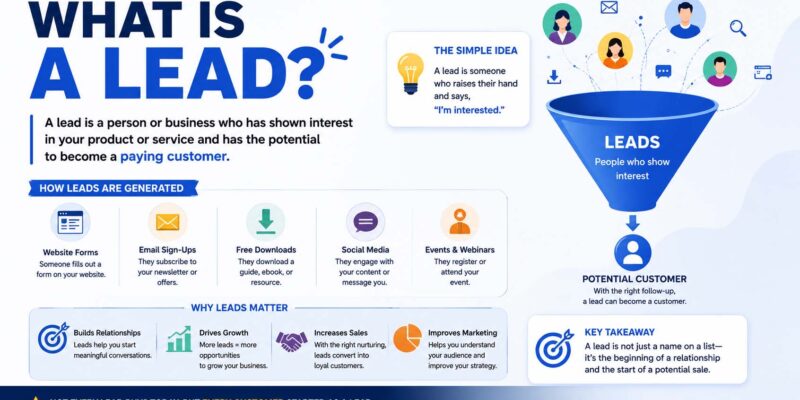
A lead is a person or organization that shows interest in a company’s products or services. Although they haven’t necessarily made a purchase, their actions suggest they might become customers in the future.
For example, someone might fill out a contact form, subscribe to a newsletter, request a quote, download a guide, or call a business for information. Each action can indicate potential buying interest.
Whether you run a small business, an online store, or a large company, understanding leads helps you create a more reliable sales process. In addition, knowing how to identify and manage potential customers can improve your marketing results.
This guide explains the different types of leads, how businesses generate them, and practical ways to turn interested prospects into paying customers.
Quick Overview
| Term | Meaning |
|---|---|
| Lead | A person or business showing potential interest in a product or service |
| Prospect | A potential customer who meets relevant qualification criteria |
| Customer | Someone who has completed a purchase |
| Lead Generation | The process of attracting and identifying potential customers |
| Lead Qualification | Evaluating whether someone is a suitable potential buyer |
What Is a Lead in Marketing?
A lead is someone who has expressed interest in a business through an inquiry, interaction, or other identifiable action.
For example, someone may become a lead when they:
- Fill out a contact form.
- Request a product demonstration.
- Subscribe to a newsletter.
- Download a free guide.
- Ask about pricing.
- Register for a webinar.
- Start a free trial.
However, not every website visitor qualifies as an identifiable lead. Someone who reads an article without providing contact information or making an inquiry may simply be a visitor.
Similarly, not every lead becomes a customer. Some people are only researching options, while others are actively preparing to purchase.
Therefore, businesses must evaluate interest before deciding how to approach potential buyers.
Why Are Leads Important for Businesses?
Without potential customers, businesses have fewer opportunities to generate sales. For this reason, attracting qualified leads is an essential part of business development.
Leads help companies:
- Identify potential customers.
- Build lasting relationships.
- Create new sales opportunities.
- Increase revenue potential.
- Expand their customer base.
- Evaluate marketing effectiveness.
Instead of waiting for customers to appear, businesses can develop marketing systems that attract interested people consistently.
For example, a software company might publish helpful tutorials to attract visitors. Then, it can invite interested readers to request a product demonstration.
In addition, a well-defined Customer Engagement Strategy helps businesses develop stronger relationships with potential customers throughout the buying process.
How the Lead Generation Process Works
Most businesses follow a similar journey from initial awareness to a completed purchase.
| Stage | What Happens |
|---|---|
| Awareness | Someone discovers the business |
| Interest | They explore its products or services |
| Lead | They make an inquiry or provide contact information |
| Qualification | The business evaluates their buying potential |
| Proposal | The sales team presents a suitable offer |
| Customer | The person completes a purchase |
First, someone discovers a business through search engines, advertisements, recommendations, or social media.
Next, they explore its offerings and decide whether the products meet their needs.
If they show identifiable interest, the business can begin communicating with them. Afterward, marketing or sales teams evaluate whether the person is a suitable customer.
Finally, qualified prospects may receive personalized offers, demonstrations, or consultations before making a purchasing decision.
Although the process varies between industries, each stage helps businesses understand customer behavior.
What Is a Sales Lead?
A sales lead is a person or organization that shows potential interest in purchasing a company’s products or services.
Sales leads often have:
- Identifiable contact information.
- Interest in a particular product.
- A relevant business or personal need.
- Potential purchasing authority.
- A reason to consider the company’s offer.
For example, a homeowner requesting a roofing estimate becomes a sales lead for a roofing company.
Similarly, a business requesting accounting software pricing may become a lead for a software provider.
However, expressing interest does not automatically mean someone is ready to buy. Therefore, sales teams often qualify leads before investing significant time in follow-up activities.
Different Types of Leads
Not all potential customers have the same level of interest or purchasing readiness.
Consequently, businesses commonly classify leads into different categories.
Cold Leads
Cold leads have little familiarity with a business or have not yet demonstrated strong purchasing interest.
For example, they may have:
- Clicked an advertisement.
- Visited a website once.
- Encountered a business through outreach.
- Seen promotional content on social media.
These individuals generally need more information before considering a purchase.
Therefore, educational content and relevant introductions can help develop their interest.
Warm Leads
Warm leads already recognize a business and have demonstrated some interest.
They may have:
- Read several blog articles.
- Joined an email list.
- Downloaded helpful resources.
- Compared products or services.
- Interacted with marketing emails.
Because they have already engaged with the business, warm leads may respond well to personalized information.
However, businesses should still evaluate their needs before making direct sales offers.
Hot Leads
Hot leads show strong signs that they may be ready to purchase.
For example, they might:
- Request detailed pricing.
- Schedule a sales meeting.
- Ask specific product questions.
- Request a contract.
- Discuss purchasing timelines.
As a result, these leads often deserve prompt attention from the sales team.
Nevertheless, businesses should avoid assuming that every pricing inquiry guarantees a sale.
How Businesses Generate Leads
Lead generation involves attracting potential customers and encouraging them to express interest.
According to Salesforce’s guide to lead generation, businesses can use marketing and sales activities to identify potential buyers and develop sales opportunities.
Several methods can support this process.
Search Engine Optimization (SEO)
SEO helps businesses attract people searching for relevant information online.
For example, a plumbing company might publish an article explaining how to fix a leaking faucet.
Someone who reads the article may later request professional plumbing services.
Therefore, useful content can introduce potential customers to a business before they are ready to purchase.
Content Marketing
Content marketing focuses on creating valuable information for a specific audience.
Businesses commonly publish:
- Blog articles.
- Educational videos.
- Podcasts.
- Case studies.
- Tutorials.
- Downloadable guides.
For example, an accounting company might publish a guide about managing small-business expenses.
Readers who find the information useful may eventually request accounting services.
In addition, using a Marketing Strategy Template can help businesses organize content campaigns and maintain consistent marketing activities.
Social Media Marketing
Platforms such as LinkedIn, Facebook, Instagram, and X allow businesses to connect with potential customers.
For instance, a clothing brand might share styling ideas and encourage interested followers to explore its online store.
Meanwhile, a business consulting company may use LinkedIn to share industry insights and attract professional inquiries.
Paid Advertising
Paid advertising allows businesses to reach selected audiences through platforms such as Google Ads and social media networks.
For example, a home renovation company might advertise its services to people searching for kitchen remodeling.
However, advertising campaigns require careful targeting and performance monitoring to avoid unnecessary spending.
Customer Referrals
Satisfied customers may recommend businesses to friends, relatives, or professional contacts.
Because recommendations often come from trusted sources, referral leads may enter the buying process with greater confidence.
For example, a business owner might recommend a reliable accountant to another entrepreneur.
In addition, reviewing Partnership Business Examples can provide ideas for developing professional relationships that support referral opportunities.
What Is a Lead Magnet?
A lead magnet is a valuable resource or incentive that a business offers in exchange for someone’s contact information or another desired action.
Common examples include:
- Free eBooks.
- Downloadable checklists.
- Business templates.
- Discount codes.
- Educational webinars.
- Free trials.
- Industry reports.
For example, a fitness coach might offer a free meal-planning guide.
Visitors enter their email addresses to access the resource. As a result, the coach can identify people interested in nutrition and fitness services.
Afterward, the business may share relevant information and introduce suitable services, provided it respects applicable consent and privacy requirements.
What Makes a Good Lead Magnet?
Effective lead magnets usually share several characteristics.
They should be:
- Useful to the intended audience.
- Easy to access.
- Relevant to a specific problem.
- Simple to understand.
- Focused on providing immediate value.
For instance, a free budgeting spreadsheet may attract more relevant interest for an accounting business than an unrelated giveaway.
Therefore, relevance matters more than offering something expensive.
What Is a Lead-In?
Some people search for “what is a lead in” when they actually want to understand the term lead-in.
A lead-in is an introduction that prepares an audience for the main message.
Examples include:
- The opening paragraph of a blog article.
- The first sentence of a sales presentation.
- An introductory question before a product demonstration.
For example, a salesperson might begin a presentation by asking, “How much time does your team spend preparing monthly reports?”
This question introduces a problem before the salesperson explains a possible solution.
Although the words sound similar, a lead-in is different from a marketing lead.
How to Qualify Leads
Generating interest is only the beginning. Businesses must also identify which potential customers are suitable for their products or services.
Lead qualification helps sales teams prioritize opportunities.
Common qualification questions include:
- Does the person need the product or service?
- Can they afford the proposed solution?
- Do they have purchasing authority?
- Are they planning to buy soon?
- Does the product solve their specific problem?
For example, someone researching accounting software for a future project may not need immediate sales attention.
On the other hand, a business owner requesting a demonstration for an upcoming purchase may deserve faster follow-up.
As a result, qualification helps businesses allocate time and resources more effectively.
Common Sources of Business Leads
Businesses can attract potential customers through several channels.
Popular sources include:
- Company websites.
- Contact forms.
- Email marketing.
- Social media.
- Trade shows.
- Online directories.
- Customer referrals.
- Search engines.
- Networking events.
However, relying on only one source can limit growth opportunities.
For example, a company that depends entirely on paid advertising may struggle when advertising costs increase.
Therefore, combining organic marketing, referrals, and other suitable channels can create a more balanced approach.
Common Lead Generation Mistakes
Businesses sometimes lose valuable opportunities because of avoidable mistakes.
Responding Too Slowly
Potential customers may contact several companies before making a decision.
Consequently, delayed responses can reduce the chance of starting a productive conversation.
Asking for Too Much Information
Long contact forms may discourage people from submitting inquiries.
Instead, businesses should request only the information necessary for the next step.
Ignoring Follow-Up Opportunities
Some potential customers need additional information before purchasing.
Therefore, appropriate follow-up messages can help answer questions and maintain interest.
Using Weak Calls to Action
Visitors may leave a website if they cannot identify what to do next.
For example, a clear “Request a Free Quote” button can communicate the next step more effectively than a vague message.
Failing to Track Lead Sources
Without tracking, businesses may struggle to understand which marketing channels generate valuable opportunities.
As a result, they might continue investing in campaigns that produce little meaningful interest.
Best Practices for Managing Leads
An organized management process helps businesses maintain relationships and improve sales efficiency.
Useful practices include:
- Respond promptly to inquiries.
- Personalize communication.
- Maintain accurate contact records.
- Use a customer relationship management (CRM) system.
- Record important interactions.
- Follow up at appropriate intervals.
- Monitor conversion rates.
- Respect communication preferences.
For example, a CRM system can help a sales team track inquiries, schedule follow-ups, and record customer conversations.
In addition, reviewing conversion data helps businesses identify which marketing activities produce qualified prospects.
However, collecting more contacts does not always mean better performance. Businesses should focus on attracting relevant people rather than simply increasing the size of their contact lists.
Example of a Lead Journey
Imagine someone searching online for accounting software.
Their journey might follow these steps:
- Discovery: They find a helpful article about accounting software.
- Interest: They explore the company’s website.
- Initial engagement: They download a free accounting checklist.
- Contact: They provide an email address and agree to receive relevant communications.
- Nurturing: They receive educational emails about accounting tools.
- Qualification: They request a product demonstration.
- Sales conversation: A salesperson answers their questions.
- Purchase: They subscribe to the software.
Initially, this person was simply a website visitor.
However, downloading the checklist and providing contact information created an opportunity for further communication.
Later, requesting a demonstration showed stronger purchasing interest.
Finally, the person became a customer after completing the subscription.
This example demonstrates how useful content, relevant follow-up, and effective sales communication can work together.
Lead vs. Prospect vs. Customer
These terms describe different stages of a potential buyer’s relationship with a business.
| Term | Description |
|---|---|
| Visitor | Someone who explores a website without necessarily identifying themselves |
| Lead | A person or organization showing identifiable interest |
| Prospect | A potential buyer who meets relevant qualification criteria |
| Customer | Someone who has completed a purchase |
For example, someone reading a product article may be a visitor.
If they submit an inquiry, they may become a lead.
After the sales team confirms that the product fits their needs, the person becomes a qualified prospect.
Finally, completing a purchase makes them a customer.
Understanding these differences helps businesses communicate appropriately at each stage.
Frequently Asked Questions
What is a lead?
A lead is a person or organization that has shown potential interest in a company’s products or services. For example, someone who requests a quote or submits a contact form may become a lead.
What is a sales lead?
A sales lead is a potential customer who has demonstrated interest in purchasing a product or service. However, the sales team may still need to evaluate their needs and purchasing readiness.
What is a lead magnet?
A lead magnet is a valuable resource or incentive offered in exchange for contact information or another desired action. Common examples include free guides, templates, webinars, and checklists.
What is a lead-in?
A lead-in is an introductory statement, question, or section that prepares an audience for the main message. Unlike a sales lead, it refers to a communication technique rather than a potential customer.
How do businesses generate leads?
Businesses generate leads through SEO, content marketing, paid advertising, referrals, social media, networking, and website inquiries. In addition, offering relevant resources can encourage interested visitors to make contact.
What happens after someone becomes a lead?
Businesses typically evaluate the person’s needs and provide appropriate follow-up communication. For example, they may send helpful emails, answer questions, arrange meetings, or offer product demonstrations.
What is the difference between a lead and a prospect?
A lead has demonstrated potential interest, while a prospect has usually undergone further evaluation. Therefore, prospects generally meet more specific criteria for becoming customers.
Turning Interest Into Business Growth
Understanding what is a lead provides a useful foundation for sales and marketing. Although not every interested person becomes a customer, each relevant inquiry creates an opportunity to build a relationship.
By attracting the right audience, offering valuable resources, qualifying prospects, and following up consistently, businesses can develop a more organized sales pipeline.
In addition, tracking lead sources and conversion rates helps companies identify which strategies deserve further investment.
With a consistent approach, businesses can turn customer interest into meaningful sales opportunities and support long-term growth.