
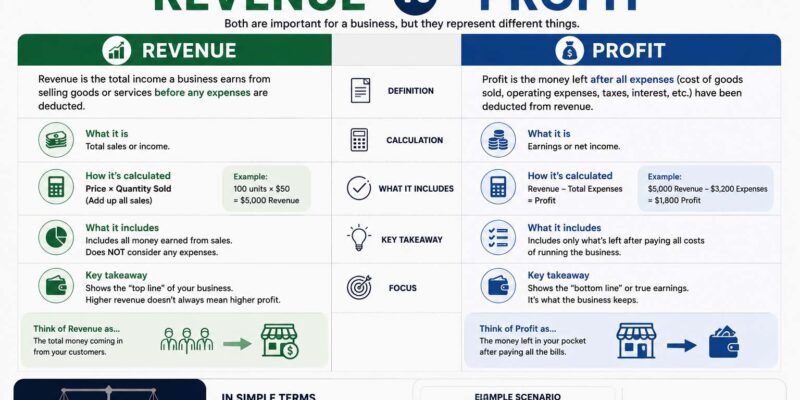
Have you ever seen a company announce millions of dollars in sales but still report a financial loss? That’s a common situation, and it highlights the difference between revenue and profit. Although people often use these terms interchangeably, they measure two very different aspects of business performance.
Revenue is the total amount of money a business earns from selling products or services before any expenses are deducted. Profit is the amount of money that remains after subtracting operating costs, taxes, salaries, rent, and other business expenses from that revenue.Whether you’re running a small business, studying finance, or reviewing a company’s financial statements, understanding these two metrics helps you make better financial decisions.
Difference Between Revenue and Profit at a Glance
The easiest way to understand the difference between revenue and profit is to compare them side by side and see how each measures a different aspect of a business’s financial performance.
| Feature | Revenue | Profit |
|---|---|---|
| Definition | Total income from sales | Money remaining after expenses |
| Also Known As | Sales or turnover | Net income or earnings |
| Includes Expenses | No | Yes |
| Appears First on Income Statement | Yes | No |
| Indicates | Business activity | Financial success |
| Can Be High While Business Loses Money | Yes | No |
While both numbers are valuable, they answer different business questions.
What Is Revenue?
Revenue is the total amount of money a business earns from its primary operations before deducting any costs or expenses.
For example, if a clothing store sells 1,000 jackets at $80 each, its revenue is $80,000.
Revenue is sometimes called the “top line” because it appears at the top of an income statement.
Business owners monitor revenue because it reflects customer demand and overall sales performance.
If you’re learning how businesses organize financial records, understanding What Is a Ledger provides useful background because revenue transactions are recorded there before being summarized into financial statements.
Types of Revenue
Businesses may generate revenue from different sources.
Common examples include:
- Product sales
- Service fees
- Subscription income
- Licensing fees
- Rental income
- Advertising revenue
Some companies rely on a single revenue stream, while others diversify to reduce risk.
What Is Profit?
Profit is the amount of money a business keeps after subtracting all operating expenses, taxes, and other costs from its revenue.
Expenses can include:
- Employee wages
- Rent
- Utilities
- Marketing
- Insurance
- Taxes
- Loan interest
- Equipment costs
Unlike revenue, profit measures how efficiently a business converts sales into earnings.
Companies with strong profits generally have healthier finances because they generate enough income to cover expenses, invest in growth, and manage costs effectively.
Different Types of Profit
Businesses often calculate more than one type of profit.
Gross Profit
Gross profit equals revenue minus the direct costs of producing goods or delivering services.
Formula:
Gross Profit = Revenue − Cost of Goods Sold (COGS)
Gross profit helps businesses evaluate production efficiency.
Operating Profit
Operating profit is calculated by subtracting operating expenses—such as salaries, rent, utilities, and marketing costs—from gross profit, showing how much a business earns from its core operations before interest
This shows how profitable the core business operations are before taxes and financing costs.
Net Profit
Net profit is the final amount remaining after every business expense has been deducted.
Many investors and lenders focus on net profit because it reflects the company’s overall financial health.
What Is the Difference Between Revenue and Profit?
Many beginners ask, what is the difference between revenue and profit when reviewing financial reports.
The answer is straightforward.
Revenue measures income.
Profit measures earnings after costs.
Imagine a bakery sells $50,000 worth of products during one month.
Its expenses include:
- Ingredients
- Staff wages
- Utilities
- Equipment maintenance
- Packaging
- Insurance
If those expenses total $42,000, the bakery’s profit is only $8,000.
Although the bakery generated impressive revenue, its actual earnings are much smaller.
That’s why successful businesses monitor both numbers instead of focusing only on sales.
How Revenue and Profit Work Together
Revenue and profit are closely connected.
Without revenue, a business cannot earn profit.
At the same time, high revenue doesn’t automatically lead to high profit.
A business may increase sales by offering heavy discounts or spending aggressively on advertising. While revenue rises, profit can shrink if expenses increase faster than sales.
Understanding this relationship helps business owners avoid making decisions based only on revenue growth.
Calculating Revenue and Profit
Knowing how each figure is calculated makes financial reports easier to understand.
Revenue Formula
Revenue is generally calculated using:
For service businesses, revenue equals the total value of services provided during a specific period.
Profit Formula
The basic formula is:
Profit = Revenue − Total Expenses
Expenses include all the costs a business incurs to operate, such as salaries, rent, utilities, inventory, marketing, taxes, and other day-to-day operating expenses.
As companies grow, these calculations become more detailed because they include depreciation, taxes, financing costs, and other accounting adjustments.
For example, learning What Is a Depreciation Schedule helps explain how long-term assets gradually reduce reported profit over time without affecting revenue directly.
Real-World Example
Suppose a software company sells annual subscriptions.
During one year, it earns:
- Subscription sales: $900,000
- Training services: $100,000
Total revenue equals:
$1,000,000
Its annual expenses include:
- Employee salaries: $420,000
- Office rent: $90,000
- Marketing: $140,000
- Software infrastructure: $80,000
- Taxes and other expenses: $120,000
Total expenses:
$850,000
Net profit:
$150,000
This example clearly shows the difference between profit and revenue.
Why Revenue Alone Doesn’t Tell the Whole Story
Businesses often celebrate strong sales figures.
However, revenue by itself doesn’t reveal whether the company is financially healthy.
For example:
- High operating costs can reduce profit.
- Rising material prices can shrink margins.
- Poor pricing strategies can increase revenue but lower earnings.
- Excess inventory can create unnecessary expenses.
That’s why investors, lenders, and managers examine profit alongside revenue before evaluating business performance.
Understanding both metrics provides a much clearer picture than looking at either one alone.
Why Businesses Track Revenue and Profit Separately
A growing business needs more than strong sales to stay financially healthy. Managers use revenue and profit together because each metric answers a different question.
Revenue helps answer:
- Are sales increasing?
- Is customer demand growing?
- Are marketing campaigns generating results?
Profit helps answer:
- Is the business making money?
- Are expenses under control?
- Can the company invest in future growth?
Looking at only one figure can create a misleading picture. A company may post record sales while earning very little because operating costs have increased.
What’s the Difference Between Revenue and Profit When Making Business Decisions?
Business owners often ask, what’s the difference between revenue and profit when deciding where to invest their time and money.
It shows whether customers are buying your products or services.
Profit is more useful for measuring sustainability. It shows whether the business earns enough after paying expenses to continue operating and expanding.
For example, a retailer may increase revenue by opening several new locations. If rent, staffing, and inventory costs rise faster than sales, overall profit may decline.
Successful companies balance growth with profitability instead of chasing sales alone.
Business Strategies to Increase Revenue and Profit
Improving financial performance usually requires working on both sides of the equation.
Increase Revenue
Businesses can grow revenue by:
- Launching new products or services
- Entering new markets
- Improving customer retention
- Raising prices when appropriate
- Expanding online sales
- Offering subscription plans
The goal is to increase sales without damaging customer satisfaction.
Improve Profit
Profit often grows by managing expenses more efficiently.
Common strategies include:
- Reducing unnecessary overhead
- Negotiating better supplier pricing
- Improving inventory management
- Automating repetitive tasks
- Reviewing marketing return on investment
- Increasing employee productivity
Many companies find that small cost savings across multiple areas have a significant impact on annual profit.
How Everyday Business Operations Affect Profit
Financial performance depends on hundreds of daily decisions.
Ordering too much inventory can tie up cash.
Poor pricing may reduce margins.
Delayed customer payments can affect cash flow.
Even purchasing processes play a role. Having a clear What Is a Purchase Order process helps businesses control spending, document supplier agreements, and reduce purchasing errors that could affect profitability.
Strong operational systems often support stronger financial results.
Common Mistakes When Comparing Revenue and Profit
Many new entrepreneurs misunderstand these financial terms.
Here are some of the most common mistakes.
Assuming High Revenue Means Success
Large sales numbers can look impressive, but they don’t guarantee healthy finances.
A business with high expenses may earn very little profit despite strong revenue.
Ignoring Operating Costs
Some owners focus heavily on sales while overlooking expenses such as payroll, rent, software subscriptions, or shipping.
Managing costs is just as important as increasing income.
Using Revenue Instead of Profit for Planning
Major investments should usually be based on profit rather than revenue.
Hiring new employees or opening another location based only on sales can create financial pressure if earnings remain low.
Comparing Different Industries
Profit margins vary widely between industries.
For example, grocery stores often operate on thin margins, while software companies may achieve much higher profits.
Likewise, businesses in different sectors have unique cost structures. Looking at What Companies Are in the Energy Field shows how capital-intensive industries often report large revenues alongside substantial operating expenses.
Best Practices for Managing Revenue and Profit
Healthy businesses review their financial performance regularly instead of waiting until the end of the year.
Consider these practical habits:
- Track revenue every month.
- Review expenses regularly.
- Compare profit margins over time.
- Create realistic financial forecasts.
- Monitor pricing strategies.
- Look for unnecessary spending.
- Invest in accounting software for accurate reporting.
Regular financial reviews help identify problems before they become difficult to fix.
Quick Reference Guide
| If You Want to Know… | Focus On |
|---|---|
| Total sales generated | Revenue |
| Money left after expenses | Profit |
| Customer demand | Revenue |
| Business efficiency | Profit |
| Growth opportunities | Revenue and Profit |
| Long-term financial health | Profit |
Frequently Asked Questions
What is the difference between revenue and profit?
Revenue is the total income generated from selling products or services before expenses. Profit is the amount remaining after all business expenses have been deducted.
Can a company have high revenue but low profit?
Yes. Rising operating costs, discounts, production expenses, or inefficient operations can reduce profit even when revenue is growing.
Which is more important, revenue or profit?
Both are important because they measure different aspects of business performance. Revenue reflects sales activity, while profit reflects financial success and sustainability.
Why do investors pay attention to profit?
Profit shows whether a company can generate earnings after covering its expenses. Consistent profitability often indicates a stronger long-term business.
Can a business survive without profit?
A business may operate without profit for a limited period, especially during its early growth stage. Over time, however, consistent losses can make it difficult to invest, repay debt, or continue operating.
Key Takeaways
Understanding the difference between revenue and profit gives you a clearer view of how a business actually performs.
Revenue tells you how much money comes into the business through sales, while profit shows how much remains after paying every expense. Looking at both figures together helps owners, managers, investors, and students evaluate financial health with greater accuracy.
Whether you’re reviewing your own company’s finances or analyzing a large corporation, asking what is the difference between profit and revenue is the first step toward making smarter business decisions. By increasing sales responsibly and managing costs carefully, businesses can build steady growth while improving long-term profitability.