
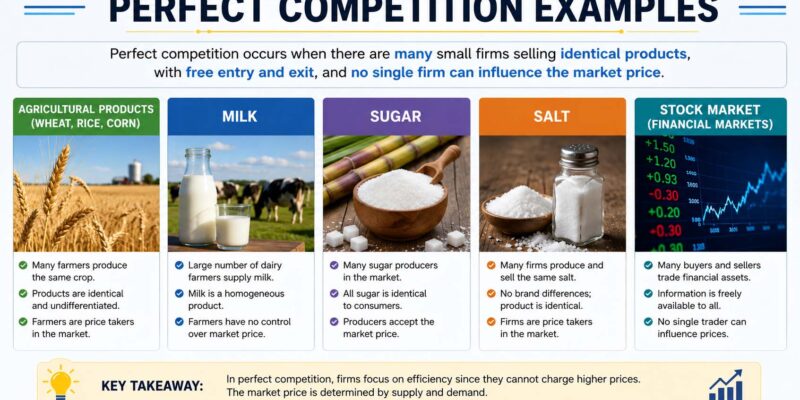
Perfect competition is one of the most important concepts in economics and business studies. It helps explain how markets operate when many sellers compete while offering nearly identical products.
Although true perfect competition is rare in the real world, studying perfect competition examples helps students, entrepreneurs, and business professionals understand pricing, competition, and market behavior.
What Is Perfect Competition?
Perfect competition is a market structure where many businesses sell identical products and no single seller can influence the market price.
Under perfect competition:
- Many buyers and sellers exist
- Products are identical
- Entry and exit are easy
- Information is widely available
- Companies are price takers
Because products are nearly identical, businesses compete primarily on efficiency rather than branding.
Key Characteristics of Perfect Competition
Understanding the core characteristics makes it easier to identify potential perfect competition market examples.
Large Number of Sellers
No individual business controls a significant portion of the market.
Homogeneous Products
Products offered by different sellers are considered nearly identical, making it difficult for businesses to create major differences.
Free Market Entry and Exit
New businesses can enter or leave without major barriers.
Perfect Information
Buyers and sellers have access to market information, including pricing.
Price-Taking Firms
Companies accept market prices rather than setting them independently.
These features create a highly competitive environment.
Quick Comparison: Perfect Competition vs Other Market Structures
| Feature | Perfect Competition | Monopoly | Oligopoly |
|---|---|---|---|
| Number of Sellers | Many | One | Few |
| Product Differences | None | Unique | Often Differentiated |
| Pricing Power | Very Low | High | Moderate |
| Entry Barriers | Low | High | Moderate to High |
| Competition Level | Very High | None | Moderate |
This comparison highlights why perfect competition is often considered the most competitive market structure.
Examples of Perfect Competition
Many students search for examples of perfect competition because textbook definitions can seem abstract.
While no market is perfectly competitive in every aspect, several industries come close.
Agricultural Markets
Agriculture is one of the most frequently cited examples.
Farmers often sell:
- Wheat
- Corn
- Rice
- Soybeans
Individual farmers generally cannot influence market prices because thousands of producers sell similar products.
In highly competitive industries, businesses must focus on efficiency and planning. Understanding Strategy vs Tactics can help companies decide whether to improve long-term operations or focus on short-term actions to remain competitive.
Fresh Produce Markets
Many fruit and vegetable markets display characteristics of perfect competition.
Examples include:
- Tomatoes
- Potatoes
- Onions
- Apples
Consumers often view products from different sellers as interchangeable.
Commodity Markets
Commodities are standardized products traded globally.
Examples include:
- Gold
- Silver
- Crude oil
- Natural gas
Pricing is largely determined by overall market supply and demand.
Perfect Competition Examples in Real Life
Many people ask about perfect competition examples in real life.
Although pure perfect competition rarely exists, several industries closely resemble the model.
Local Farmers Markets
Multiple vendors often sell similar agricultural products.
Customers can compare prices easily, encouraging competition.
Fish Markets
In some coastal regions, numerous sellers offer nearly identical seafood products.
Price differences are often minimal.
Basic Agricultural Products
Global agricultural trading remains one of the strongest real-world examples because products are highly standardized.
These markets demonstrate many principles associated with perfect competition.
Perfect Competition Market Examples
There are several perfect competition market examples often discussed in economics courses.
Wheat Market
Thousands of farmers produce wheat.
No single producer controls prices.
Corn Industry
Corn producers compete in a highly competitive environment where market forces determine pricing.
Coffee Bean Production
In some producing regions, farmers sell raw coffee beans into broader commodity markets.
Individual producers have limited pricing power.
Livestock Auctions
Certain livestock markets may display characteristics similar to perfect competition due to numerous buyers and sellers.
These examples help illustrate how competitive markets function.
Perfect Competition Examples Companies
A common question is whether there are specific perfect competition examples companies.
The answer is somewhat complex.
Perfect competition focuses on markets rather than individual companies.
However, businesses operating in highly competitive commodity sectors often resemble participants in perfect competition.
Examples include:
- Small grain farms
- Independent produce growers
- Commodity crop producers
- Small-scale agricultural suppliers
These businesses generally have little control over market pricing.
How Perfect Competition Affects Businesses
Perfect competition creates unique challenges and opportunities.
Limited Pricing Power
Companies cannot simply raise prices because customers can easily switch to competitors.
Focus on Efficiency
Success often depends on reducing costs and improving productivity.
Narrow Profit Margins
Competition tends to keep prices close to production costs.
Continuous Innovation
Businesses often seek operational improvements to remain profitable.
Understanding these factors helps entrepreneurs recognize competitive pressures.
Business Strategy in Competitive Markets
Although firms in perfectly competitive markets have limited control over pricing, strategy still matters.
A structured approach similar to a Marketing Strategy Template can help businesses identify opportunities, improve positioning, and organize their efforts even in highly competitive environments.
Improve Operational Efficiency
Reducing costs can improve profitability.
Examples include:
- Better equipment
- Process optimization
- Supply chain improvements
Monitor Market Conditions
Changes in supply and demand can significantly affect profitability.
Focus on Quality
Even when products are similar, consistency can help build customer trust.
Diversify Revenue Sources
Many agricultural businesses supplement income through additional products or services.
These strategies can help businesses remain sustainable despite intense competition.
Advantages of Perfect Competition
Perfect competition offers several benefits.
Fair Pricing
Consumers generally pay prices determined by market forces.
Efficient Resource Allocation
Resources tend to move toward their most productive uses.
Consumer Choice
Buyers can select from many sellers.
Market Transparency
Access to information promotes informed decision-making.
These advantages contribute to economic efficiency.
Disadvantages of Perfect Competition
Despite its benefits, perfect competition also has limitations.
Lower Profit Potential
High competition can reduce profits.
Limited Product Differentiation
Businesses may struggle to stand out.
Price Volatility
Market changes can quickly affect revenue and profitability.
Pressure on Small Producers
Smaller firms may find it difficult to compete during market downturns.
Understanding both advantages and disadvantages provides a balanced perspective.
Why Perfect Competition Matters in Business Education
Perfect competition serves as a foundational concept in economics.
Students learn how:
- Markets determine prices
- Competition influences behavior
- Supply and demand interact
- Businesses respond to competitive pressures
Even though perfect competition rarely exists in its pure form, it provides a useful framework for understanding real-world markets.
FAQ
What is perfect competition?
Perfect competition is a market structure with many sellers, identical products, and limited pricing power for individual businesses.
What are some examples of perfect competition?
Common examples include agricultural markets, wheat production, corn farming, and commodity trading.
Are there perfect competition examples in real life?
Yes, although pure perfect competition is rare. Agricultural and commodity markets often display many of its characteristics.
What are perfect competition market examples?
Examples include wheat markets, fresh produce markets, livestock auctions, and certain commodity industries.
Are there perfect competition examples companies?
Perfect competition typically applies to markets rather than specific companies, though many small commodity producers operate within highly competitive markets.
Why is perfect competition important?
It helps explain pricing, market efficiency, competition, and business decision-making.
Conclusion
Studying perfect competition examples provides valuable insight into how highly competitive markets operate. While perfect competition is largely a theoretical model, industries such as agriculture, commodity trading, and certain local produce markets demonstrate many of its characteristics.
By understanding examples of perfect competition, perfect competition market examples, perfect competition examples companies, and perfect competition examples in real life, students, entrepreneurs, and business professionals can better understand market behavior, pricing strategies, and the forces that shape competitive industries. This knowledge remains an essential part of business education and long-term strategic thinking.