
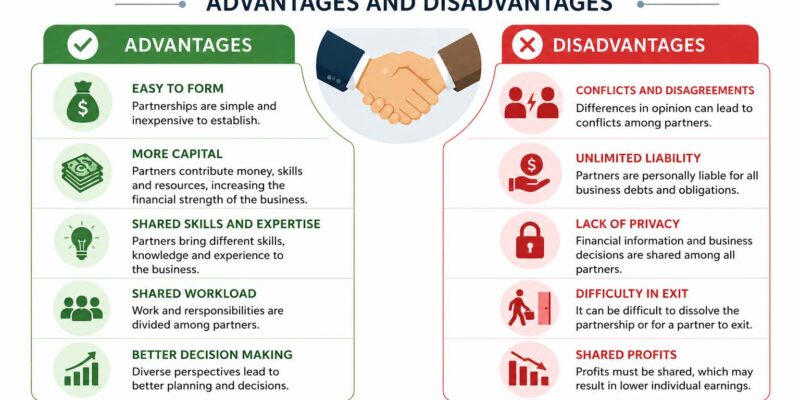
Starting a business with someone else can offer exciting opportunities, but it also comes with responsibilities that shouldn’t be overlooked. Understanding partnership advantages and disadvantages is one of the first steps toward choosing the right business structure. While partnerships allow owners to share skills, costs, and responsibilities, they also require trust, communication, and clear agreements.
Whether you’re launching a small local business or planning a larger venture, knowing both the benefits and potential drawbacks can help you make a more informed decision.
What Is a Business Partnership?
A partnership is a business structure where two or more people own and operate a company together.
Partners usually agree to share:
- Profits
- Losses
- Responsibilities
- Decision-making
- Business risks
Although exact rules vary by country, most partnerships operate under a written partnership agreement that outlines how the business will be managed.
If you’re still comparing business structures, reviewing Sole Proprietorship Examples can provide a useful contrast before deciding whether a partnership better fits your goals.
Partnership Advantages and Disadvantages at a Glance
Before exploring each point in detail, here’s a quick overview.
| Advantages | Disadvantages |
|---|---|
| Shared startup costs | Shared liability in many partnerships |
| Combined knowledge | Potential disagreements |
| Easier decision support | Profit sharing |
| More business resources | Reduced individual control |
| Flexible management | Partner disputes may affect operations |
Neither side automatically outweighs the other. The best option depends on the business, the partners involved, and long-term goals.
The Main Advantages of a Partnership
Many entrepreneurs choose partnerships because they combine resources and expertise.
Let’s look at the biggest benefits.
Shared Financial Responsibility
Starting a business often requires significant investment.
With multiple partners:
- Startup costs can be divided.
- Equipment purchases become easier.
- Operating expenses are shared.
- Financial pressure on each owner is reduced.
This allows businesses to launch with greater financial flexibility than many sole-owned companies.
Diverse Skills and Experience
Very few entrepreneurs excel at everything.
One partner may specialize in:
- Sales
- Marketing
- Finance
- Customer service
Another may bring strengths in:
- Operations
- Product development
- Technical expertise
Combining different skill sets often creates a stronger management team.
Faster Decision-Making Through Collaboration
Having another business owner available to discuss ideas can improve decisions.
Instead of making every choice alone, partners can:
- Brainstorm solutions
- Review risks
- Share industry experience
- Challenge assumptions
Healthy discussions often lead to better long-term strategies.
Easier Business Growth
As a company expands, responsibilities increase.
With multiple owners, work can be divided more effectively.
Examples include:
- Managing employees
- Handling customer relationships
- Negotiating suppliers
- Overseeing finances
This shared workload helps many partnerships grow faster than businesses operated by a single owner.
Greater Business Credibility
Some lenders, investors, and suppliers view partnerships positively because several owners contribute resources and expertise.
Although approval is never guaranteed, multiple experienced partners may strengthen a business’s overall credibility.
Types of Business Partnerships
Not every partnership operates the same way.
Understanding the differences helps explain why advantages and disadvantages of partnership can vary.
General Partnership
In a general partnership:
- All partners help manage the business.
- Profits are shared according to the agreement.
- Partners generally share legal responsibility for business obligations.
This is often the simplest partnership structure.
Limited Partnership
Limited partnerships usually include:
- One or more general partners
- One or more limited partners
Their liability may also be limited depending on local laws.
Limited Liability Partnership (LLP)
Many professional firms choose LLP structures.
The limited liability partnership advantages and disadvantages differ from traditional partnerships because partners often receive some protection from personal liability related to another partner’s actions.
However, LLP rules differ significantly depending on jurisdiction, so professional legal advice is recommended before selecting this structure.
Partnership vs Sole Proprietorship
Many new entrepreneurs compare partnerships with sole proprietorships before registering a business.
Here’s a simple comparison.
| Partnership | Sole Proprietorship |
|---|---|
| Multiple owners | Single owner |
| Shared investment | Self-funded |
| Shared management | Full individual control |
| Shared profits | Owner keeps profits |
| Shared responsibilities | Owner handles everything |
Neither structure fits every situation.
The right choice depends on your goals, available resources, and willingness to work closely with others.
A Real-World Example
Imagine two friends opening a digital marketing agency.
One has years of experience in sales and client management.
The other specializes in website development and digital advertising.
Working together allows them to:
- Offer more services.
- Share startup costs.
- Divide responsibilities.
- Handle more clients.
This is one reason many entrepreneurs search for Partnership Business Examples before choosing a legal structure. Real-world scenarios often make the practical advantages easier to understand.
Before You Form a Partnership
Many problems can be avoided by discussing expectations early.
Partners should agree on topics such as:
- Ownership percentages
- Profit distribution
- Daily responsibilities
- Voting rights
- Exit strategies
- Conflict resolution
Writing these terms into a formal partnership agreement helps reduce misunderstandings later.
Don’t Forget Legal Requirements
Forming a partnership usually involves more than simply agreeing to work together.
Depending on your location, you may need registrations, tax identification numbers, permits, or licenses before operating legally. Understanding What Is a Business License is a helpful starting point because licensing requirements often vary by industry and local regulations.
The Main Disadvantages of a Partnership
While partnerships offer many benefits, they also create challenges that every entrepreneur should understand before signing an agreement.
Shared Liability
In many general partnerships, each partner may be personally responsible for business debts and legal obligations.
That means one partner’s decisions can affect everyone involved.
Because of this shared responsibility, choosing business partners carefully is just as important as choosing the business idea itself.
Profit Sharing
Sharing profits is one of the biggest advantages and disadvantages of a partnership.
On one hand, everyone contributes to building the business.
On the other, profits must usually be divided according to the partnership agreement.
Even if one partner contributes more time during certain periods, profit sharing may still follow the agreed ownership percentages.
Decision-Making Can Take Longer
Running a business alone often allows quick decisions.
In a partnership, however, important choices usually require discussion.
Examples include:
- Hiring employees
- Purchasing equipment
- Expanding into new markets
- Taking on debt
Healthy collaboration improves decisions, but disagreements can slow progress if partners struggle to reach consensus.
Conflicts Between Partners
Even strong business relationships experience disagreements.
Common sources of conflict include:
- Different leadership styles
- Unequal workloads
- Financial disagreements
- Growth expectations
- Communication problems
A detailed partnership agreement helps reduce these issues by clearly defining responsibilities and decision-making processes.
Limited Liability Partnership Advantages and Disadvantages
Many professionals choose Limited Liability Partnerships (LLPs) because they provide a different balance between flexibility and legal protection.
Advantages
- Some personal liability protection
- Shared management responsibilities
- Flexible ownership structure
- Professional collaboration
Disadvantages
- Availability depends on local laws.
- Registration requirements may be more complex.
- Compliance obligations are often greater than those of a general partnership.
Before choosing an LLP, it’s worth consulting a legal or tax professional to understand the rules that apply in your jurisdiction.
Common Mistakes New Partners Make
Many partnership problems don’t begin with the business itself—they begin with poor planning.
Here are some mistakes to avoid.
Skipping a Written Agreement
Verbal agreements may work initially, but they rarely provide enough protection if disputes arise.
A written partnership agreement should explain:
- Ownership percentages
- Profit distribution
- Voting rights
- Exit procedures
- Dispute resolution
Choosing the Wrong Partner
Technical skills matter, but reliability, communication, and shared values are equally important.
A great business idea can struggle if partners have completely different expectations.
Ignoring Financial Planning
Partners should regularly review:
- Cash flow
- Expenses
- Profit allocation
- Tax obligations
- Future investments
Clear financial reporting helps maintain trust.
Best Practices for a Successful Partnership
Strong partnerships usually follow a few simple principles.
Communicate Regularly
Schedule consistent meetings to discuss:
- Business performance
- Upcoming goals
- Challenges
- New opportunities
Open communication helps prevent small issues from becoming major problems.
Define Responsibilities Clearly
Partners should know exactly who handles:
- Sales
- Marketing
- Finance
- Hiring
- Customer service
- Operations
Clear responsibilities improve efficiency and reduce confusion.
Plan for Growth
Business needs often change over time.
Review your partnership agreement periodically to ensure it still matches the company’s direction.
As your business grows, you may also evaluate operational improvements such as the benefits of outsourcing payroll, especially if administrative tasks begin taking time away from strategic work.
Is a Partnership the Right Choice?
A partnership may be a good fit if you:
- Want to share startup costs.
- Value collaboration.
- Have complementary skills.
- Trust your business partner.
- Prefer shared responsibilities.
It may not be the best option if you:
- Want complete control.
- Prefer making decisions independently.
- Feel uncomfortable sharing profits.
- Have very different long-term goals from your potential partner.
Every business is different, so there’s no one-size-fits-all answer.
Frequently Asked Questions
What are the biggest partnership advantages and disadvantages?
The biggest advantages include shared investment, combined expertise, and shared responsibilities. The main disadvantages include shared liability, profit sharing, and the possibility of partner disagreements.
Is a partnership better than a sole proprietorship?
It depends on your goals.
A sole proprietorship offers complete control, while a partnership allows owners to combine resources and skills.
What is the difference between a partnership and an LLP?
A general partnership often involves shared personal liability, while an LLP may provide liability protection for partners, depending on local regulations.
Should every partnership have a written agreement?
Yes.
A written agreement helps clarify expectations and provides guidance if disagreements arise later.
Is a partnership the same as a disregarded entity?
No. If you’re comparing legal business structures, understanding What Is a Disregarded Entity can help explain how certain entities are treated for tax purposes and why they differ from partnerships.
Make Your Decision With Long-Term Goals in Mind
Understanding partnership advantages and disadvantages helps you choose a business structure that matches your goals rather than simply following what others have done. Partnerships can offer financial support, broader expertise, and shared responsibilities, but they also require trust, communication, and careful planning.
Before launching your business, take time to discuss expectations, create a detailed partnership agreement, and understand the legal requirements in your area. A well-planned partnership has a much better chance of growing into a stable and successful business because every partner begins with clear roles, shared objectives, and realistic expectations.