
Running a business means wearing many hats. One day you’re focused on winning new customers, and the next you’re dealing with payroll, hiring paperwork, employee benefits, or changing labor laws. As a company grows, these responsibilities can quickly consume valuable time.
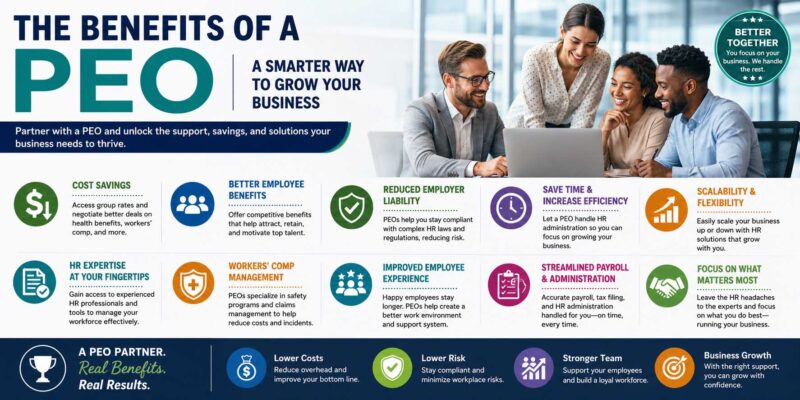
That’s why many business owners explore the benefits of a PEO before expanding their teams. A Professional Employer Organization (PEO) helps businesses manage essential human resources tasks while allowing owners and managers to stay focused on growth. Instead of building a large internal HR department, companies can partner with a PEO to gain access to experienced HR professionals, competitive employee benefits, payroll administration, compliance support, and much more.
Whether you’re launching a startup or managing an established small business, understanding how a PEO works can help you decide if it’s the right solution for your organization.
What Is a Professional Employer Organization (PEO)?
A Professional Employer Organization is a company that partners with businesses to handle many employer-related responsibilities through a co-employment arrangement.
In this relationship:
- You continue managing your employees and daily operations.
- The PEO assists with HR administration and employment-related services.
- Both parties share certain legal and administrative responsibilities.
A PEO does not take over your business. Instead, it acts as an experienced HR partner that helps simplify complex employment tasks.
Typical services include:
- Payroll processing
- Employee benefits administration
- HR guidance
- Tax reporting
- Workers’ compensation support
- Compliance assistance
- Employee onboarding
- Performance management resources
- Training and development support
Many growing businesses use PEOs because they need professional HR support without hiring multiple in-house specialists.
Benefits of a PEO for Small Businesses
The benefits of a PEO for small businesses extend well beyond reducing paperwork. A good PEO helps create stronger business operations while supporting employees throughout their careers.
Save Valuable Time on Administrative Work
Administrative tasks often consume hours every week.
Payroll processing, tax filings, employee documentation, onboarding forms, and benefits enrollment all require careful attention. As a business grows, these tasks become increasingly complex.
Working with a PEO allows owners and managers to spend less time handling paperwork and more time serving customers, improving products, and developing long-term business strategies.
Many companies exploring the benefits of outsourcing payroll also discover that a PEO provides broader HR support rather than payroll services alone.
Access Better Employee Benefits
Small businesses often struggle to compete with larger employers when offering health insurance and retirement plans.
Because PEOs serve many businesses, they may have access to benefit programs that individual small companies would find difficult to negotiate independently.
Depending on the provider, employees may gain access to:
- Health insurance
- Dental coverage
- Vision insurance
- Retirement savings plans
- Flexible spending accounts
- Wellness programs
- Life insurance
- Employee assistance programs
Better benefits can make a business more attractive to qualified candidates while supporting existing employees.
Improve HR Expertise
Employment regulations change regularly.
Hiring practices, workplace safety requirements, wage laws, leave policies, and employee documentation all require ongoing attention.
Rather than trying to keep up with every legal update alone, business owners can rely on experienced HR professionals who specialize in these areas.
This guidance helps reduce uncertainty while improving day-to-day HR management.
Benefits of a PEO for Employees
The benefits of a PEO for employees often receive less attention than employer advantages, yet they can have a significant impact on workplace satisfaction.
Employees generally care about more than their paycheck. They also value clear HR processes, competitive benefits, timely payroll, and opportunities for professional development.
A PEO can contribute to these areas by improving consistency across many HR functions.
Employees may experience:
- Faster onboarding
- Easier benefits enrollment
- Reliable payroll processing
- Better access to HR support
- Employee training resources
- Clear workplace policies
- Improved retirement options
When employees feel supported, they’re more likely to remain engaged and productive. That’s one reason many businesses looking to improve the benefits of employee retention also evaluate whether stronger HR support through a PEO can enhance the overall employee experience.
How a PEO Helps Reduce Compliance Risks
Employment laws can vary by country, state, and even local jurisdiction.
Business owners must stay current on issues such as:
- Payroll taxes
- Overtime rules
- Employee classification
- Workplace safety
- Hiring documentation
- Anti-discrimination regulations
- Leave requirements
Missing a filing deadline or misunderstanding employment regulations can lead to expensive penalties.
A PEO helps businesses establish consistent HR processes that support compliance with applicable employment laws. While the employer remains responsible for running the business, the PEO provides valuable guidance and administrative assistance that reduces the likelihood of costly mistakes.
Benefits of Using a PEO for Employee Management
One of the biggest benefits of using a PEO for employee management is having structured HR processes from the beginning.
Without clear systems, growing businesses often face inconsistent hiring, onboarding, evaluations, and documentation.
A PEO can help standardize areas such as:
Recruiting Support
Many providers offer recruiting resources, job description templates, and hiring best practices that make recruitment more organized.
Employee Onboarding
New hires benefit from consistent onboarding procedures, digital paperwork, policy acknowledgments, and benefits enrollment.
A smoother onboarding experience helps employees become productive more quickly.
Performance Management
Some PEOs provide tools for:
- Performance reviews
- Goal setting
- Employee feedback
- Manager coaching
- Development planning
These systems help managers support employee growth while maintaining consistent documentation.
Comparing In-House HR vs. a PEO
The right solution depends on a company’s size, budget, and internal resources.
| Area | In-House HR | PEO |
|---|---|---|
| Payroll Administration | Managed internally | Typically supported by the PEO |
| Employee Benefits | Limited by company size | Often broader benefit options |
| HR Expertise | Depends on staff experience | Access to experienced HR professionals |
| Compliance Support | Internal responsibility | Shared guidance and administrative support |
| Hiring Support | Internal resources | Often includes recruiting assistance |
| HR Technology | Purchased separately | Frequently included in services |
| Scalability | Requires additional hiring | Easier to expand as the business grows |
For many small businesses, partnering with a PEO provides access to enterprise-level HR resources without the expense of building a large internal HR department.
Choosing the Right PEO
Not every provider offers the same services. Before signing an agreement, compare several options carefully.
Look for a PEO that offers:
- Transparent pricing
- Strong customer support
- Payroll accuracy
- Comprehensive employee benefits
- Compliance expertise
- Modern HR technology
- Experience serving businesses in your industry
- Flexible service packages
Ask prospective providers how they handle onboarding, payroll deadlines, employee questions, and compliance updates. Understanding these details early can help you choose a partner that fits your company’s long-term goals.
Benefits of Using a PEO to Support Business Growth
Beyond handling HR tasks, one of the biggest benefits of using a PEO is giving business leaders more time to focus on growth. Instead of spending hours on administrative work, owners can invest their energy in improving products, expanding into new markets, or strengthening customer relationships.
As a company grows, HR responsibilities become more demanding. Hiring additional employees, managing benefits, and keeping up with employment regulations all require consistent attention. A PEO helps create processes that can scale alongside the business.
Some ways a PEO supports growth include:
- Simplifying hiring as the workforce expands
- Improving employee onboarding
- Providing access to HR technology
- Reducing administrative workloads
- Supporting compliance as regulations change
- Helping managers resolve employee issues more effectively
For many small businesses, these improvements create a stronger foundation for long-term success.
Building a Better Workplace with a PEO
People are often a company’s greatest asset. Creating a positive work environment can improve productivity, employee satisfaction, and business performance.
A PEO can help businesses establish consistent HR policies that encourage fairness and transparency. Clear expectations, organized onboarding, and accessible HR support all contribute to a healthier workplace.
Leadership also plays a major role. Managers who receive HR guidance are often better equipped to handle performance conversations, workplace concerns, and employee development.
At the same time, every company should continue developing its own types of organizational culture because culture comes from leadership, shared values, and everyday behavior—not from outsourced HR services alone.
Common Challenges to Consider
Although a PEO offers many advantages, it is not the perfect solution for every business.
Understanding the potential drawbacks helps business owners make informed decisions.
Monthly Service Costs
PEOs charge fees based on factors such as payroll, employee count, or service level.
For businesses with very few employees or limited HR needs, those costs may outweigh the benefits.
Shared Responsibilities
A PEO supports HR administration, but business owners still manage daily operations, employee performance, and strategic decisions.
Knowing who is responsible for each task is essential before entering a partnership.
Provider Quality Varies
Not every PEO offers the same level of service.
Some specialize in startups, while others focus on larger organizations or specific industries.
Researching providers, checking customer reviews, and requesting references can help identify a reliable partner.
Common Mistakes Businesses Make When Choosing a PEO
Selecting a PEO is a significant business decision. Rushing the process can lead to unnecessary costs or services that don’t fit your needs.
Avoid these common mistakes.
Choosing Based Only on Price
Lower pricing may seem attractive, but the cheapest option isn’t always the best value.
Compare:
- HR expertise
- Customer support
- Technology platforms
- Benefits offerings
- Compliance assistance
- Industry experience
A slightly higher investment may deliver stronger long-term results.
Ignoring Service Agreements
Read the contract carefully.
Understand:
- Contract length
- Cancellation terms
- Service guarantees
- Fee structure
- Responsibilities of each party
Clear expectations help prevent misunderstandings later.
Overlooking Technology
Modern HR platforms simplify payroll, onboarding, benefits enrollment, and employee record management.
Before choosing a provider, ask for a demonstration of their technology to ensure it’s easy for managers and employees to use.
A Simple Framework for Deciding if a PEO Is Right for You
Use this checklist to evaluate your business.
| Question | If You Answer “Yes” |
|---|---|
| Is HR taking too much management time? | A PEO may reduce administrative work. |
| Are compliance requirements becoming difficult to manage? | Professional HR guidance may help. |
| Is hiring becoming more frequent? | A PEO can support recruiting and onboarding. |
| Are employees requesting better benefits? | A PEO may improve available benefit options. |
| Is your business growing quickly? | Scalable HR support can make expansion easier. |
If you answered “yes” to several questions, exploring PEO services may be worthwhile.
Example: How a Growing Business Can Benefit
Imagine a marketing agency with 18 employees.
The owner spends several hours each week processing payroll, updating employee records, managing benefits, and answering HR questions. As the agency grows, those responsibilities begin affecting client work.
After partnering with a PEO, payroll processing becomes more efficient, benefits enrollment moves online, and HR specialists assist with compliance and employee documentation.
The owner now spends more time meeting clients, developing new services, and growing revenue rather than handling administrative tasks.
This example illustrates how the value of a PEO often comes from improving operational efficiency rather than simply outsourcing paperwork.
Frequently Asked Questions
What is a PEO?
A Professional Employer Organization partners with businesses to provide HR services such as payroll administration, employee benefits, compliance support, tax reporting, and human resources guidance through a co-employment relationship.
Who benefits most from a PEO?
Small and medium-sized businesses often gain the greatest value because they receive professional HR support without building a large internal HR department.
Does a PEO become my employees’ employer?
No. The business continues managing employees, daily operations, and business decisions. The PEO shares certain administrative and employment-related responsibilities through the co-employment arrangement.
Can a PEO help attract better employees?
Yes. Many PEOs provide access to competitive employee benefits, structured onboarding, and professional HR support, all of which can improve recruitment efforts.
Is a PEO only for startups?
No. While startups frequently use PEOs, established businesses also partner with them to improve HR operations, support expansion, and reduce administrative workloads.
How is a PEO different from payroll software?
Payroll software mainly processes payroll. A PEO offers a broader range of services that may include HR consulting, employee benefits administration, compliance assistance, recruiting support, and HR technology.
Understanding the difference between salary and hourly compensation can also help employers make informed payroll and workforce planning decisions alongside broader HR management.
Key Takeaways
The benefits of a PEO extend well beyond simplifying payroll. A well-chosen PEO can strengthen HR operations, improve access to employee benefits, support compliance efforts, and free business leaders to focus on growth instead of administrative work.
For small and growing companies, partnering with a PEO can create more consistent hiring practices, smoother onboarding, stronger employee support, and scalable HR processes. That doesn’t replace effective leadership or company culture, but it does provide the operational foundation many businesses need as they expand.
Before choosing a provider, assess your current HR challenges, compare service offerings carefully, and look for a partner with experience in your industry. Taking the time to find the right fit can help your business operate more efficiently while creating a better experience for both managers and employees.