
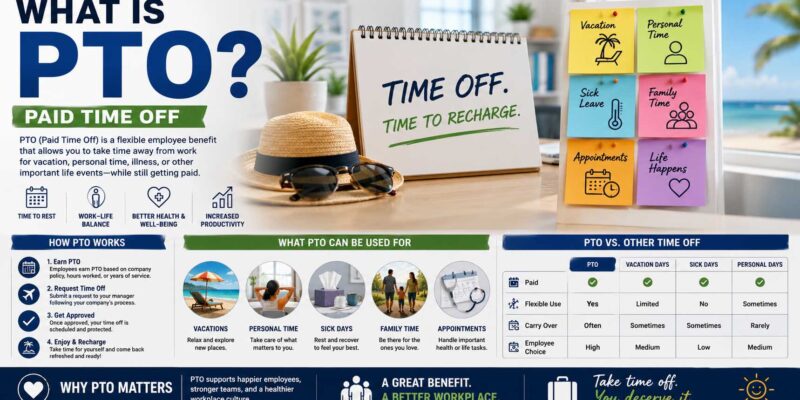
If you’ve seen PTO listed in a job posting or employee benefits package, you may be wondering what is PTO and how it actually works. In most workplaces, PTO means paid time off—approved time away from work during which an employee continues to receive pay. Depending on the employer’s policy, workers may use PTO for vacations, personal days, illness, appointments, or other reasons.
However, PTO isn’t structured the same way at every company. Some businesses provide a single bank of paid days, while others separate vacation and sick leave. Employees may earn time gradually, receive it at the start of the year, or work under a flexible or unlimited policy.
Understanding these differences helps employees compare job benefits and helps employers design clearer, easier-to-manage leave programs.
What Is PTO in Work?
When people ask what is PTO in work, they’re usually referring to paid time off offered as an employee benefit.
For example, imagine that an employee has 15 days available. They could request five days for a summer vacation, use one day for a personal appointment, and potentially use another when they’re sick, assuming the company’s policy allows those uses.
While the employee is taking approved , the employer generally pays them according to the applicable policy rather than treating the absence as unpaid.
However, having available doesn’t necessarily mean employees can take any day off without notice. Companies commonly establish procedures for requesting planned leave and reporting unexpected absences.
What Is PTO Mean for Your Employee Benefits?
If you’re asking what is PTO mean on a job offer, think of it as one part of your total compensation package.
Salary matters, of course, but paid leave has real value as well. For instance, two employers could offer identical salaries while providing very different amounts of paid time away from work.
That’s why job seekers should look beyond a simple statement such as “15 days PTO.” Instead, ask when those days become available, whether they include sick leave, whether unused days carry over, and what happens to the balance when employment ends.
The employment arrangement can affect benefits too. Understanding the difference between salary and hourly compensation can help workers evaluate how pay, schedules, overtime rules, and workplace benefits fit together.
How Does PTO Work?
Employers generally choose one of several methods for providing paid time off.
The exact system affects when employees can use leave and how much time they have available throughout the year.
Accrued PTO
Under an accrual system, employees earn PTO gradually.
For example, an employee might earn several hours of paid leave during each pay period. As the year progresses, those hours accumulate in the employee’s PTO balance.
The accrual rate may also increase with length of service. Therefore, someone who has worked at a company for five years might earn leave faster than a new employee.
Front-Loaded PTO
Instead of gradual accrual, some employers provide an annual allowance upfront.
For instance, an eligible employee might receive 15 PTO days at the beginning of the company’s benefit year.
This approach makes planning easier because employees know their available balance immediately. However, employers need clear policies for employees who start or leave during the year.
Separate Leave Categories
Not every company combines paid leave into one PTO bank.
Instead, an employer could provide 10 vacation days, five sick days, and two personal days. In that case, each category may have its own rules.
A combined system offers more flexibility, while separate categories can preserve certain leave specifically for illness or other needs.
How Employees Track and Request PTO
Modern companies commonly track through payroll, HR, or workforce-management software.
Employees can usually see their available balance, submit requests, and review previous leave. Managers can then approve or deny requests based on staffing needs and company policies.
Accurate records become especially useful when employees earn leave according to hours worked. Since What Is a Timesheet is closely connected with understanding how companies record working hours, employers using hourly accrual methods need reliable timekeeping data.
For planned vacations, companies often ask employees to submit requests several days or weeks ahead. Meanwhile, illness and emergencies generally require a different notification process.
Clear procedures reduce confusion for everyone.
What Is a PTO Policy?
A PTO policy is the employer’s written set of rules explaining how paid leave works.
A useful policy should answer basic questions before employees need to contact HR.
For example, it should explain:
- Who qualifies for PTO
- How much leave employees receive
- How PTO accrues
- When new employees become eligible
- How employees request time away
- How managers approve requests
- Whether unused carries over
- Whether accrual has a maximum limit
- How sick leave fits into the system
- What happens to unused PTO when employment ends
Employers should also make sure their policies comply with federal, state, and local requirements that apply to their workforce.
PTO vs. Vacation vs. Sick Leave
These terms can sound interchangeable, although their meanings often differ by employer.
| Leave type | Typical purpose | Usually paid? |
|---|---|---|
| General PTO | Vacation, personal needs, illness | Yes |
| Vacation | Planned leisure and travel | Usually |
| Sick leave | Illness, medical care, qualifying family needs | Often, depending on policy and law |
| Personal day | Personal obligations | Usually |
| Unpaid leave | Approved time without regular wages | No |
A company using combined may put several categories into one balance. Consequently, employees gain flexibility in deciding how to use their days.
However, employers should clearly explain whether legally required sick leave is included in or handled separately from general PTO, since requirements vary by jurisdiction.
What Is Unlimited PTO?
Another increasingly familiar term is unlimited . So, what is unlimited PTO in practice?
Under this approach, employees don’t receive a traditional fixed annual balance such as 10 or 20 days. Instead, eligible workers can request paid time away according to company rules, manager approval, workload, and performance expectations.
Despite the name, unlimited doesn’t mean employees can disappear from work whenever they want.
Companies still need reasonable procedures. For example, an employee may need approval before taking a two-week vacation, while teams still need enough people available to operate.
Unlimited can reduce some administrative work related to tracking accrued vacation. However, it can also create uncertainty if employees don’t know how much leave the company considers reasonable.
For that reason, employers should communicate expectations clearly.
Why PTO Matters to Employees
Paid time off provides employees with room to handle life outside work without automatically losing income.
Vacations can provide genuine breaks from job responsibilities. Meanwhile, personal days can help workers manage appointments, family responsibilities, and other needs.
From a business perspective, a well-designed benefits package can also support recruitment and retention.
For example, employers reviewing the benefits of employee retention often consider compensation, workplace culture, career development, management quality, and useful benefits such as paid leave.
However, simply offering PTO isn’t enough. Employees need to feel that they can actually use the benefit without unnecessary pressure or confusion.
Why PTO Matters to Employers
PTO gives businesses a structured way to manage employee absences.
Without a clear policy, managers may handle similar requests differently. That inconsistency can create confusion and frustration.
A formal system also improves workforce planning. Managers can review approved vacations before scheduling projects, assigning shifts, or establishing deadlines.
At the same time, employers can track leave alongside payroll records. Businesses that want external support with these processes may examine the benefits of outsourcing payroll, particularly when payroll administration, timekeeping, and employee records become more complex.
Still, outsourcing a function doesn’t remove an employer’s responsibility to follow applicable employment laws.
PTO Laws and Employer Responsibilities
In the United States, federal law generally doesn’t require private employers to provide paid vacation time. However, state and local laws can establish requirements involving paid sick leave and other forms of protected or paid leave.
Rules concerning accrued vacation and can vary too.
For example, some jurisdictions place restrictions on forfeiting earned vacation, while others give employers more flexibility through written policies. Requirements for paying unused leave when employment ends can also differ.
Therefore, businesses operating in multiple states should avoid assuming that one policy automatically works everywhere.
Employers should periodically review their policies and obtain qualified HR or legal guidance when necessary.
Can Unused PTO Carry Over?
Sometimes.
A company might allow employees to carry unused days into the next benefit year. However, it could set a maximum balance.
For example, an employee with five unused days could move those days into the next year while continuing to accrue new PTO.
Other employers may restrict carryover where legally permitted.
Employees should check their handbook before assuming unused days will remain available indefinitely. Meanwhile, employers should communicate year-end rules early enough for workers to plan appropriately.
What Happens to PTO When You Leave a Company?
Unused can become a major question when someone resigns, retires, or is terminated.
Whether an employer must pay an unused balance depends on applicable state law and the company’s policy.
Therefore, employees should review their handbook before leaving and check the balance shown in their HR system.
Employers should also maintain accurate records. Inconsistent or incomplete tracking can create unnecessary payroll disputes when employment ends.
How Small Businesses Can Manage PTO
Small businesses don’t necessarily need complicated leave programs.
Instead, start with a policy employees can easily understand. Define eligibility, accrual, requests, approvals, carryover, and separation rules.
Then, choose a reliable tracking method. Very small teams might begin with basic HR software, while growing businesses may need integrated payroll and workforce-management systems.
Some employers also work with professional employer organizations for HR-related administration. Understanding the benefits of a peo can help business owners decide whether external support makes sense for payroll, benefits, HR administration, and other workforce needs.
Regardless of the system, managers should apply policies consistently.
Common PTO Mistakes Businesses Should Avoid
One common mistake is writing a vague policy. Employees shouldn’t have to guess whether includes sick days or whether unused hours carry over.
Another problem is inconsistent approval. Managers need reasonable discretion, yet similar requests should generally follow the same standards.
Employers should also avoid discouraging workers from using earned benefits through workplace pressure. A generous policy has little value when employees believe taking time away will hurt their careers.
Finally, businesses shouldn’t copy a PTO template without checking applicable laws. Leave requirements can vary significantly between locations.
FAQs About PTO
What is a PTO?
In a workplace context, PTO usually means paid time off. It allows eligible employees to take approved time away while receiving pay according to the employer’s policy.
Is PTO the same as vacation?
Not necessarily. Vacation may be one category of PTO, while some companies combine vacation, personal days, and sick leave into one balance.
Do part-time employees receive PTO?
Some do, but eligibility varies by employer and applicable law. Part-time workers may receive a prorated benefit or a different leave allowance.
Can an employer deny PTO?
Employers can generally establish reasonable procedures for ordinary vacation requests based on scheduling and operational needs. However, certain absences may involve protected leave or legally required sick leave, so businesses must distinguish those situations from standard vacation requests.
Is PTO paid at your normal rate?
Paid time off generally provides compensation according to the employer’s policy and applicable law. Employees should check their handbook or ask payroll or HR how their pay is calculated.
Does PTO reset every year?
That depends on the policy and applicable law. Some balances reset, some carry forward, and others have accrual caps.
Making PTO Work for Everyone
When you’re comparing job offers, don’t judge PTO only by the number of days listed. Instead, check how you earn the time, what you can use it for, whether it carries over, and how requests are approved.
For employers, simplicity and transparency matter just as much. A clearly written policy, reliable tracking system, consistent management, and regular compliance reviews can prevent many common problems.
So, what is PTO? In the workplace, it’s paid time off that gives eligible employees compensated time away from work under defined rules. When employees understand those rules and managers apply them consistently, PTO becomes a practical benefit rather than another confusing HR policy.