
Businesses rely on organized communication, clear documentation, and effective teamwork. Therefore, learning how to write meeting minutes helps managers, assistants, team leaders, and company secretaries create clear records of discussions, decisions, and follow-up actions.
Good meeting minutes do not need to record every word spoken during a meeting. Instead, they should capture the most important information in a clear and organized format. As a result, readers can quickly understand what happened and what needs to happen next.
How to Write Meeting Minutes: Understanding the Basics
Meeting minutes are written records of a meeting. Usually, they include the meeting date, time, location, attendees, agenda items, important discussions, decisions, and action items.
The main purpose of meeting minutes is to give participants a reliable record they can review after the meeting. In addition, clear minutes can help people who were unable to attend understand the main outcomes.
Therefore, effective meeting minutes should be factual, organized, and easy to review.
How to Write Meeting Minutes: Why They Matter
Understanding how to write meeting minutes can help teams improve communication and organization. For this reason, many teams use a consistent format for their meeting records.
Well-prepared minutes can help employees remember decisions, track responsibilities, and review important information later. Moreover, they provide a useful reference when a project involves several people or departments.
Clear records can also make follow-up easier. For example, everyone can see what was discussed, what was decided, and what needs to happen next.
How to Write Meeting Minutes Step by Step
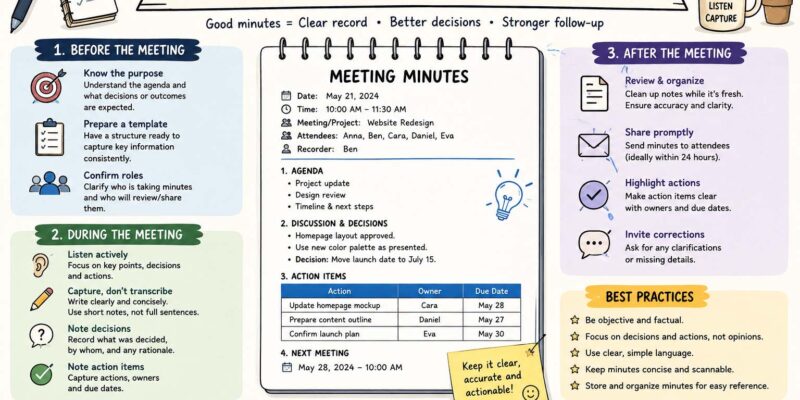
Learning how to write meeting minutes becomes easier when you use a consistent process. First, prepare your notes and review the agenda. Next, record the important information during the meeting. Finally, review and organize the minutes after the meeting.
How to Write Meeting Minutes Before the Meeting
Preparation can make note-taking easier. Before the meeting starts, review the agenda and prepare a simple meeting minutes template.
For example, create sections for:
- Meeting title
- Date and time
- Location or meeting platform
- Attendees
- Absentees
- Agenda items
- Decisions
- Action items
- Deadlines
- Next meeting
In addition, review previous minutes if they are available. This can help you identify unfinished tasks and expected follow-up.
As a result, you can enter the meeting with a clear structure instead of creating the format while people are speaking.
How to Write Meeting Minutes During the Meeting
During the meeting, focus on important information rather than recording every sentence. Instead, listen for decisions, responsibilities, deadlines, and important outcomes.
For each agenda item, identify:
- The main topic
- Important discussion points
- Decisions made
- Tasks assigned
- Responsible people
- Deadlines
Furthermore, use short notes while people are speaking. After the meeting, you can turn those notes into complete sentences.
How to Write Meeting Minutes After the Meeting
After the meeting ends, review your notes while the information is still fresh. Then, organize the notes according to the agenda.
Next, remove unnecessary details and clarify unclear points. Also, check names, dates, decisions, responsibilities, and deadlines.
Finally, make sure the document is easy to read and accurately reflects the important outcomes of the meeting.
How to Write Meeting Minutes Clearly and Objectively
Use simple and neutral language when preparing the final document. Avoid personal opinions, emotional descriptions, and unnecessary commentary.
Instead of explaining whether an idea was good or bad, record the important idea, discussion, decision, or action that followed.
In addition, use factual wording throughout the document. This approach keeps the minutes professional and useful.
How to Write Meeting Minutes as a Secretary
A secretary or designated note-taker may be responsible for preparing the official meeting record. Therefore, knowing how to write meeting minutes helps the secretary create an accurate and useful document.
The secretary should focus on the main outcomes rather than attempting to capture every statement.
How to Write Meeting Minutes Clearly as a Secretary
Start with the basic meeting information and follow the agenda throughout the meeting. Then, record important discussions and decisions under the appropriate agenda item.
Next, identify action items, responsible people, and deadlines when those details are available.
Before distributing the minutes, review the document for accuracy, clarity, spelling, and formatting. In addition, make sure the wording remains neutral.
How to Write Meeting Minutes for Board Meetings
Board meetings can involve formal discussions, decisions, and responsibilities. Therefore, learning how to write meeting minutes for these meetings requires a clear and objective writing style.
Begin with the meeting date, time, location, and participants. Then, organize the record around the agenda.
For each important matter, summarize the relevant discussion and record the resulting decision or action. In addition, keep the wording factual and avoid personal opinions.
For information about parliamentary procedure and meeting practices, consult the National Association of Parliamentarians.
How to Write Meeting Minutes for Board Meetings
Start by recording the basic meeting details. Next, identify the relevant agenda item and summarize the important discussion.
Then, record the decision or action that resulted from the discussion. Finally, check the minutes for accuracy before they are distributed.
How to Write Meeting Minutes Efficiently
A consistent process can make meeting minute-taking faster and easier. First, prepare a template before the meeting. Next, use the agenda as your structure.
During the meeting, focus on decisions, action items, responsibilities, and important outcomes. Afterward, organize and review the notes as soon as practical.
As a result, you can produce useful minutes without spending unnecessary time rewriting your notes.
How to Write Meeting Minutes Using a Template
A template gives every meeting record the same basic structure. For example, it can include sections for meeting details, attendees, agenda items, discussions, decisions, action items, and the next meeting.
Furthermore, using the same structure can save time and make documents easier for readers to scan.
Common Meeting Minutes Mistakes to Avoid
Avoiding common mistakes can improve the quality of your meeting records. However, even a simple mistake can make important information harder to understand.
Writing Too Much Detail
Meeting minutes should not become a word-for-word transcript. Instead, focus on the points that readers need for understanding and follow-up.
Too much information can make important decisions difficult to find. Therefore, keep the record focused.
Missing Action Items
A meeting record becomes less useful when it does not show what needs to happen next. For this reason, always record assigned tasks clearly.
When a task is assigned, record the task, responsible person, and deadline when available.
Adding Personal Opinions
Meeting minutes should remain neutral. Therefore, avoid personal judgments about people, ideas, or discussions.
Instead, describe the relevant discussion, decision, or action in factual language.
Poor Organization
Long paragraphs and inconsistent formatting can make minutes difficult to read. Instead, use headings, bullet points, and a consistent structure.
As a result, readers can find important information more quickly.
Delaying the Review
Review your notes soon after the meeting. This makes it easier to correct unclear information while the details are still fresh.
In addition, an early review can help you identify missing decisions or action items.
Meeting Minutes Example and Format
A simple meeting minutes format can include these sections:
Meeting Title: Weekly Team Meeting
Date: [Date]
Time: [Time]
Location: [Location]
Attendees: [Names]
Agenda
First, list the main topics planned for the meeting.
Discussion
Next, summarize the important points discussed under each agenda item.
Decisions
Then, record the decisions made during the meeting.
Action Items
After that, list assigned tasks, responsible people, and deadlines.
Next Meeting
Finally, add the date and time of the next meeting when available.
This format provides a simple starting point for businesses, organizations, and project teams. Moreover, it makes the final document easier to review.
How to Write Meeting Minutes: Best Practices
Following a few simple practices can improve every meeting record. In particular, focus on clarity, accuracy, and useful follow-up information.
How to Write Meeting Minutes in a Clear Format
Use short paragraphs, descriptive headings, and bullet points where appropriate. In addition, organize information according to the meeting agenda.
Avoid repetition and focus on decisions, responsibilities, and important outcomes. As a result, readers can find essential information quickly.
How to Write Meeting Minutes Without Unnecessary Detail
Focus on important discussions, decisions, tasks, and outcomes. Instead, avoid repeating the same information.
Likewise, leave out comments that do not help readers understand the meeting.
How to Write Meeting Minutes With Clear Action Items
Whenever a task is assigned, identify what needs to be done, who is responsible, and when the task is due if a deadline is provided.
This makes follow-up easier. Moreover, it reduces confusion about responsibilities.
Benefits of Well-Written Meeting Minutes
Well-written minutes can provide several practical benefits. For example, they help teams maintain a clear record of decisions and responsibilities.
Improve Accountability
Clear action items show who is responsible for specific tasks. Therefore, follow-up becomes easier.
Improve Decision Tracking
A written record allows teams to review previous decisions without relying only on memory. In addition, it provides useful context for future discussions.
Strengthen Communication
Team members who could not attend can use the minutes to understand the main outcomes of the meeting. As a result, they can stay informed without needing a complete meeting transcript.
Support Strategic Follow-Up
Meeting records can help teams connect decisions with future tasks and business priorities.
For example, meeting discussions may relate to a Skip Level Meeting, a customer engagement strategy, or a marketing strategy template.
How to Write Meeting Minutes With AI
AI tools can help organize notes and summarize meeting information. However, important details should still be reviewed by a person before the minutes are shared.
First, check names and dates. Next, review decisions, deadlines, and responsibilities. Finally, compare the final document with the original notes.
AI can assist with organization. Nevertheless, the final document should accurately reflect what happened during the meeting.
How to Write Better Meeting Minutes
Good note-taking comes from preparation and consistent habits. Therefore, use a repeatable process for every meeting.
How to Write Meeting Minutes With Simple Language
Use clear sentences that readers can understand easily. In addition, avoid unnecessary technical language when simpler wording works.
How to Write Meeting Minutes With Organized Notes
Follow the meeting agenda and use clear sections for different topics. Then, organize the final notes in the same order.
How to Write Meeting Minutes by Focusing on Outcomes
Pay close attention when participants make decisions, assign tasks, set deadlines, or identify follow-up actions.
Instead of recording every statement, focus on information that affects the next steps.
How to Write Meeting Minutes With Consistent Templates
A standard template can save time and provide a predictable structure for every meeting. Moreover, it can make important information easier to locate.
How to Write Meeting Minutes With Accurate Details
Before sharing the final document, check names, dates, decisions, tasks, and deadlines. Finally, review the entire document for clarity and accuracy.
FAQ: How to Write Meeting Minutes
What Should Meeting Minutes Include?
Meeting minutes usually include meeting details, attendees, agenda topics, important discussions, decisions, action items, and follow-up information.
In addition, include deadlines and responsibilities when they are provided during the meeting.
How Detailed Should Meeting Minutes Be?
Minutes should contain enough information to explain the important outcomes without becoming a complete transcript. Therefore, focus on decisions, actions, responsibilities, and key discussion points.
Who Should Write Meeting Minutes?
A secretary, assistant, project coordinator, team member, or another designated person may write the minutes. The appropriate person depends on the organization and meeting structure.
How Quickly Should Meeting Minutes Be Prepared?
Minutes should be reviewed and shared soon after the meeting while the details are still fresh. However, the exact timing can depend on the organization’s process.
Can AI Write Meeting Minutes?
AI can help summarize and organize meeting information. However, a person should review the final document to confirm that important details are accurate.
How to Write Meeting Minutes: Final Checklist
Before sharing the final document, check the following:
- Meeting title is included.
- Date and time are correct.
- Attendees are listed accurately.
- Important agenda items are covered.
- Major decisions are recorded.
- Action items are clear.
- Responsibilities are identified.
- Deadlines are included when available.
- Personal opinions have been removed.
- Spelling and grammar have been checked.
- The document is easy to read.
Finally, confirm that the minutes clearly communicate the important outcomes of the meeting.
Conclusion: How to Write Meeting Minutes Successfully
Learning how to write meeting minutes can make workplace communication more organized and effective. Therefore, use a consistent format and focus on important discussions, decisions, action items, responsibilities, and deadlines.
First, prepare before the meeting. Next, take focused notes during the discussion. Afterward, organize and review the final document.
As a result, your meeting minutes can become a clear and practical reference for everyone involved.
For additional strategic planning context, see this guide to the chief strategy officer.