
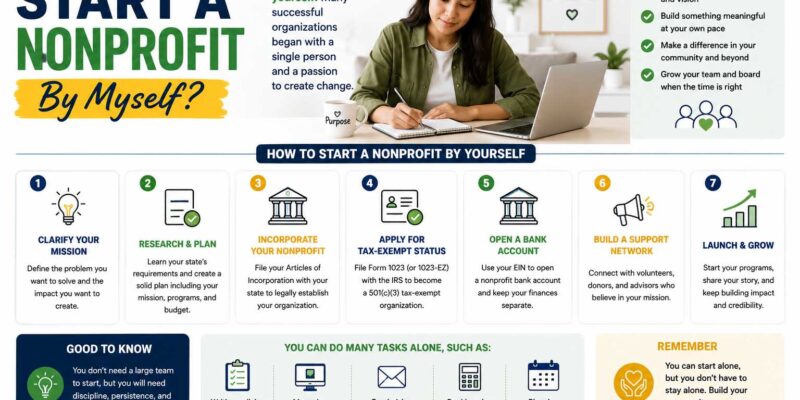
If you have a cause you care about, you may wonder, can I start a nonprofit by myself? In many cases, yes—you can handle much of the early planning and formation work on your own. However, running a nonprofit completely alone is a different matter. State incorporation rules, board requirements, federal tax-exemption rules, and ongoing governance responsibilities may require other people to become involved.
So, while a single founder can often turn an idea into a real organization, you should understand where individual control ends and formal nonprofit governance begins. Here is how the process works and what you should consider before filing paperwork.
Can I Start a Nonprofit by Myself Legally?
Generally, one person can develop a nonprofit’s mission, choose a name, create an initial plan, prepare documents, and begin the formation process. However, the exact legal requirements depend on the state where you incorporate and the nonprofit structure you choose.
For example, state law may specify how many directors a nonprofit corporation needs. Meanwhile, organizations seeking federal tax-exempt status must follow IRS rules that can affect governance, private benefit, compensation, and conflicts of interest.
You can certainly be the founder and handle much of the startup work yourself. Still, you may need directors, officers, or other participants to meet applicable requirements and create credible governance.
Before filing anything, learn how to start a nonprofit organization from the planning stage through incorporation and tax-exemption applications. That broader process helps you see where outside help may become necessary.
Can I Start a Nonprofit Organization by Myself?
A nonprofit is an organization created to pursue a mission rather than distribute profits to private owners. Nonprofits may support charitable, educational, religious, scientific, literary, or other qualifying purposes.
That does not mean a nonprofit cannot make money. In fact, it may receive donations, charge certain fees, sell goods or services related to its mission, employ workers, and generate more revenue than it spends.
However, those funds generally stay within the organization and support its mission. They do not function like profits distributed to shareholders.
This distinction matters when comparing types of ownership, because a nonprofit corporation does not operate with owners in the same way that a sole proprietorship or conventional corporation does.
Nonprofit Founder vs. Nonprofit Owner
You may create the nonprofit, serve as its executive director, and play a major role in its development. Still, you do not personally own the nonprofit’s assets.
Instead, the organization exists as a separate legal entity after proper formation. Its directors have duties to act in the organization’s interests, while its money and property must support legitimate organizational purposes.
Consequently, starting alone should not be confused with personally controlling every aspect of the organization indefinitely.
What Can I Do If I Start a Nonprofit by Myself?
A solo founder can complete a surprising amount of preparation before building a larger team.
First, define the problem you want the organization to address. Then, identify the people or community you intend to serve. A clear purpose makes later decisions about programs, funding, governance, and marketing much easier.
Next, research existing organizations. If several nonprofits already provide the same service locally, creating another organization may not be the best approach. Instead, you could collaborate with an existing nonprofit, volunteer, develop a new program, or use fiscal sponsorship.
You can also prepare a preliminary budget. Estimate startup filing fees, professional services, insurance, technology, fundraising expenses, program costs, and administrative spending.
Finally, identify potential board members before you need them. Look for people who understand the mission but can also bring independent judgment, financial awareness, community connections, legal knowledge, fundraising experience, or program expertise.
How to Start a Nonprofit by Yourself: Basic Steps
Although requirements differ by jurisdiction, most U.S. nonprofit startups follow a similar general path.
1. Define Your Nonprofit Mission
Start with a short statement explaining whom the organization serves, what it does, and why the work matters.
For instance, “helping people in need” is extremely broad. In contrast, providing after-school tutoring to underserved middle-school students in a particular community gives the organization a much clearer direction.
A focused mission also helps potential board members, donors, volunteers, and grantmakers understand what you are trying to accomplish.
2. Check Nonprofit Formation Requirements
Next, check the official nonprofit corporation requirements in your state. Rules can differ regarding directors, incorporation documents, registered agents, reports, and filing fees.
For example, someone researching how to start a nonprofit in California will need to follow California’s specific formation, registration, governance, and reporting requirements rather than relying on a generic nationwide checklist.
Because regulations can change, use current information from your state’s official agency and the IRS before submitting documents.
3. Choose Your Nonprofit Organization Name
Your nonprofit needs a name that complies with state rules and is distinguishable from names already registered where required.
Therefore, search your state’s business entity database before spending money on a website, logo, signs, or printed materials.
You may also want to check domain and social media availability. While branding comes later than legal compliance, consistent naming can make the organization easier for supporters to recognize.
4. Build a Board for Your Nonprofit
Even when you start the idea alone, a board can provide oversight and accountability. Depending on applicable law and your circumstances, you may need multiple directors.
Choose people based on useful skills and genuine commitment rather than simply filling seats. For example, a balanced board might include people with financial, fundraising, program-management, legal, community, or industry experience.
Also, avoid assuming that a board made entirely of relatives or close associates is automatically the best choice. Independent directors can strengthen governance and help manage conflicts of interest.
5. Form Your Nonprofit Organization
Usually, forming a nonprofit corporation requires filing articles of incorporation or a similarly named document with the appropriate state agency.
Your articles commonly include the organization’s name, purpose, registered agent information, and other required provisions. Organizations planning to seek 501(c)(3) recognition should pay close attention to language required for tax-exempt purposes.
At this stage, you may also wonder What Is a Business License and whether your nonprofit needs one. Incorporating a nonprofit does not automatically satisfy every local licensing, permit, registration, or tax requirement, so check the rules that apply to your activities and location.
6. Create Nonprofit Bylaws and Governance Policies
Bylaws explain how the nonprofit operates. They may cover board meetings, director terms, voting, officer responsibilities, committees, vacancies, and other governance matters.
A conflict-of-interest policy is also useful and may be particularly relevant during the federal tax-exemption process.
Even if your nonprofit begins very small, written rules reduce confusion later. As the organization grows, they also make transitions easier when new directors and officers join.
7. Get an EIN for Your Nonprofit
An Employer Identification Number identifies an organization for federal tax purposes. Despite the word “employer,” a nonprofit can generally need an EIN even before it hires employees.
You can request one from the IRS after properly forming the organization. You may also need it for banking and other administrative tasks.
8. Apply for Nonprofit Tax-Exempt Status
Creating a nonprofit corporation under state law does not automatically make the organization federally tax-exempt.
Organizations seeking recognition under Internal Revenue Code Section 501(c)(3), for example, generally apply to the IRS using the applicable Form 1023 process, subject to eligibility requirements.
The IRS guidance for applying for 501(c)(3) tax-exempt status explains the federal application process and related requirements.
The application asks for information about the organization’s structure, activities, finances, governance, and other matters. Therefore, keep accurate records from the beginning rather than trying to reconstruct them later.
9. Complete State and Local Nonprofit Requirements
After federal steps, you may still have state obligations. Depending on the organization and location, these can involve charitable solicitation registration, tax exemptions, annual reports, permits, or other filings.
Since these rules vary widely, avoid assuming that federal approval completes the entire setup process.
Can I Start a Nonprofit by Myself or Do I Need a Team?
Starting solo gives you freedom during the idea stage. However, building a small team can improve the organization before launch.
| Starting Mostly Alone | Starting With a Team |
|---|---|
| Faster early decisions | More perspectives |
| Easier mission development | Broader skills |
| Less coordination initially | Shared workload |
| Founder carries most tasks | Responsibilities can be divided |
| May require recruiting directors later | Governance can develop earlier |
Neither approach automatically produces a stronger nonprofit. Instead, your mission, available resources, state requirements, and personal capacity should guide the decision.
For instance, a small community project may begin with one highly motivated founder. In contrast, an organization planning complex programs or major fundraising may benefit from financial, operational, and legal expertise from the beginning.
How Much Does It Cost to Start a Nonprofit by Yourself?
There is no single startup price. Costs depend on your state, tax-exemption application, professional help, insurance needs, fundraising activities, technology, and programs.
At a minimum, plan for possible state incorporation fees and applicable federal filing fees. Meanwhile, you may spend more if you hire an attorney or accountant.
You might also need website hosting, accounting software, insurance, marketing materials, payment-processing services, or a registered-agent service.
However, avoid spending heavily on branding before establishing the legal and operational foundation. A polished logo cannot compensate for weak governance or an unclear mission.
Because fees and service prices change, verify current amounts directly with the relevant government agency or provider before budgeting.
Common Mistakes When Starting a Nonprofit Alone
One common mistake is treating the nonprofit like a personally owned business. Although a founder may have significant influence, nonprofit assets and income cannot simply become personal property.
Another mistake is recruiting board members only because they are friends. Instead, choose directors who will participate, ask useful questions, understand their responsibilities, and support the mission.
Founders also sometimes underestimate recordkeeping. Yet meeting minutes, financial records, receipts, policies, filings, and donor information can become essential as the organization grows.
Likewise, do not assume incorporation automatically gives you federal tax-exempt status. State formation and federal recognition are separate processes.
Finally, avoid launching too many programs immediately. A smaller, measurable first program often gives a new organization a better opportunity to learn what works.
Can I Start a Nonprofit by Myself and Pay Myself?
Potentially, a nonprofit can pay employees, including a founder who performs legitimate work for the organization. However, compensation must follow applicable rules and should be reasonable for the services provided.
Being the founder does not give you unrestricted access to nonprofit funds. Therefore, compensation decisions should follow proper governance procedures, and conflicts of interest need careful handling.
For a small startup, the organization may initially lack enough revenue to pay anyone. As a result, founders sometimes volunteer during the early stage and introduce paid positions only after funding becomes sustainable.
If compensation or tax questions are complex, seek advice from a qualified nonprofit attorney, accountant, or tax professional.
Do You Need a Lawyer When Starting a Nonprofit?
You do not necessarily need an attorney for every nonprofit formation. Many founders complete straightforward filings themselves by following official state and IRS instructions.
However, professional help may make sense when the organization has complicated governance arrangements, significant assets, unusual activities, major contracts, employees, complex fundraising plans, or questions about tax-exempt eligibility.
An accountant can also help establish bookkeeping practices and financial controls. Meanwhile, an attorney can address legal structure, governance, contracts, and compliance questions.
Paying for targeted professional guidance can sometimes be more practical than outsourcing the entire startup process.
FAQs: Can I Start a Nonprofit by Myself?
Can One Person Start a Nonprofit Organization?
One person can often begin the planning and formation process. However, state law or governance requirements may require multiple directors or officers. Therefore, check the specific rules that apply where you plan to form the organization.
Can One Person Be the Only Member of a Nonprofit?
Possibly, depending on the nonprofit’s structure and the law in the state where it is formed. However, member requirements and board requirements are separate issues. Therefore, check the rules for your specific nonprofit corporation.
Can I Run a Nonprofit From Home?
Often, small nonprofits begin from a home office. However, local zoning, lease or homeowners’ association rules, insurance, licensing, privacy, and the organization’s activities may affect whether this arrangement works.
Does a Nonprofit Need Employees?
No. Many small nonprofits initially rely on directors and volunteers. Later, the organization can hire employees when its programs and finances justify paid staffing.
Can a Nonprofit Make a Profit?
Yes, a nonprofit can have revenue left after expenses. However, those funds generally remain with the organization and support its exempt mission rather than being distributed to private owners.
Is Starting a Nonprofit Better Than Starting a Business?
That depends on your goal. If your primary objective is pursuing a qualifying public-serving mission, a nonprofit may fit. However, if you want to build personal equity and distribute profits to owners, a conventional for-profit structure may be more appropriate.
How to Move Forward With Your Nonprofit
So, can I start a nonprofit by myself? Yes, one person can develop the concept and often complete much of the startup work. However, forming a sustainable nonprofit usually means moving beyond a one-person project as governance, compliance, fundraising, and programs develop.
First, define one clear mission and research your state’s current requirements. Next, estimate realistic costs and identify capable board candidates. Then, work through formation, governance, tax, and registration requirements carefully rather than rushing to launch.
Most of all, build the organization around the mission instead of the founder. That approach creates a stronger foundation for attracting directors, volunteers, donors, and community partners as the nonprofit grows.