
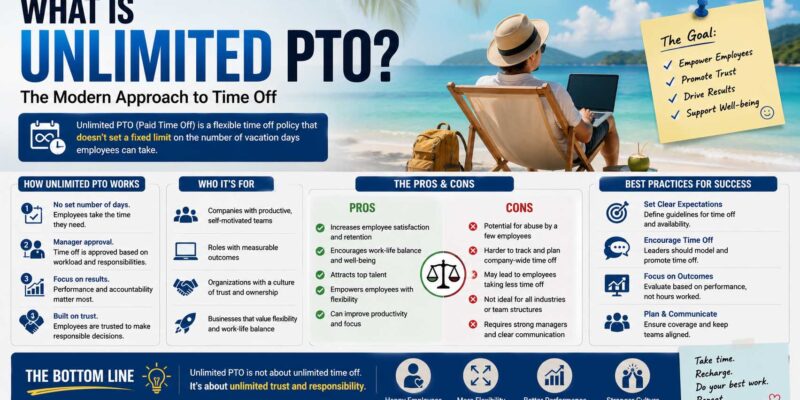
If a job posting says employees receive unlimited vacation days, the offer can sound almost too good to be true. So, what is unlimited PTO? It is a paid-time-off policy that generally allows eligible employees to request time away from work without receiving a fixed annual bank of PTO days. However, “unlimited” rarely means employees can take time off whenever they want without restrictions. Requests still usually depend on company policies, manager approval, workload, performance expectations, and applicable employment laws.
For businesses, unlimited PTO can reduce some administrative work while giving employees greater flexibility. Still, a poorly designed policy can create confusion about how much leave employees should actually take. Therefore, both employers and workers need to understand how the system operates before judging whether it is a valuable benefit.
What Is Unlimited PTO?
Traditional PTO policies usually give employees a specific number of paid days each year. For example, an employee might receive 15 PTO days that can be used for vacation, personal needs, or other approved absences.
Unlimited PTO removes that predetermined vacation balance. Instead, employees request paid leave when they need it, subject to the employer’s rules.
If you are first learning what is PTO, it helps to understand that paid time off is a broad workplace benefit. Depending on the employer, PTO may combine vacation and personal leave, while sick leave or other legally protected absences may be handled separately.
Under an unlimited system, employees generally do not watch a vacation balance increase throughout the year. However, employers still need a clear request and approval process.
What Does Unlimited PTO Mean in a Real Workplace?
Although people sometimes search what is unlimited PTO mean, the practical question is usually whether “unlimited” really has no limit.
In most workplaces, it does not mean unrestricted absence.
Suppose a marketing company has an unlimited PTO policy. An employee wants to take five paid days off for a family vacation. They submit a request to their manager, who checks project deadlines, team coverage, and other scheduled absences.
If the team can cover the work, the manager may approve the request. However, the same company could reject or reschedule a request during a critical project period if its written policy permits that approach.
Therefore, unlimited PTO is better understood as flexible access to paid vacation time rather than a promise of unlimited approved vacation.
How Does Unlimited PTO Work?
The exact process varies by employer. Still, many policies follow a straightforward pattern.
First, an eligible employee decides when they want time away. Next, they submit a request through a manager, HR system, or scheduling platform. Then, the company reviews the request according to its policy.
Common considerations include:
- Staffing and team coverage
- Major deadlines
- Previously approved vacations
- Employee performance or responsibilities
- Length of the requested absence
- Required advance notice
- Busy or restricted periods
Once approved, the employee receives normal pay during the covered absence according to company policy.
However, companies should clearly separate ordinary vacation policies from sick leave, family and medical leave, disability-related accommodations, parental leave, and other legally protected forms of absence. Applicable rules vary by jurisdiction.
For example, employers and employees in the United States can review the U.S. Department of Labor’s guidance on vacation leave when considering federal rules. State and local requirements may also apply, so businesses should review the laws relevant to their workforce.
Unlimited PTO vs. Traditional PTO
The biggest difference is whether employees accumulate a defined amount of paid leave.
| Feature | Traditional PTO | Unlimited PTO |
|---|---|---|
| Annual allowance | Usually fixed | Usually no fixed vacation bank |
| Accrual | Often earned over time | Usually not accrued |
| Request process | Generally required | Generally required |
| Manager approval | Often required | Usually required |
| Remaining balance | Can often be tracked | Usually no vacation balance |
| Year-end carryover | Depends on policy and law | Usually not applicable in the same way |
| Separation payout | Depends on policy and law | Can differ because leave may not accrue |
Neither model is automatically better. Instead, the quality of the policy depends heavily on company culture, management practices, legal compliance, staffing, and how comfortable employees feel taking leave.
What Is Unlimited or Flexible PTO?
The terms “unlimited PTO” and “flexible PTO” sometimes appear interchangeably, although employers may define them differently.
Unlimited PTO usually means there is no preset annual vacation allowance for eligible employees.
Flexible PTO may describe a similar system, or it may simply mean employees have greater freedom over how and when they use a defined PTO allowance.
Therefore, anyone evaluating what is unlimited or flexible PTO should read the actual employer policy instead of relying on the label.
A company should explain eligibility, approval procedures, notice requirements, expected use, restricted periods, extended absences, and what happens when employment ends.
Benefits of Unlimited PTO for Employees
One major advantage is flexibility. Employees do not necessarily need to save a limited number of vacation days for unexpected personal needs later in the year.
Likewise, workers may find it easier to plan vacations, family events, or occasional personal days without constantly checking a remaining vacation balance.
The policy can also reduce the feeling that every day away from work is being deducted from a scarce resource.
However, flexibility only works when employees genuinely feel comfortable using it. If managers rarely take vacation or routinely discourage requests, an unlimited policy may look generous on paper while providing little practical value.
That is why strong employee engagement best practices often include clear communication, supportive management, reasonable workloads, and consistent treatment rather than relying on benefits alone.
Why Employers Offer Unlimited PTO
Businesses may adopt unlimited PTO for several reasons.
First, the policy can make a compensation package more attractive to some candidates, particularly in industries where flexible work arrangements are common.
Second, it may simplify certain aspects of PTO balance administration because vacation days typically do not accumulate in the traditional way.
Third, employers may use flexibility as part of a broader strategy for creating an appealing workplace. Since the benefits of employee retention can include reduced hiring disruption and preservation of institutional knowledge, employers often look for policies that support a sustainable employee experience.
Still, unlimited PTO should not be treated as a quick retention solution. Employees also care about compensation, management quality, career development, workload, recognition, job security, and workplace culture.
Potential Disadvantages of Unlimited PTO
The word “unlimited” creates expectations, so unclear rules can quickly become frustrating.
Employees May Take Less Vacation
Without a defined allowance, some employees may wonder how much time off is considered acceptable.
For example, an employee with 20 traditional vacation days knows that the company has explicitly provided those days. Under an unlimited policy, the same employee may hesitate to request 20 days because there is no visible benchmark.
As a result, companies need to build a culture in which reasonable time off is actually encouraged.
Approval Can Feel Subjective
Manager discretion can create another problem.
If one manager regularly approves vacation while another frequently denies requests, employees may view the policy as inconsistent. Therefore, businesses need written standards and manager training to reduce arbitrary decisions.
Work Can Follow Employees on Vacation
Unlimited PTO has limited value if employees spend their vacation answering messages and joining meetings.
Before someone leaves, teams should identify who will handle urgent tasks, customer questions, and deadlines. This approach makes genuine time away more realistic.
It Can Create Misleading Expectations
Employers should avoid presenting unlimited PTO as “take as much vacation as you want” when substantial restrictions apply.
Clear language helps candidates understand the benefit before accepting a position.
What Is Unlimited PTO and How Does Payout Work?
Payout at separation is one area where unlimited PTO can differ significantly from traditional accrued vacation.
With a traditional system, an employee may have unused accrued vacation when employment ends. Whether the employer must pay that balance can depend on state or local law, the employer’s policy, and how the leave program is structured.
Under a genuine unlimited PTO system, employees generally do not accumulate a defined bank in the same way. Therefore, there may be no conventional unused balance to cash out.
However, businesses should not assume that calling a policy “unlimited” automatically eliminates every legal obligation. Employment laws vary, and courts or regulators may consider how the policy works in practice.
Employers reviewing do companies have to pay out PTO should therefore consider the rules that apply in the relevant jurisdiction and seek qualified employment-law guidance when necessary.
Unlimited PTO and Overall Compensation
Job seekers should evaluate unlimited PTO as one part of a complete employment package.
For instance, compare salary, health benefits, retirement contributions, bonuses, remote-work options, scheduling flexibility, parental benefits, and career opportunities alongside vacation policies.
Understanding the benefits of salary and other compensation structures can also help candidates judge the full value of an offer instead of choosing based on one attractive benefit.
During an interview, candidates can ask how much vacation employees typically take, how requests are approved, whether there are restricted periods, and whether managers actively encourage employees to disconnect.
These questions often reveal more than the word “unlimited.”
How Businesses Can Create a Better Unlimited PTO Policy
A successful policy needs more than a short statement in an employee handbook.
Establish Clear Eligibility
Employers should specify which workers qualify. For example, policies may differ for full-time, part-time, hourly, temporary, or newly hired employees.
Any classifications should comply with applicable employment rules.
Explain the Approval Process
Employees should know who approves requests, how far in advance to submit them, and what factors can lead to denial.
Clear procedures reduce uncertainty for both employees and managers.
Address Longer Absences
A two-day break is different from a six-week vacation. Therefore, employers may need separate procedures for unusually long discretionary absences while also distinguishing them from protected leave.
Encourage Employees to Take Meaningful Time Off
Managers influence workplace behavior. If leaders never take vacation, employees may interpret that as an unwritten expectation.
Instead, managers can plan coverage, encourage reasonable breaks, and avoid unnecessary contact with employees who are off.
Review Usage Patterns
HR teams can examine whether employees are actually using the benefit.
For instance, consistently low vacation use may indicate workload problems, unclear expectations, or a culture that discourages absence. Meanwhile, repeated staffing problems may show that the approval or coverage process needs adjustment.
Common Unlimited PTO Mistakes
One mistake is adopting the policy mainly because competitors offer it. A business should first consider whether its staffing model, management structure, and workload can support flexible leave.
Another mistake is leaving expectations vague. Employees should not have to guess whether taking two weeks of vacation will hurt their reputation.
Likewise, managers should avoid applying different unwritten standards to different team members.
Finally, businesses should not treat unlimited PTO as a replacement for every type of leave. Vacation, legally required sick leave, protected family or medical leave, accommodations, and other absence categories may have separate requirements.
Frequently Asked Questions About Unlimited PTO
What Is Unlimited PTO?
Unlimited PTO is a workplace policy that generally lets eligible employees request paid vacation or personal time without receiving a fixed annual vacation bank. Requests remain subject to the employer’s policy and approval process.
Does Unlimited PTO Mean Unlimited Vacation?
Not in practical terms. Employees normally must meet their responsibilities and follow request procedures, while employers can manage staffing and business needs according to their policies and applicable laws.
Do Employees Get Paid During Unlimited PTO?
Typically, approved unlimited PTO allows eligible employees to receive their regular pay while away. However, workers should check their employer’s written policy for specific terms.
Can an Employer Deny Unlimited PTO?
Generally, an unlimited policy does not mean every vacation request must be approved. Employers commonly consider staffing, deadlines, advance notice, and operational needs. However, legally protected leave is a separate matter and may carry different rights and obligations.
Is Unlimited PTO Better Than Traditional PTO?
It depends. Unlimited PTO can provide greater flexibility, while traditional PTO gives employees a clearly defined benefit and balance. Company culture and actual vacation usage often matter as much as the policy type.
Making Unlimited PTO Work in Practice
Understanding what is unlimited PTO requires looking beyond the attractive name. A well-designed policy can give employees meaningful flexibility while helping businesses manage time off without a fixed vacation bank. Yet the system works best when expectations are transparent, managers apply rules consistently, and employees genuinely feel able to take reasonable breaks.
For employees, the best approach is to read the written policy and ask how it operates in everyday practice. For employers, clear guidelines, fair approvals, reliable workload coverage, and supportive management can turn unlimited PTO from a recruiting phrase into a workplace benefit people can actually use.