
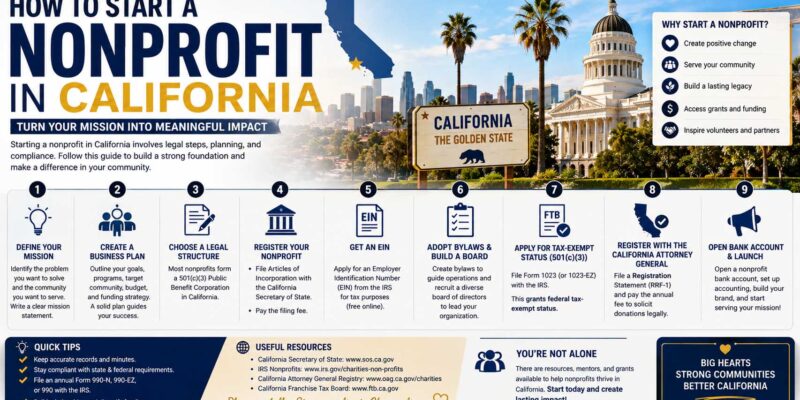
If you are wondering how to start a nonprofit in California, the process involves more than choosing a cause and collecting donations. You generally need to create a legal organization, establish a board, prepare governing documents, obtain an EIN, apply for federal tax-exempt status when appropriate, and complete California charity and tax requirements. Although the paperwork can seem complicated at first, the process becomes much easier when you handle each requirement in the right order.
A nonprofit can support education, community development, animal welfare, arts, health initiatives, environmental projects, religious activities, and many other missions. However, forming a nonprofit corporation does not automatically make the organization federally tax-exempt.
Therefore, founders should understand both the California formation process and the separate federal tax-exemption process before launching.
What Does It Mean to Start a Nonprofit in California?
A nonprofit is an organization created to pursue a purpose rather than distribute profits to private owners or shareholders. Still, a nonprofit can earn revenue, employ staff, pay reasonable salaries, and operate many of the same administrative functions as a business.
For many charitable founders, the common structure is a California nonprofit public benefit corporation that later seeks recognition under Section 501(c)(3) of the Internal Revenue Code.
However, “nonprofit” and “501(c)(3)” are not interchangeable terms. California incorporation creates the legal entity at the state level, while the IRS determines whether an organization qualifies for federal tax-exempt status.
If you are still learning the broader formation process, understanding how to start a nonprofit organization can help you separate basic nonprofit planning from California-specific filing requirements.
Likewise, founders comparing nonprofits with corporations, partnerships, and other structures may benefit from first understanding the main types of ownership and how nonprofit organizations differ from owner-controlled businesses.
How to Start a Nonprofit in California: Steps to Follow
Although individual situations vary, most charitable organizations follow a similar sequence.
A practical order looks like this:
- Define the charitable mission.
- Choose an available organization name.
- Select the initial board of directors.
- File nonprofit Articles of Incorporation.
- Prepare and adopt bylaws.
- Hold an organizational board meeting.
- Obtain an EIN from the IRS.
- Apply for federal tax-exempt status when required.
- Handle California tax-exemption requirements.
- Register with the California Attorney General when required.
- Set up ongoing accounting, reporting, and compliance procedures.
Each stage builds on the previous one. As a result, careful preparation early in the process can prevent filing problems later.
Step 1: Define Your Nonprofit’s Mission
Before filing forms, clearly explain what your organization will accomplish.
A strong mission answers three basic questions: Who will you serve? What problem will you address? How will your activities address that problem?
For example, “helping people” is too broad for practical planning. In contrast, a nonprofit that provides free after-school tutoring to low-income middle-school students has a much clearer purpose.
Your mission influences fundraising, programs, board recruitment, budgets, tax-exemption applications, and public messaging. Therefore, write it before you start building the organization around it.
At this stage, founders should also research existing organizations. If several established nonprofits already provide the same service locally, collaboration may create more impact than launching another organization.
Step 2: Choose a Name for the Organization
Next, choose a name that represents your mission and meets California naming requirements.
Before becoming attached to a name, search California business records and check whether another organization already uses it. Also, consider website domain availability and potential trademark conflicts.
A good nonprofit name should be easy to remember, easy to spell, and broad enough to support future growth.
For instance, a neighborhood-specific name may work initially. However, it can become restrictive if the organization later serves communities throughout California.
Step 3: Build Your Initial Board
A nonprofit corporation needs governance rather than traditional owners.
Therefore, your directors will have significant responsibilities. They help oversee finances, organizational policies, executive leadership, programs, conflicts of interest, and long-term direction.
Choose directors because they can contribute useful skills and sound judgment, not simply because they are friends or relatives. Ideally, a board combines expertise in areas such as finance, fundraising, legal matters, community outreach, operations, and the nonprofit’s mission.
California nonprofit governance rules can vary based on the organization’s structure and circumstances. Consequently, founders should review the current statutory requirements before deciding board composition.
Step 4: File Articles of Incorporation
The next major part of how to start a nonprofit in California is legally creating the corporation.
Generally, this means filing appropriate nonprofit Articles of Incorporation with the California Secretary of State. The articles establish the corporation and provide core information about it.
If you plan to seek 501(c)(3) status, the document should contain language that satisfies federal requirements concerning the organization’s exempt purpose and distribution of assets after dissolution.
Small wording errors can create problems during the federal exemption process. Therefore, use the current California forms and IRS guidance rather than copying an old document found online.
Also, remember that forming the corporation does not by itself grant federal 501(c)(3) status.
Step 5: Create Bylaws and Governance Policies
After forming the corporation, prepare bylaws.
Bylaws act as the organization’s internal operating rules. For example, they commonly explain how directors are selected, how meetings work, how voting takes place, what officers do, and how governance decisions are made.
The board should formally adopt the bylaws and keep them with the organization’s permanent records.
Meanwhile, many organizations also adopt a conflict-of-interest policy. This policy helps the board identify situations where a director’s personal or financial interests could interfere with the nonprofit’s interests.
Good governance may feel unnecessary when an organization has only a few volunteers. However, clear rules become much more valuable once donations, employees, grants, and larger programs enter the picture.
Step 6: Hold the Organizational Board Meeting
Once the corporation exists, the initial board should formally organize it.
During this meeting, directors may adopt the bylaws, appoint officers, approve policies, establish the fiscal year, authorize a bank account, and approve steps needed for tax-exempt applications.
Document major decisions in written meeting minutes.
Accurate records create a clear history of board actions. They also make future audits, grant applications, leadership transitions, and compliance work easier to manage.
Religious founders may face different federal filing rules in certain circumstances. Therefore, anyone researching How to Start a Church should review the special rules that can apply to churches rather than assuming every charitable organization follows exactly the same exemption process.
Step 7: Get an Employer Identification Number
Your nonprofit should obtain an Employer Identification Number, commonly called an EIN, from the IRS.
An EIN functions as the organization’s federal taxpayer identification number. Despite the word “employer,” an organization generally needs an EIN for important administrative and tax purposes even if it does not initially have employees.
You will commonly need the EIN for banking, tax filings, exemption applications, payroll, and other administrative tasks.
Obtaining an EIN directly from the IRS is free. Therefore, be cautious about third-party websites that charge unnecessary fees for a service you can complete through the government.
Step 8: Apply for Federal 501(c)(3) Status
For many charitable nonprofits, federal tax exemption is one of the biggest steps.
Organizations seeking recognition under Section 501(c)(3) generally apply using Form 1023 or, when eligible, the streamlined Form 1023-EZ. These applications require information about the organization’s structure, activities, governance, and finances.
Not every organization qualifies for the streamlined application. Instead, founders should review the current eligibility requirements before choosing the filing route.
Application procedures and government fees can change. Therefore, confirm the current IRS requirements before submitting the application rather than relying on an older fee or filing method.
The application may require information about your activities, finances, governance, compensation, fundraising, and organizational structure. As a result, keeping good records from the beginning makes this stage easier.
How Much Does It Cost to Start a Nonprofit in California?
There is no single total because costs depend on your filing route, tax-exemption application, professional help, insurance, fundraising plans, and operating needs.
Government filing fees may apply at several stages, including incorporation, federal exemption, or state charity registration. Because agencies can change their fees, check the current amounts before budgeting or filing.
Beyond government fees, you may spend money on accounting, legal assistance, insurance, a website, bookkeeping software, fundraising systems, marketing, and program operations.
Therefore, when asking how much to start a nonprofit in California, separate formation expenses from the money needed to actually operate the mission. A legally formed organization without enough working capital may struggle before its programs gain traction.
Step 9: Handle California Tax Exemption
Federal recognition does not mean you should ignore California tax requirements.
California’s Franchise Tax Board handles state income and franchise tax exemption. Depending on the organization’s situation, the appropriate exemption process may differ.
Therefore, after obtaining or applying for federal recognition, review the current California Franchise Tax Board requirements and determine which filing route applies.
Keep copies of every approval letter and government filing. You may need these documents for banking, grant applications, charity registration, and future reporting.
Step 10: Register With the California Attorney General
Charitable organizations may also need to register with the California Attorney General’s Registry of Charities and Fundraisers.
Registration requirements depend on the organization’s activities and applicable California rules. Therefore, founders should review the California Attorney General’s official charity registration guidance for current registration forms, deadlines, reporting requirements, and other compliance information.
Supporting documents may include founding documents, bylaws, tax-exemption records, and other organizational materials required for registration.
This requirement matters because creating the corporation and receiving IRS recognition do not automatically replace California charity-registration responsibilities.
Do California Nonprofits Need Business Licenses?
Sometimes.
The answer depends on where the nonprofit operates and what activities it conducts. Local governments may impose licensing, permit, zoning, or registration requirements even when an organization operates on a nonprofit basis.
Therefore, understanding What Is a Business License can be useful before signing a lease, opening a physical location, running regulated programs, or starting revenue-generating activities.
For example, childcare, food service, healthcare-related activities, raffles, and certain fundraising operations may trigger requirements beyond basic nonprofit formation.
Check applicable city, county, and state rules rather than assuming tax-exempt status removes every licensing obligation.
Common Mistakes New Nonprofit Founders Make
One common mistake is treating the nonprofit like a founder-owned business. A charitable nonprofit exists to pursue its mission, while its assets generally cannot simply be distributed to founders for personal benefit.
Another mistake is starting fundraising before understanding registration requirements. Because charity-registration obligations can relate to fundraising and charitable assets, fundraising should be coordinated with compliance planning.
Poor recordkeeping creates problems as well. Save incorporation documents, bylaws, board minutes, financial statements, tax filings, receipts, donor records, and government correspondence.
Finally, do not assume approval ends your compliance responsibilities. California charities can face ongoing state reporting requirements, while federally tax-exempt organizations may have annual IRS filing obligations.
Keeping a California Nonprofit Compliant
Learning how to start a nonprofit organization in California is only the first stage. Once the organization is active, create a simple annual compliance calendar.
Track federal returns, California filings, Attorney General reporting, board meetings, permits, insurance renewals, fundraising registrations, and internal financial reviews.
Registered charities may have ongoing renewal and reporting obligations after initial registration. Therefore, keep current filing deadlines on the organization’s compliance calendar.
Meanwhile, maintain a realistic budget and separate organizational money from personal finances. Open an account in the nonprofit’s name and use a consistent bookkeeping system from the beginning.
As donations increase, financial transparency becomes even more valuable. Clear reports help the board make decisions while also strengthening accountability to donors and grantmakers.
FAQs About Starting a California Nonprofit
How Long Does It Take to Start a Nonprofit in California?
The timeline varies because several agencies can be involved. Forming the state corporation is only one stage, while federal tax-exemption review and other registrations may take longer. Therefore, avoid promising donors or program partners a specific launch date until your required approvals and registrations are clear.
Can One Person Start a Nonprofit in California?
One person can begin developing the idea and organizing the project. However, nonprofit corporations have governance requirements, so you should review California’s current rules for directors, officers, and board composition before filing.
Can a Nonprofit Make Money?
Yes. A nonprofit can earn revenue through programs, services, memberships, donations, grants, and other lawful activities. However, earnings cannot simply be distributed to private owners like profits from a conventional business.
Do I Need an Attorney to Start a Nonprofit?
Not every founder hires an attorney. Still, professional help can be useful when the organization has complicated programs, substantial assets, unusual governance arrangements, major contracts, or questions about tax-exempt eligibility.
Is a Nonprofit Automatically a 501(c)(3)?
No. State nonprofit incorporation and federal tax-exempt recognition are separate matters. Organizations seeking IRS recognition under Section 501(c)(3) generally follow the applicable federal exemption application process.
Build the Organization Before You Build the Fundraising Campaign
The smartest approach to how to start a nonprofit in California is to build the legal and operational foundation before aggressively promoting the organization. Start with a specific mission, choose capable directors, establish clear governance, complete the appropriate filings, and create reliable financial systems.
Then focus on programs and fundraising. A strong nonprofit is not defined only by receiving tax-exempt status; instead, it needs responsible leadership, accurate records, sustainable finances, and measurable work that supports its mission.
Because filing forms, fees, and regulatory requirements can change, verify the current requirements with the relevant California agencies and the IRS before submitting applications. This small check can prevent outdated information from turning into an expensive filing mistake.