
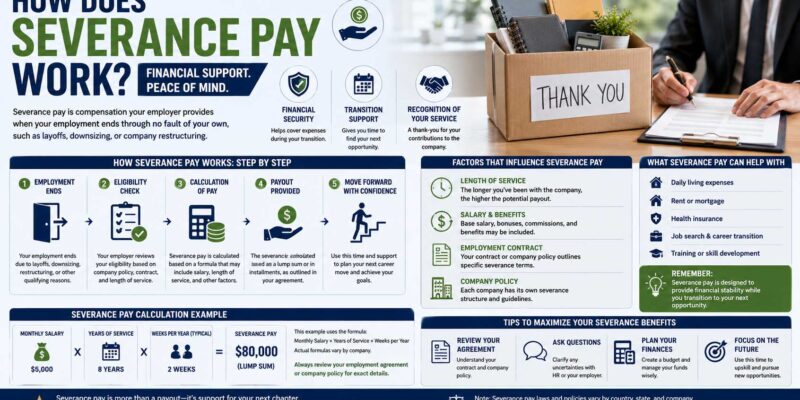
Losing a job can create immediate questions about income, health insurance, unused benefits, and what happens next. One of the first questions many employees ask is how does severance pay work? Severance pay is compensation that some employers provide when an employment relationship ends, often after a layoff, restructuring, position elimination, or negotiated departure. However, not every employee receives it, and the amount can vary significantly.
An employer might offer several weeks of salary, a lump-sum payment, temporary continuation of certain benefits, or a package containing several forms of compensation. Meanwhile, the employee may need to sign a severance agreement before receiving some or all of those benefits.
Because employment laws and company policies vary by jurisdiction, employees should review their specific agreement and applicable laws rather than assuming every severance package follows the same rules.
What Is Severance Pay and How Does It Work?
Severance pay is money an employer may provide to an employee when employment ends.
In the United States, federal law generally does not require employers to provide severance simply because an employee has been terminated. Instead, entitlement may arise from an employment contract, collective bargaining agreement, company policy, severance plan, or another legally enforceable commitment. The U.S. Department of Labor’s guidance on severance pay explains that the Fair Labor Standards Act does not require severance pay and that agreements between employers and employees generally determine it.
Therefore, the answer to what is severance pay and how does it work depends partly on the employer and the employee’s circumstances.
For example, a company undergoing restructuring might offer affected employees two weeks of regular pay for every completed year of service. Another employer may offer a fixed eight-week package regardless of tenure.
Employees should distinguish severance from ordinary wages they have already earned. Likewise, severance is separate from questions about what is PTO, although unused paid time off may appear alongside severance in the employee’s final compensation paperwork.
Why Do Companies Offer Severance?
Companies offer severance for several reasons.
First, it can provide financial support while an employee looks for another job. As a result, an unexpected employment transition may become more manageable.
Second, organizations sometimes use standardized severance policies to create a more consistent process during layoffs or restructuring.
Third, severance packages can include agreements addressing legal claims, confidentiality, company property, or other post-employment matters.
Employers may also offer career-transition services, temporary benefit assistance, or other support.
However, a severance package is not simply a gift in every case. If an employer asks the employee to sign an agreement in exchange for compensation, the employee should understand exactly what rights and obligations the document contains.
How Does Severance Pay Work When Calculating the Amount?
There is no universal formula that every employer must use.
Instead, companies may base severance on length of service, salary, job level, employment agreement, internal policy, reason for separation, or a combination of factors.
A company formula might look like:
Two weeks of base pay × completed years of service
Suppose an employee earns $1,500 per week and has worked for the company for six completed years.
Under that hypothetical policy:
2 weeks × 6 years = 12 weeks
Then:
12 × $1,500 = $18,000
The employee’s gross severance would therefore be $18,000 before applicable taxes and deductions.
However, this is only an example, not a standard legal formula.
Compensation structure also matters when interpreting workplace pay. Employees comparing their regular earnings may find the difference between salary and hourly useful because employers can structure severance formulas differently depending on company policy and the employee’s normal compensation arrangement.
Lump Sum vs. Salary Continuation
Employers commonly structure severance in one of two broad ways: a lump sum or payments over time.
Lump-Sum Severance
With a lump sum, the employer generally pays the agreed severance amount at once, subject to the agreement’s terms and applicable deductions.
For example, someone offered $15,000 in severance might receive that amount through one payment rather than remaining on the normal payroll schedule for several months.
A lump sum provides immediate access to the money. However, tax withholding and the interaction with unemployment benefits can depend on applicable rules and circumstances.
Continued Payments
Another employer may continue making payments according to a regular payroll schedule for a defined period.
For example, an employee could receive the equivalent of eight weeks of compensation through normal biweekly payments.
Still, salary continuation does not necessarily mean the person remains an active employee. Therefore, employees should check whether benefits, employment status, and other rights continue during the payment period.
What Can a Severance Package Include?
Severance packages can contain more than cash.
Depending on the employer and agreement, a package may address:
- Severance compensation
- Unused vacation or PTO
- Health insurance information
- Bonuses or commissions
- Stock or equity treatment
- Retirement plan information
- Outplacement assistance
- Company equipment
- References or employment verification
- Confidentiality obligations
- Release of legal claims
Because each item can follow different rules, employees should read the entire package rather than focusing only on the headline payment.
For salaried workers, some of the benefits of salary may include predictable regular compensation during employment. However, termination can change how bonuses, benefits, and other forms of compensation are handled. The severance agreement should explain what continues and what ends.
Severance Pay vs. Final Paycheck
A final paycheck and severance pay are not the same thing.
Your final paycheck generally covers wages you already earned before your employment ended. Severance, meanwhile, is separate compensation connected with the termination of employment.
Depending on applicable law and company policy, a final paycheck may include regular wages and certain other earned amounts.
Unused vacation or PTO creates another issue. State laws and employer policies vary, so employees asking do companies have to pay out PTO need to check the rules that apply to their location and the employer’s established policy.
Therefore, review each line of your final compensation rather than assuming one large payment represents only severance.
Does Severance Pay Get Taxed?
In the United States, severance pay is generally treated as taxable wages.
As a result, employers generally withhold applicable federal income tax and payroll taxes. State or local taxes may also apply depending on location.
Consequently, the amount deposited into your bank account can be noticeably lower than the gross severance amount shown in the agreement.
The payment method and withholding rules can also affect what the paycheck looks like.
Employees with large severance packages or unusual financial circumstances may want to speak with a qualified tax professional about their individual situation.
Does Severance Affect Unemployment Benefits?
Potentially.
Unemployment programs operate at the state level, and the treatment of severance can vary. The structure and timing of the severance payment may also matter.
For example, a state may treat certain severance arrangements differently depending on whether the payment applies to a specific period after termination.
Therefore, do not assume receiving severance automatically makes you eligible or ineligible for unemployment benefits.
Instead, apply according to your state’s procedures and accurately report the severance when asked. The relevant unemployment agency can then determine eligibility based on current rules and your circumstances.
How Does Severance Pay Work in California?
Employees frequently ask how does severance pay work in California because the state has detailed employment rules.
California generally does not require an employer to provide severance pay merely because an employee has been terminated. However, an employer may have an obligation when severance is promised through an enforceable agreement, policy, or other arrangement.
California also has specific rules surrounding final wages and earned vacation. Accrued vacation generally cannot simply disappear at termination when it qualifies as earned wages under California law.
Still, severance and accrued vacation are separate concepts.
Because California employment rules can change and individual agreements differ, employees dealing with significant compensation or disputed terms should consider guidance from a qualified California employment professional.
What Is a Severance Agreement?
A severance agreement is a contract setting out the terms under which an employee receives severance compensation or other benefits.
The document may explain the payment amount, payment date, benefits, return of company property, confidentiality requirements, and other conditions.
It may also contain a release of certain legal claims against the employer.
Therefore, employees should avoid signing simply because they want the payment quickly.
Read every section carefully. If the wording is unclear or the agreement involves substantial compensation, disputed termination circumstances, discrimination concerns, restrictive provisions, or other legal issues, consider consulting a qualified employment attorney.
Certain employees may also have legally required consideration or revocation periods for particular waivers, depending on the circumstances.
Severance After a Layoff vs. Being Fired
Severance is commonly associated with layoffs, but termination circumstances can influence eligibility.
For instance, an employer may offer severance when positions disappear because of restructuring, mergers, cost reductions, or facility closures.
By contrast, a company policy may provide less or no severance when an employee is terminated for certain forms of misconduct.
However, there is no universal rule that every laid-off worker receives severance or every fired worker loses eligibility.
Instead, the controlling employment agreement, severance plan, company policy, and applicable law matter.
Likewise, voluntary resignation and what is job abandonment involve different employment circumstances, so employees should not assume severance policies treat every type of separation identically.
Can You Negotiate a Severance Package?
Sometimes.
Whether negotiation is realistic depends on the employer, the employee’s position, the circumstances of departure, and whether the package follows a standardized company plan.
Potential discussion points might include the payment amount, payment timing, health coverage assistance, treatment of bonuses or commissions, references, outplacement support, or the termination date.
However, employees should identify what matters most rather than asking for changes without a clear reason.
For example, continued health coverage assistance may be more valuable to one employee, while another may prioritize payment amount or the treatment of an upcoming bonus.
If legal rights or substantial compensation are involved, professional advice may help the employee evaluate the proposed terms.
What to Review Before Signing
A severance offer can contain several pages of detailed terms. Therefore, review it systematically.
Check:
- The gross severance amount
- How the employer calculated it
- When payments will arrive
- Whether payments are lump sum or installments
- What happens to health coverage
- Treatment of unused PTO or vacation
- Treatment of commissions and bonuses
- Stock or equity provisions
- Retirement plan information
- Any release of legal claims
- Confidentiality or other post-employment obligations
- Deadlines for accepting the agreement
- Any applicable revocation period
Also, compare the agreement with your employment contract, employee handbook, compensation plan, and prior written promises where relevant.
Common Severance Mistakes to Avoid
One mistake is assuming the first number presented is the only part of the package worth reviewing.
Benefits, bonuses, commissions, equity, vacation, and insurance can have significant value as well.
Another mistake is confusing severance with wages already earned. Therefore, keep those categories separate when reviewing the final payment.
Employees may also overlook deadlines. Some offers remain available only for a specific period.
Finally, avoid making financial plans based on the gross severance amount. Taxes and other applicable deductions can reduce the amount you actually receive.
Practical Steps After Receiving a Severance Offer
Start by reading the full document rather than signing immediately.
Then, write down any unclear terms and compare the package with relevant employment documents.
Next, calculate the approximate gross payment and review the proposed payment schedule. At the same time, check what happens to health insurance and other benefits.
After that, review unemployment application requirements and prepare a short-term budget based on realistic after-tax funds rather than the headline severance amount.
If the agreement asks you to waive legal rights or the termination involves complicated circumstances, professional legal advice may be worthwhile.
Understanding how does severance pay work gives you a better foundation for evaluating the offer, but the actual agreement controls many of the practical details.
Frequently Asked Questions
How Does a Severance Pay Work?
An employer offers compensation or benefits connected with the end of employment, often under a company policy or severance agreement. The employer may calculate the payment using salary, years of service, position, or another formula. In some cases, the employee must sign an agreement before receiving the offered severance.
Is Severance Pay Required by Law?
In the United States, federal law generally does not require severance pay simply because employment ends. However, an obligation may arise from an employment contract, collective bargaining agreement, severance plan, company policy, or another enforceable commitment. State laws can affect related termination issues.
How Much Severance Pay Is Normal?
There is no universal amount. Some employers use formulas based on weeks of pay for each year of service, while others offer fixed amounts. Seniority, position, company policy, contracts, and termination circumstances can all affect the offer.
Can an Employer Pay Severance in Installments?
Yes. Some severance arrangements use payments over time rather than a single lump sum. The agreement should explain the payment schedule and any conditions attached to continued payments.
Do You Get Severance if You Quit?
Usually, severance programs focus on employer-initiated separations such as layoffs, but policies vary. However, some negotiated departures may include severance even when an employee agrees to leave voluntarily. Check the applicable plan or agreement.
Can You Get Severance and Unemployment at the Same Time?
Possibly, but unemployment rules vary by state. Severance amount, payment structure, and timing can affect eligibility in some jurisdictions. Therefore, report your severance accurately when applying and allow the state unemployment agency to determine eligibility.