
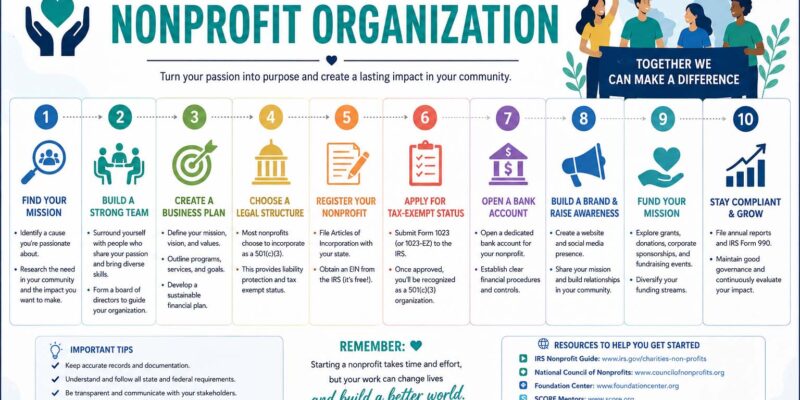
Learning how to start a nonprofit organization begins with more than having a good idea. It requires identifying a real need, defining a clear mission, creating an appropriate organizational structure, securing funding, and meeting applicable legal requirements.
Whether your goal is supporting education, helping families, protecting animals, improving healthcare, organizing youth sports, or serving another community need, creating a nonprofit requires careful planning and long-term commitment.
Fortunately, you don’t need years of business experience to begin. By following a structured process, you can build an organization that is legally organized, financially responsible, and prepared to pursue its mission.
In this guide, you’ll learn how to start a nonprofit organization, including planning, startup costs, registration, fundraising, management, and practical steps for running the organization after launch.
What Is a Nonprofit Organization?
A nonprofit organization is an entity established to pursue a mission rather than distribute profits to owners or shareholders.
For example, depending on its purpose and jurisdiction, a nonprofit might support charitable, educational, religious, scientific, cultural, environmental, or community-focused activities.
Examples include:
- Food banks
- Animal rescue organizations
- Educational foundations
- Community health charities
- Environmental groups
- Youth sports organizations
- Scholarship programs
Therefore, any revenue remaining after expenses is generally retained by the organization and used to support its activities and mission rather than distributed to private owners.
However, it is important to distinguish nonprofit status from federal tax-exempt status in the United States. The IRS explains that state law governs nonprofit status, while federal law governs exemption from federal income tax. Its guidance for organizations applying for tax-exempt status provides official federal information.
Why Start a Nonprofit?
For instance, people create nonprofits for many different reasons.
For example, common goals include:
- Solving community problems
- Supporting underserved populations
- Providing educational opportunities
- Improving public health
- Protecting the environment
- Supporting local sports programs
- Creating long-term community impact
In addition, a nonprofit can bring together volunteers, donors, businesses, professionals, and community leaders around a shared mission.
Before forming one, however, research whether another organization already addresses the same problem. Sometimes collaborating with an established nonprofit can be more effective than creating a new organization.
Step-by-Step: How to Start a Nonprofit Organization
Starting a nonprofit becomes easier when you divide the process into manageable stages.
However, requirements vary by location. Therefore, treat these steps as a general framework and verify the legal and tax requirements that apply where your organization will operate.
Step 1: Define Your Mission
In other words, Your mission explains why the organization exists. In addition, it identifies whom the organization intends to serve.
First, answer these questions:
- What problem are you trying to solve?
- Who will benefit?
- What services will you provide?
- Where will you operate?
- What impact do you hope to create?
For example:
“Our mission is to provide free educational resources for underserved students in our community.”
As a result, a focused mission can guide programs, fundraising, hiring, partnerships, and future decisions.
Step 2: Research Community Needs
Before creating the organization, confirm that your idea addresses a genuine need.
For example, research:
- Existing nonprofits
- Community surveys
- Government reports
- Local statistics
- Potential beneficiaries
- Interviews with community members
- Existing services and gaps
If another organization already provides similar services, determine whether your nonprofit would address a different population, location, or unmet need.
Step 3: Create a Nonprofit Business Plan
Although nonprofits are mission-driven, they still require careful financial and operational planning.
For example, your plan can include:
- Mission statement
- Target population
- Programs and services
- Funding strategy
- Marketing plan
- Operating budget
- Leadership structure
- Fundraising approach
- Short- and long-term goals
In addition, a practical plan can help communicate your idea to potential board members, donors, grantmakers, and community partners.
Step 4: Choose the Appropriate Legal Structure
The exact structure depends on your jurisdiction.
This is also where understanding different types of ownership can help clarify how nonprofit structures differ from conventional for-profit businesses.
Depending on your location, you may need to:
- Create governing documents
- File formation documents
- Register with government agencies
- Appoint directors
- Adopt bylaws
- Obtain identification numbers
- Apply separately for tax-exempt status
Therefore, always verify current requirements with the relevant government agencies.
Step 5: Build a Board of Directors
A board can provide governance, accountability, financial oversight, and strategic direction.
In addition, look for people who understand or can contribute to areas such as:
- Finance
- Law
- Marketing
- Fundraising
- Community leadership
- Education
- Program management
- Business operations
Similarly, board requirements vary by jurisdiction. Therefore, verify how many directors are required and whether any independence or residency rules apply.
If you’re wondering can I start a nonprofit by myself, you can begin much of the planning independently. However, formal governance requirements may mean other people must become involved before or during formation.
Step 6: Register Your Organization
Once your mission, structure, and leadership are established, complete the required registrations.
Depending on the jurisdiction, this process may include:
- Choosing an available organization name
- Preparing formation documents
- Filing with the appropriate authority
- Obtaining an identification number
- Creating bylaws
- Opening an organizational bank account
- Applying for tax-exempt recognition when appropriate
Afterward, keep copies of formation documents, registrations, agreements, board minutes, financial records, and other important paperwork.
Step 7: Develop a Funding Strategy
Even nonprofit organizations need reliable income.
For example, potential funding sources include:
- Individual donations
- Corporate sponsorships
- Government grants
- Foundation grants
- Membership fees
- Community fundraising events
- Online crowdfunding
- Program revenue where appropriate
- Merchandise sales where permitted
Instead of depending entirely on one source, consider building a diversified funding model.
For example, an organization might combine individual donations with grants, sponsorships, and fundraising events.
Quick Nonprofit Startup Checklist
| Task | Complete? |
|---|---|
| Define your mission | □ |
| Research community needs | □ |
| Create a business plan | □ |
| Choose an organizational structure | □ |
| Recruit board members | □ |
| Prepare governing documents | □ |
| Register the organization | □ |
| Obtain required identification numbers | □ |
| Apply for tax-exempt status if appropriate | □ |
| Open an organizational bank account | □ |
| Create a fundraising plan | □ |
| Build a website | □ |
| Begin community outreach | □ |
How Much Money Is Needed to Start a Nonprofit Organization?
Generally, startup costs vary considerably.
For instance, your expenses depend on your jurisdiction, filing requirements, organization size, professional services, programs, insurance needs, technology, and fundraising strategy.
For example, typical expenses can include:
| Expense | Potential Cost |
|---|---|
| Registration and filing fees | Varies by jurisdiction |
| Professional legal assistance | Optional; cost varies |
| Accounting support | Varies |
| Website and hosting | Low to moderate |
| Insurance | Depends on activities |
| Marketing materials | Flexible |
| Office and program supplies | Based on needs |
However, avoid relying on a universal dollar estimate because official filing fees and organizational needs can change.
Instead, create a startup budget based on the actual requirements in your jurisdiction.
How to Start a Nonprofit Organization With No Money
Starting with very little money is possible in some circumstances. However, “no money” does not necessarily mean there will be no costs.
Formation fees, insurance, registrations, professional assistance, technology, or program expenses may still apply.
Nevertheless, founders can reduce early expenses by:
- Recruiting volunteers
- Using free or low-cost software
- Starting with a simple website
- Using donated meeting space
- Applying for appropriate grants
- Seeking donated supplies
- Building community partnerships
- Using organic social media
- Starting with a small pilot program
For example, rather than immediately renting an office, a new nonprofit may initially work remotely or use donated community space.
Ultimately, the goal is to keep overhead manageable without ignoring important legal, financial, or operational requirements.
Is There a “How to Start a Nonprofit Organization With No Money PDF”?
For example, people sometimes search for a printable nonprofit startup guide or checklist.
While a PDF can be convenient, legal and tax requirements may change. A generic document can also become outdated or may not reflect your jurisdiction.
Therefore, use downloadable checklists primarily as organizational tools and verify legal or tax information against current government guidance before filing documents.
Alternatively, you can create your own checklist using the steps in this guide and adapt it to your state, country, mission, and planned activities.
How to Start a Nonprofit in California
The overall planning process is similar. However, state-specific formation and registration requirements matter.
If California is your location, use our dedicated guide on how to start a nonprofit in California rather than relying only on general nonprofit formation information.
As a result, you can focus specifically on California requirements while keeping this article centered on the broader startup process.
How to Start a Youth Sports Nonprofit Organization
A youth sports nonprofit follows many of the same general formation steps. However, its programs may create additional operational responsibilities.
For example, plan for areas such as:
- Equipment purchases
- Volunteer coaches
- Child-safety policies
- Insurance
- Background checks where applicable
- Field or facility rentals
- Parent communication
- Transportation
- Emergency procedures
- Fundraising
In addition, youth sports organizations may receive support through local sponsorships, fundraising events, participant fees where appropriate, donations, and community partnerships.
Starting a Religious Nonprofit or Church
However, religious organizations can have different legal and tax considerations from other nonprofit organizations.
Therefore, if your goal is specifically to establish a religious organization, our guide on How to Start a Church covers that narrower topic.
Before filing documents, verify which rules apply to your organization’s structure and activities.
Build a Strong Nonprofit Marketing Strategy
After formation, people need to know that the organization exists and understand why its mission matters.
Create a Professional Website
First, your website should clearly explain:
- Your mission
- Programs
- Community served
- Ways to donate
- Volunteer opportunities
- Contact information
- Progress or impact
In addition, keep important information easy to find, especially for potential donors and volunteers.
Use Social Media Strategically
Moreover, social media can help nonprofits communicate directly with supporters.
For example, possible content includes:
- Volunteer activities
- Community events
- Program updates
- Impact stories
- Fundraising campaigns
- Educational information
However, consistency is generally more useful than opening accounts on every platform and rarely updating them.
Build an Email List
In addition, email gives the organization a direct way to communicate with supporters, volunteers, donors, and community partners.
For example, use it for relevant updates, fundraising campaigns, program information, event announcements, and impact reports.
How to Run a Nonprofit Organization After Launch
In fact, formation is only the beginning.
Afterward, management becomes an ongoing responsibility. This is particularly important because people researching nonprofit formation often also need to understand how the organization operates after launch.
For example, key priorities include:
- Maintaining accurate financial records
- Following governing documents
- Holding required board meetings
- Tracking donations and expenses
- Monitoring program outcomes
- Meeting applicable filing deadlines
- Managing volunteers and employees
- Maintaining donor relationships
- Reviewing budgets
- Protecting the organization’s mission
Therefore, creating a nonprofit and successfully running one should be viewed as two connected but different stages.
Leadership Tips for Long-Term Growth
Furthermore, strong leadership can help a nonprofit remain focused as it grows.
Effective leaders generally:
- Communicate openly
- Delegate responsibilities
- Listen to volunteers and staff
- Track measurable goals
- Review finances regularly
- Recognize achievements
- Continue learning
- Keep programs aligned with the mission
In addition, leadership should create systems that allow the organization to function effectively without depending entirely on one founder.
Common Mistakes to Avoid
However, new nonprofits often face similar challenges.
Starting Without a Clear Mission
A vague mission can make fundraising, program development, and decision-making more difficult.
Therefore, define who you serve, what you do, and what outcome you want to achieve.
Depending on One Funding Source
A major donor or grant can provide valuable support. However, depending entirely on one source can create financial risk.
Where practical, diversify funding.
Ignoring Legal Requirements
In fact, formation does not eliminate ongoing responsibilities.
For example, depending on the organization and jurisdiction, there may be annual filings, tax requirements, charitable solicitation rules, employment obligations, and reporting deadlines.
Weak Financial Planning
Therefore, create realistic budgets and monitor actual income and expenses.
In addition, financial records should be organized enough to support reporting, planning, and accountability.
Poor Communication
Keep board members, employees, volunteers, donors, and other important stakeholders appropriately informed.
As a result, clear communication can help prevent confusion and support trust.
Best Practices for Running a Successful Nonprofit
Long-term nonprofit management requires consistent attention rather than focusing only on formation.
For example, helpful practices include:
- Measure program results.
- Maintain organized financial records.
- Build community partnerships.
- Train volunteers when appropriate.
- Keep your website current.
- Communicate with supporters.
- Thank donors promptly.
- Review programs periodically.
- Monitor compliance obligations.
- Stay focused on the organization’s mission.
As the nonprofit develops, review which programs are creating meaningful results and whether resources are being used effectively.
Frequently Asked Questions
Can one person start a nonprofit organization?
One person can begin researching, planning, defining the mission, and developing the concept. However, formal governance and board requirements depend on the jurisdiction and organizational structure.
For a more detailed explanation, see can I start a nonprofit by myself.
Is a nonprofit the same as a tax-exempt organization?
Not necessarily. For example, in the United States, nonprofit status is generally determined under state law, while federal tax-exempt status is governed by federal law.
Do nonprofit founders earn a salary?
A nonprofit can employ people, including founders in appropriate circumstances. However, compensation must comply with applicable laws and organizational requirements and should not be confused with distributing profits to owners.
How long does it take to launch a nonprofit organization?
There is no universal timeline. Instead, formation and tax-exemption processing depend on the jurisdiction, organizational structure, completeness of filings, and applicable government processes.
Can nonprofits make money?
Yes. Nonprofits can receive revenue from activities such as donations, grants, memberships, programs, events, and other permitted sources. However, net earnings are not distributed to private owners like profits from a conventional for-profit company.
Do I need a business plan?
A formal business plan may not always be legally required. Nevertheless, creating one can help clarify programs, budgets, funding needs, staffing, marketing, and long-term goals.
How do you run a not-for-profit organization successfully?
First, establish clear governance, organized finances, defined programs, and appropriate compliance processes.
Then, develop diversified funding where practical, measure program performance, and keep the organization’s activities aligned with its mission.
Your Next Steps
Learning how to start a nonprofit organization gives you a framework for turning a community-focused idea into an organized initiative.
First, define the problem you want to address and research whether your proposed organization fills a genuine need. Then, create a practical plan, determine the appropriate structure, establish governance, complete the required registrations, and develop a realistic funding strategy.
After launch, shift some of your attention from formation to management. Maintain organized records, monitor finances, measure program results, communicate with supporters, and keep up with applicable compliance requirements.
Ultimately, a nonprofit does not become sustainable simply because its formation paperwork is complete. Strong governance, responsible financial management, useful programs, and consistent commitment to the mission are what help an organization continue serving its community over time.