
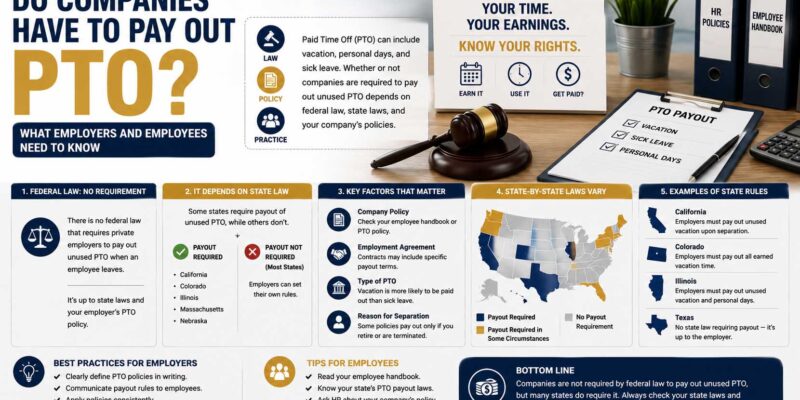
Leaving a job with unused vacation hours often raises one immediate question: do companies have to pay out PTO? In the United States, no single nationwide rule requires every private employer to pay every worker for unused paid time off when employment ends. Instead, the answer often depends on state law, the type of leave involved, the employer’s written policy, and sometimes how the employee leaves the company.
Do Companies Have to Pay Out PTO Under Federal Law?
At the federal level, the Fair Labor Standards Act (FLSA) does not generally require private employers to provide paid vacation time.
The U.S. Department of Labor’s FLSA guidance on vacation and other leave benefits explains that the FLSA does not require payment for time not worked, such as vacation, sick leave, or holidays. Instead, these benefits are generally matters of agreement between an employer and employee.
Therefore, federal law does not create a general rule requiring every employer to cash out unused vacation when an employee leaves.
However, that does not mean an employer can always refuse payment.
State law may treat earned vacation differently. In some states, rules governing accrued vacation can limit an employer’s ability to take it away.
Meanwhile, other states give employers greater freedom to establish payout rules through written policies or employment agreements.
Therefore, when asking do companies have to pay out PTO, employers and employees need to look beyond federal law.
PTO, Vacation Time, and Sick Leave Are Not Always the Same
Before asking whether an employer must pay unused leave, identify exactly what kind of leave the employee has earned.
PTO often combines vacation, personal time, and sometimes sick time into one bank. However, some employers maintain separate vacation and sick-leave balances.
These distinctions matter because state laws may treat vacation and sick leave differently.
For anyone unfamiliar with workplace leave terminology, understanding what is pto provides a useful starting point because PTO policies can cover several kinds of paid absence depending on the employer.
For example, a state might require payout of earned vacation under certain circumstances without requiring employers to cash out unused statutory sick leave.
As a result, simply seeing “40 hours remaining” in an HR system does not necessarily tell you whether those hours must appear in final pay.
When Do Companies Legally Have to Pay Out PTO?
Whether an employer must pay unused PTO depends heavily on state law and the employer’s policy.
Broadly, states can approach unused vacation in several ways.
| Situation | Possible PTO Treatment |
|---|---|
| State protects accrued vacation | Employer may need to pay qualifying unused vacation |
| State primarily follows employer policy | Written company policy may determine payout |
| Employer promises payout in a contract or policy | Employer may need to follow that commitment |
| Leave is statutory sick time rather than vacation | Separate rules may apply |
| Employee has unlimited PTO | Traditional accrued-balance payout may not apply in the same way |
This table provides only a general overview because state rules can contain exceptions and change over time.
Therefore, employees should check their state’s current labor department guidance. Employers should also review applicable law before establishing or enforcing a forfeiture policy.
Do Companies Have to Pay Out PTO When You Quit?
A common variation of the question concerns what happens when an employee resigns voluntarily.
Again, state law comes first.
In some jurisdictions, employers must pay qualifying accrued vacation regardless of whether the employee resigns or faces termination. Elsewhere, an employer’s established policy can determine whether the employee receives unused PTO after resignation.
The employee handbook may also contain conditions.
For example, a policy might address whether employees must provide a certain amount of notice to qualify for a payout where state law allows such a condition.
Therefore, employees planning to resign should review the current PTO policy before submitting notice.
They should look for wording about:
- Vacation accrual
- PTO payout
- Resignation
- Termination
- Required notice
- Carryover
- Forfeiture
- Final paycheck timing
- Separate sick-leave balances
Also, keep a copy of the policy that applied while you were employed, especially if a dispute later develops.
Do Companies Have to Pay Out PTO If You Quit Without Notice?
Whether an employee gives notice can sometimes affect payout, but only when applicable law allows the employer’s policy to make that distinction.
Suppose a handbook says employees who provide two weeks’ notice receive unused vacation, while those who leave immediately do not.
That policy does not automatically override state law.
If state rules protect accrued vacation from forfeiture, the employer may still have obligations despite its handbook language.
On the other hand, in a state that permits employers to set payout conditions, a clearly communicated policy may carry greater weight.
This is also where what is job abandonment becomes relevant. An employer may classify an unexplained failure to report for work differently from a normal resignation. However, that classification does not by itself determine whether the employee loses accrued vacation.
Do Companies Have to Pay Out PTO in Texas?
People frequently ask about PTO payouts in Texas because the state generally takes a policy-driven approach to vacation benefits.
Texas does not generally require employers to provide vacation benefits. However, when an employer has a written policy or agreement promising payment of accrued leave at separation, the terms of that policy or agreement can determine the payout.
Therefore, a Texas employee should review the employer’s written vacation or PTO policy rather than assuming every unused hour will automatically produce a payment.
The details matter.
For example, the policy may specify how employees accrue vacation, when they become eligible, whether notice affects payout, and what happens to unused balances after separation.
Because employment policies and laws can change, employers and workers should confirm current requirements when a specific dispute arises.
Do Companies Have to Pay Out PTO After Termination?
Termination can affect the analysis, but once again, state law and company policy determine the answer.
Some employers use the same payout rules regardless of whether an employee resigns or faces termination. Meanwhile, others distinguish between different types of separation where the law permits them to do so.
Therefore, employees should not assume that being fired automatically eliminates accrued PTO.
Likewise, employers should not assume that labeling a termination “for cause” automatically allows them to erase an otherwise protected vacation balance.
Instead, HR teams should check the applicable state rule, employment agreement, and written policy before calculating final wages.
Salaried vs. Hourly Employees and PTO Payouts
Workers sometimes assume salaried employees receive different unused-vacation rights than hourly employees.
However, the difference between salary and hourly compensation does not by itself decide whether an employer must pay accrued PTO at separation.
The relevant questions usually concern state law, the nature of the leave, the employer’s policy, and whether the employee has earned the benefit.
Still, compensation structure can affect how an employer calculates leave balances and pay rates.
For example, HR may need a defined method for converting a PTO balance into a cash amount. Therefore, a well-written policy should explain how the company calculates payouts instead of leaving employees guessing.
PTO Is Different From Comp Time
PTO should not automatically be confused with compensatory time.
Understanding what is comp time matters because compensatory time can involve different legal rules, particularly under federal wage-and-hour law and in public-sector employment.
PTO usually refers to an employer-provided bank of paid leave.
Comp time, by contrast, generally refers to time off connected with extra hours worked under circumstances where the law permits such an arrangement.
Therefore, employers should track these categories separately and apply the correct rules to each.
How Unlimited PTO Affects Payouts
Unlimited PTO policies create another issue because employees generally do not accumulate a traditional fixed number of vacation hours.
Under a typical accrued system, an employee might earn a certain number of hours each pay period. Consequently, the employer can identify a specific unused balance when employment ends.
An unlimited plan works differently.
Employees can generally request time off subject to the employer’s rules without building a conventional bank of hours.
However, calling a policy “unlimited” does not automatically resolve every legal question. How the program actually operates can matter, and state-specific rules may affect whether a particular arrangement creates payout obligations.
Therefore, businesses considering unlimited PTO should review the policy for every jurisdiction where their employees work.
How PTO Fits Into the Overall Compensation Package
Paid leave forms part of the broader employment relationship.
Employees often evaluate a job based on base pay, insurance, retirement contributions, bonuses, flexibility, and paid time away from work.
For example, the benefits of salary can extend beyond predictable base compensation when a salaried position also offers competitive leave and other workplace benefits.
For employers, a clear PTO policy can reduce misunderstandings and make compensation packages easier to compare.
However, generous benefits can create accounting and administrative responsibilities as well.
Therefore, companies should understand how leave accrues, how much can carry forward, and what obligations arise when workers leave.
Best Practices for Employers Managing PTO
Businesses can avoid many PTO disputes by using clear written policies.
First, define how employees earn leave.
Next, explain whether unused hours carry into the next year and whether any lawful caps apply.
The policy should also explain what happens when employment ends.
For example, specify how resignation, termination, and any notice requirements affect unused leave. However, employers should first confirm that those provisions comply with applicable law.
Companies operating in multiple states need extra care because one nationwide forfeiture rule may not comply everywhere.
HR and payroll systems should also keep accurate records of accruals and usage.
Finally, communicate policy changes clearly. Changing the treatment of leave that employees have already earned may create problems in jurisdictions that protect accrued vacation.
What Employees Should Check Before Leaving a Job
Before resigning, open your HR or payroll portal and record your current PTO balance.
Then, review the employee handbook, employment agreement, and any separate vacation policy.
Look specifically for payout provisions rather than relying on what happened to a former coworker.
Next, check your state labor agency’s current guidance.
If your employer operates in several states, remember that the rules that apply where you work may differ from those at the company’s headquarters.
Finally, review your final paycheck when it arrives.
If you believe the employer omitted vacation pay that you are legally owed, ask HR or payroll for an explanation. If the issue remains unresolved, your state labor agency or an employment attorney can explain available options based on your circumstances.
Common PTO Payout Mistakes
Employees sometimes assume every PTO balance has cash value. However, vacation, sick leave, personal leave, and unlimited PTO can receive different treatment.
Meanwhile, employers sometimes make the opposite mistake and assume their handbook can override state law.
Another problem occurs when policies use vague phrases such as “PTO may be paid at management discretion.” Ambiguous wording can lead to inconsistent decisions and disputes.
Businesses should instead create specific policies that comply with applicable law and apply them consistently.
Employees should also avoid relying entirely on verbal statements. Written policies, pay records, and documented PTO balances provide much clearer information.
Frequently Asked Questions About PTO Payouts
Does an Employer Have to Pay Unused Vacation Time?
It depends on state law and, in many jurisdictions, the employer’s policy or contract. Some states provide stronger protections for accrued vacation than others.
Do Companies Have to Pay Out PTO If You Quit?
Sometimes. A voluntary resignation does not create one nationwide answer. Check state law and your employer’s written PTO policy.
Can a Company Have a Use-It-or-Lose-It PTO Policy?
Rules vary by state. Some states restrict forfeiture of accrued vacation, while others allow more employer flexibility. Therefore, employers should verify state requirements before using such a policy.
Is Unused Sick Leave Paid When You Quit?
Not necessarily. Sick leave and vacation can receive different treatment, even when an employer informally refers to both as time off. Therefore, check the type of leave and applicable state rules.
When Should PTO Appear on the Final Paycheck?
Final-pay deadlines vary by state and sometimes depend on whether the employee resigned or faced termination. Therefore, when an employer must pay unused PTO, the applicable final-wage rules can also affect timing.
Can Companies Change Their PTO Payout Policy?
Employers may be able to change policies prospectively, subject to applicable law. However, state rules may protect leave that employees have already earned. Therefore, businesses should seek appropriate legal guidance before changing how they handle accrued balances.
Check the Law and Policy Before Making Assumptions
So, do companies have to pay out PTO? There is no universal federal rule requiring every private company to cash out every unused PTO balance. Instead, state law, the employer’s written policy, the type of leave, and the circumstances of separation can determine the outcome.
For employees trying to determine do companies have to pay out PTO in their situation, the practical approach is to check the PTO balance, read the current policy, and verify the state’s labor rules before leaving. For employers, clear policies and accurate records can prevent many final-pay disputes.
Because PTO and wage laws vary across states and can change, check current state labor guidance when dealing with a specific situation. If a dispute involves a substantial unused balance or unclear policy language, an employment professional can help explain the rules that apply.