
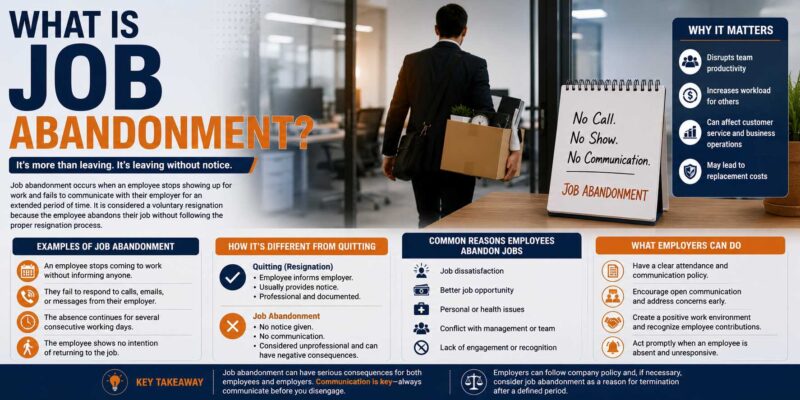
An employee misses work for several days, does not call their manager, and does not respond to messages. At that point, an employer may start wondering: what is job abandonment, and when can the employee be treated as having voluntarily left the job? In simple terms, job abandonment generally describes an employee failing to report to work for a period of time without communicating with the employer, under circumstances that suggest the employee does not intend to return.
However, employers should not assume that every unexplained absence means someone has quit. Emergencies, medical situations, protected leave, communication problems, and other circumstances can complicate the situation. Therefore, businesses usually need a clear attendance policy and a consistent process for handling unexplained absences.
What Is Job Abandonment?
Job abandonment occurs when an employee stops reporting for scheduled work and fails to communicate with the employer in a way that indicates they may have abandoned their position.
So, what is the definition of job abandonment in practical workplace terms? It is usually an employer-policy concept rather than a single universal rule that applies identically to every workplace and jurisdiction.
For example, an employee might miss one shift because of an emergency. That alone does not necessarily show an intention to quit. On the other hand, if the employee misses several consecutive scheduled shifts, ignores calls and emails, and provides no explanation, the employer may eventually classify the situation as job abandonment under its policy.
Because employers need consistency, attendance expectations should be written down. A company asking What Is SOP can apply the same principle here: a documented standard operating procedure helps managers know exactly what steps to follow when an employee disappears from work.
What Is Considered Job Abandonment?
There is no single number of missed days that automatically defines job abandonment everywhere. Instead, companies commonly establish their own reasonable attendance and no-call/no-show policies while complying with applicable employment laws.
A policy might state that a certain number of consecutive scheduled workdays missed without contacting the employer may be treated as voluntary resignation. However, the exact standard varies by employer, collective bargaining agreement, employment contract, and jurisdiction.
Several factors can help an employer determine what is considered job abandonment:
- How many scheduled shifts were missed
- Whether the employee attempted to contact anyone
- Whether managers tried to reach the employee
- Whether the employee previously requested leave
- Whether a medical or family emergency may be involved
- What the company’s written attendance policy says
- Whether employment laws provide relevant protections
Therefore, managers should avoid treating a single late arrival or isolated absence as abandonment.
Job Abandonment vs. a No-Call/No-Show
The two terms are related, but they are not necessarily identical.
A no-call/no-show generally means an employee missed a scheduled shift without properly notifying the employer. Job abandonment usually involves a broader pattern suggesting that the worker does not intend to continue employment.
| Situation | Typical Meaning |
|---|---|
| Employee misses one shift but calls later | Usually an attendance issue |
| Employee misses a shift without calling | No-call/no-show |
| Employee misses several shifts and cannot be reached | Possible job abandonment |
| Employee formally resigns | Normal voluntary resignation |
| Employee is absent on approved leave | Generally not abandonment |
| Employer ends employment for misconduct | Employer-initiated termination |
This distinction matters because employers should investigate the circumstances before deciding how to classify the separation.
Accurate attendance records also help. Businesses that understand What Is a Timesheet can use time and attendance records alongside schedules, messages, and manager notes to document exactly when an employee stopped reporting for work.
Why Does Job Abandonment Happen?
Employees can disappear from jobs for many reasons. Sometimes, they have already decided to leave and simply avoid formally resigning. In other situations, the explanation is much less straightforward.
The employee found another job
A worker may accept another position and stop reporting to the previous employer. Although giving notice is generally more professional, some employees simply leave without communicating.
Workplace dissatisfaction
Poor management, scheduling conflicts, workplace tension, burnout, or dissatisfaction with pay can contribute to abrupt departures.
For employers, this is one reason the benefits of employee retention extend beyond reducing recruitment expenses. Better retention practices can also reduce unexpected staffing gaps and preserve valuable knowledge within a team.
Personal emergencies
An employee could experience hospitalization, an accident, a serious family emergency, or another event that prevents normal communication.
As a result, employers should make reasonable efforts to determine what happened rather than immediately assuming resignation.
Confusion about scheduling or leave
Sometimes the problem is administrative. An employee may believe leave was approved, while a manager believes the employee was expected at work.
Clear documentation can prevent these disputes.
What Employers Should Do When an Employee Stops Showing Up
A consistent process protects both the business and its employees. Rather than immediately removing the person from payroll after an unexplained absence, employers can follow several practical steps.
1. Check the employee’s schedule and records
First, confirm that the employee was actually scheduled to work. Then review attendance records, leave requests, emails, messages, and any recent conversations with supervisors.
This step can reveal simple misunderstandings before they become larger problems.
2. Try multiple reasonable contact methods
Next, attempt to contact the employee using the methods permitted by company policy.
For example, a manager or HR representative may call, email, or use the company’s normal employee communication system.
Keep records of each attempt.
3. Check for known leave or accommodation issues
Before making a final decision, determine whether the absence could relate to previously requested or legally protected leave, disability accommodation, illness, workplace injury, or another protected circumstance.
Employment laws vary considerably, so employers should consult qualified HR or legal professionals when the situation is unclear.
4. Follow the written policy
If the employee remains unreachable, follow the company’s established attendance or job-abandonment procedure.
Consistency matters. Applying one standard to one worker and a completely different standard to another employee in similar circumstances can create unnecessary workplace problems.
5. Send a final notice when appropriate
Depending on company policy and local requirements, an employer may send written notice explaining that continued failure to communicate could result in the employment relationship being treated as ended.
The notice should provide clear instructions and a reasonable contact deadline where appropriate.
6. Document the final employment decision
Finally, record the missed shifts, communication attempts, applicable policy, notices sent, and final decision.
Good documentation creates a clearer record if questions later arise about what happened.
How Employers Can Reduce Job Abandonment
Employers cannot prevent every unexpected departure. Still, workplace practices can reduce situations in which employees simply disappear.
Clear communication is a good starting point.
Employees should know who to contact when they cannot work, how quickly they must report an absence, and which communication methods are acceptable. Likewise, managers should understand how to record and escalate unexplained absences.
Strong employee engagement best practices can also help businesses identify dissatisfaction before an employee reaches the point of abruptly leaving. Regular manager check-ins, clear expectations, fair scheduling, constructive feedback, and accessible communication channels all make it easier for employees to raise concerns.
Companies should also train supervisors. A written policy is less useful when individual managers interpret it differently.
What Is Job Abandonment in California?
Employers and employees often search specifically for what is job abandonment in California because employment rules can vary by state.
California does not provide a simple universal rule saying that every employee who misses a specific number of consecutive workdays has automatically abandoned their job. Employers commonly rely on their attendance and no-call/no-show policies while still complying with applicable state and federal employment protections.
Therefore, asking what is considered job abandonment in California requires looking beyond the number of missed shifts.
For instance, an unexplained absence could potentially involve protected sick leave, family or medical leave, disability-related issues, pregnancy-related protections, or another legally protected situation. The facts of each case matter.
An employer should therefore avoid assuming that three days, or any other fixed number, automatically resolves every case.
For a California business, a safer management approach is to maintain a clear written policy, document communication attempts, review possible protected reasons for the absence, and seek professional HR or employment-law guidance when needed.
Can an Employee Be Fired for Job Abandonment?
An employer may end an employment relationship after an employee fails to report to work according to applicable policies and laws. However, how the separation is classified can depend on the circumstances.
Some employers classify qualifying job abandonment as a voluntary resignation because the employee’s actions appear to demonstrate an intention not to return. Other situations may be handled differently.
That classification can matter for internal records, final pay procedures, unemployment claims, benefits, and other administrative issues.
For this reason, businesses should not rely solely on casual assumptions such as “they stopped coming, so they quit.”
Instead, employers should document what actually happened.
Does Job Abandonment Affect Future Employment?
It can.
If a former employer is legally permitted and willing to provide employment-related information, an unexplained departure may affect whether the person is eligible for rehire or how the employment history is documented.
From an employee’s perspective, communicating is usually better than simply disappearing. Even when someone wants to leave immediately, informing the employer creates a clearer employment record.
Of course, emergencies can prevent normal communication. Employees who become able to contact their employer after an emergency should explain the situation as soon as reasonably possible.
Common Mistakes Businesses Make
One major mistake is assuming that every unexplained absence equals resignation. Another is failing to contact the employee before making a final decision.
Businesses can also create problems when their written policy says one thing while managers routinely do something else.
Another common issue is weak documentation. Without schedules, attendance records, emails, contact attempts, and notices, HR may later struggle to reconstruct what happened.
Finally, employers should avoid ignoring possible legal protections. An absence involving medical leave, disability, pregnancy, family responsibilities, workplace injury, or other protected circumstances may require a different response.
Creating a Clear Job Abandonment Policy
A practical policy should explain the company’s expectations without trying to predict every possible situation.
Typically, employers should consider addressing:
- How employees report an absence
- Who employees must contact
- Which communication methods are acceptable
- When notification should occur
- How no-call/no-show absences are handled
- When repeated unexplained absences may trigger review
- How the company will attempt to contact an absent employee
- How emergencies and protected leave are handled
- How employment status decisions are documented
The policy should also leave room for HR to review unusual circumstances rather than forcing managers to make automatic decisions.
Once established, employers should communicate the policy during onboarding and make it easily accessible afterward.
Frequently Asked Questions
How many days count as job abandonment?
There is no universal number that applies to every employer or jurisdiction. Some employers establish a specific number of consecutive no-call/no-show shifts in their policies, while others use a different standard. Applicable employment laws must still be considered.
Is one no-call/no-show job abandonment?
Usually, one unexplained absence does not automatically prove that an employee intends to abandon the position. However, an employer may still treat it as an attendance violation according to company policy.
Can you return to work after job abandonment?
That depends on whether the employer has already ended the employment relationship and on the circumstances behind the absence. An employee who has experienced an emergency should contact the employer as soon as possible and explain what happened.
Is job abandonment the same as quitting?
Not exactly. A normal resignation involves communicating an intention to leave. Job abandonment generally involves conduct—such as repeated unexplained absences—that an employer may interpret under its policy as showing an intention not to return.
Should employers contact an employee before declaring job abandonment?
Making reasonable contact attempts is a sensible HR practice because the absence may have an explanation. Employers should also follow their policies and applicable employment laws.
A Practical Approach for Employers and Employees
Understanding what is job abandonment starts with recognizing that an unexplained absence and a clear resignation are not automatically the same thing. Employers need consistent policies, reliable documentation, reasonable communication attempts, and awareness of applicable employment protections.
Employees, meanwhile, should communicate absences as quickly as circumstances allow. Even when someone plans to leave a position, a clear resignation usually creates fewer misunderstandings than simply disappearing.
For businesses, the best approach is prevention as much as response: set clear attendance expectations, train managers, maintain accurate records, and create a workplace where employees know how to communicate when something goes wrong.