
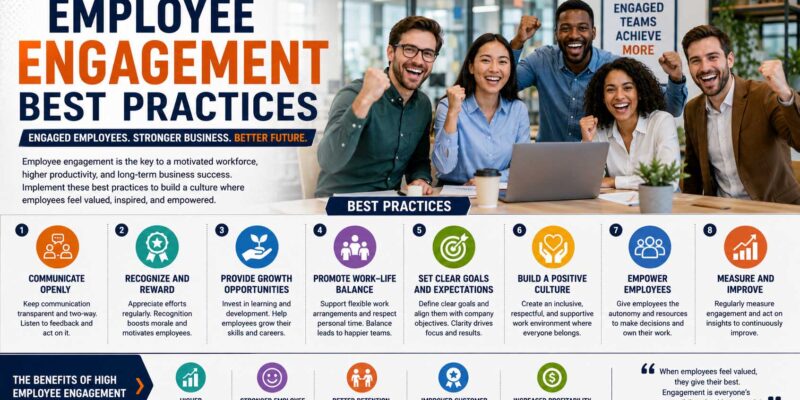
Employees rarely become engaged because of one company event, a yearly survey, or a new benefits package. Instead, engagement grows through everyday experiences at work. The most effective employee engagement best practices focus on trust, meaningful work, good management, recognition, growth, communication, and a workplace where people feel their contributions matter.
Engagement also requires consistency. A company can offer attractive perks, yet employees may still disconnect if managers rarely communicate, workloads feel unreasonable, or good work goes unnoticed. Therefore, businesses should treat engagement as part of how they manage people rather than as a separate HR campaign.
What Does Employee Engagement Actually Mean?
Employee engagement describes the connection employees have with their work, team, and organization. An engaged employee understands what is expected, sees value in the work, and feels motivated to contribute.
However, engagement is not the same as happiness.
Someone can enjoy free lunches and social events while feeling disconnected from their actual job. Likewise, a highly engaged employee can experience challenging days while still caring deeply about the team’s goals.
Engagement also differs from job satisfaction. Satisfaction may encourage someone to remain in a comfortable position, while engagement involves commitment, involvement, and willingness to contribute.
This distinction matters because companies often spend money on perks while overlooking the everyday management practices that shape the employee experience.
Employee Engagement Best Practices That Work
No single engagement strategy works for every organization. Still, several practices can create the conditions employees need to perform well and remain connected to their workplace.
| Practice | What It Supports |
|---|---|
| Clear communication | Trust and direction |
| Regular recognition | Motivation and appreciation |
| Employee feedback | Voice and involvement |
| Career development | Growth and progression |
| Manager support | Stronger daily experience |
| Autonomy | Ownership and responsibility |
| Flexible work | Work-life fit |
| Fair expectations | Sustainable performance |
| Purposeful goals | Meaning and direction |
Companies do not need to introduce everything at once. Instead, they can identify their biggest engagement gaps and improve them systematically.
Start With Clear Expectations and Purpose
Employees find it difficult to stay engaged when they are unsure what success looks like.
Managers should clearly explain responsibilities, priorities, deadlines, and performance standards. At the same time, employees should understand how their individual work connects with larger team or company goals.
For example, telling a customer service employee to “improve customer experience” offers little direction. However, explaining specific service standards, response expectations, and team goals makes the role much clearer.
Purpose matters as well. People are more likely to see meaning in repetitive or difficult tasks when they understand why those tasks matter.
Clear expectations can also support retention. In fact, many of the benefits of employee retention become easier to achieve when employees understand their roles and can see a realistic future inside the organization.
Make Employee Feedback a Two-Way Process
One of the best practices for employee engagement is giving employees genuine opportunities to speak.
Annual engagement surveys can help, but companies should not rely on them alone. Managers can gather useful insights through one-to-one conversations, team discussions, pulse surveys, suggestion systems, and informal check-ins.
Still, asking for feedback creates an expectation that someone will listen.
If employees repeatedly identify the same problem and management never responds, surveys can start feeling pointless. Therefore, leaders should explain what they heard, what they can change, what they cannot change, and why.
Sometimes an employee may hesitate to discuss an issue with their direct supervisor. In that situation, a Skip Level Meeting can give senior leaders another perspective on communication, management practices, workloads, and team challenges.
The goal should not be to bypass managers. Instead, it should be to create several healthy communication channels.
Leadership Best Practices That Improve Employee Engagement
Managers have a major influence on everyday employee experience. After all, policies may come from senior leadership, but employees often experience the organization through their immediate manager.
Listen Before Trying to Fix Everything
Managers do not need an instant solution to every concern.
Sometimes employees simply need a manager who listens carefully, asks useful questions, and follows up. Therefore, leaders should avoid turning every conversation into instructions or criticism.
Active listening can reveal problems before they become larger issues.
Explain Decisions
Employees will not agree with every management decision. However, people are often more accepting when they understand the reasoning.
For instance, if priorities suddenly change, explain what caused the shift. Likewise, if a requested change cannot happen, provide a reasonable explanation instead of ignoring the request.
Transparency reduces unnecessary uncertainty.
Treat People Consistently
Fairness plays a major role in trust.
Employees quickly notice when rules apply differently depending on someone’s position or relationship with a manager. Consequently, leaders should aim for consistent expectations while still recognizing that individual circumstances can require flexibility.
These leadership behaviors also shape company culture. Since there are many types of organizational culture, businesses should identify which everyday management behaviors reinforce the culture they actually want rather than relying only on written values.
Recognize Good Work While It Still Feels Relevant
Recognition does not always require bonuses, awards, or elaborate programs.
A specific message from a manager can be powerful when it explains what the employee did well and why it mattered.
Instead of saying, “Great job,” a manager might say, “You handled that customer issue calmly and found a solution without delaying the rest of the project. That really helped the team.”
Specific recognition feels more credible because the employee knows exactly what was appreciated.
Timing matters too. Recognition given soon after an achievement generally feels more meaningful than praise delivered months later during a performance review.
However, companies should avoid creating recognition programs that feel like popularity contests. Recognition should reflect meaningful contributions and remain reasonably fair across teams.
Give Employees Opportunities to Grow
People may disengage when they feel their job has nowhere to go.
Career development does not always mean promotion. Employees can also grow through mentoring, cross-functional projects, training, job shadowing, expanded responsibilities, certifications, or opportunities to develop new skills.
Managers should discuss development during normal conversations rather than waiting for annual reviews.
For example, an employee interested in leadership might first manage a small project. Meanwhile, someone interested in analytics could take responsibility for reporting or receive relevant training.
Development becomes more effective when it connects employee interests with real business needs.
Build Flexibility Without Losing Accountability
Flexibility can improve the employee experience when the nature of the job allows it.
For some businesses, that might mean remote or hybrid work. For others, flexible starting times, shift swaps, compressed schedules, or occasional schedule adjustments may be more realistic.
The benefits of working from home, for example, can include reduced commuting and greater schedule flexibility for some employees. Yet remote work can also create communication or isolation challenges when companies manage it poorly.
Therefore, flexibility works best when expectations remain clear.
Employees should know when they need to be available, how performance will be evaluated, and which communication channels their teams use. Meanwhile, managers should focus on meaningful results instead of monitoring activity simply for the sake of visibility.
Support Well-Being Through Sustainable Work Practices
Employee engagement and employee well-being are connected, but workplace wellness should go beyond fitness challenges and wellness apps.
Managers should pay attention to workloads, staffing levels, unnecessary meetings, unrealistic deadlines, and whether employees can actually disconnect from work.
Time away also matters.
Normal vacation policies provide regular opportunities to rest, while some organizations offer longer breaks after extended service. Employees curious about extended leave may benefit from understanding what is a sabbatical and how such programs differ from ordinary paid time off.
Still, no wellness benefit can compensate for a consistently unhealthy workload. Therefore, organizations should address the causes of workplace strain rather than relying only on wellness perks.
Give Employees Meaningful Autonomy
Micromanagement can quickly weaken engagement.
Once employees understand their responsibilities and have the skills to perform them, managers should give them reasonable freedom over how they complete their work.
Autonomy creates ownership.
For example, rather than dictating every step of a marketing project, a manager can define the objective, budget, deadline, and essential requirements. The employee can then decide how to organize and execute the work.
Of course, new employees may initially need more direction. Therefore, the right level of autonomy depends on experience, role complexity, risk, and performance.
Measure Engagement Without Obsessing Over One Score
Engagement surveys can provide useful information, but a single score does not tell the entire story.
Companies should consider several signals, including:
- Employee survey responses
- Voluntary turnover
- Absenteeism patterns
- Internal promotions
- Participation in development opportunities
- Manager feedback
- Exit interview themes
- Employee referrals
Managers should also look beneath company-wide averages.
For instance, an organization might report strong overall engagement while one department experiences unusually high turnover. Team-level patterns can reveal problems that company-wide numbers hide.
Likewise, businesses should track trends over time. One survey matters less than whether employee experiences are improving or deteriorating.
Common Employee Engagement Mistakes
One common mistake is treating engagement as HR’s responsibility alone. HR can design programs and provide tools, yet managers and senior leaders shape much of the everyday experience.
Another mistake is copying another company’s perks. A technology startup and a manufacturing business may have completely different workforces, schedules, expectations, and engagement challenges.
Companies also make the mistake of collecting feedback without acting on it. Even when a requested change is impossible, employees deserve an explanation.
Finally, businesses sometimes confuse constant activity with engagement. More meetings, events, surveys, and messages do not necessarily create a better workplace.
The best practices in employee engagement usually improve the quality of work rather than simply adding more workplace activities.
FAQs About Employee Engagement Best Practices
What are the most effective employee engagement strategies?
Strong strategies usually include clear expectations, regular communication, meaningful recognition, development opportunities, supportive managers, employee feedback, fair treatment, autonomy, and sustainable workloads.
How often should managers check in with employees?
There is no universal schedule. However, regular short conversations are often more useful than relying entirely on formal annual reviews. The appropriate frequency depends on the employee, role, team, and type of work.
Are employee perks enough to improve engagement?
Usually not by themselves. Perks can improve the employee experience, but they cannot replace good management, fair treatment, meaningful work, recognition, communication, or reasonable workloads.
How can small businesses improve employee engagement?
Small businesses can start with simple practices such as clear goals, frequent feedback, specific recognition, development conversations, and regular manager check-ins. Many effective engagement improvements require consistency rather than a large budget.
What is the manager’s role in employee engagement?
Managers translate company expectations into everyday experiences. Therefore, their communication, coaching, recognition, fairness, feedback, and workload decisions can strongly influence how connected employees feel to their work.
Turn Engagement Into an Everyday Management Habit
The strongest employee engagement best practices are rarely flashy. Instead, they create an environment where people know what is expected, receive useful feedback, have room to grow, feel recognized, and trust their managers.
Start by identifying one or two areas where employees consistently experience friction. Then gather feedback, make a practical improvement, communicate what changed, and measure whether it helped.
Over time, those small management habits can create something far more valuable than a temporary engagement campaign: a workplace where people have genuine reasons to care about the work they do.