
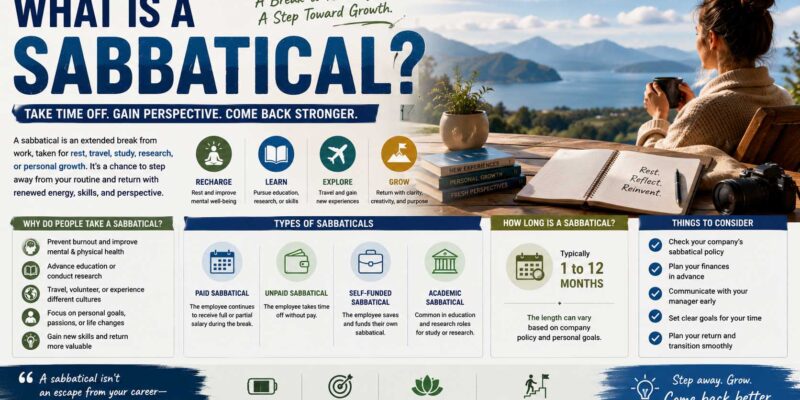
Imagine working for the same organization for several years and then taking a few months away to study, travel, conduct research, complete a personal project, or simply step outside your normal routine. So, what is a sabbatical? A sabbatical is an extended period away from regular work duties, usually taken with an employer’s approval and often with the expectation that the employee will return. Unlike a typical vacation, a sabbatical commonly lasts several weeks or months and may be paid, partially paid, or unpaid.
Sabbaticals have long been associated with universities, where professors may take extended leave for research and professional development. However, businesses, nonprofits, religious organizations, and other employers may offer them as well.
The exact arrangement depends on the organization’s policy, the employee’s agreement, and applicable employment laws.
What Is a Sabbatical Leave?
If you’re asking what is a sabbatical leave, think of it as a planned extended break from someone’s normal professional responsibilities.
A sabbatical can serve many purposes. For example, an employee might pursue education, write a book, travel, volunteer, conduct research, develop new professional skills, care for personal priorities, or take an extended period away from their normal routine.
However, sabbatical leave should not automatically be confused with vacation time.
Vacation is usually a shorter period of paid time away from work. Meanwhile, a sabbatical generally lasts longer and may operate under a separate employer policy.
Likewise, people researching what is PTO should recognize that paid time off can include vacation, personal days, or other employer-defined paid leave, while a sabbatical may have completely different eligibility and compensation rules.
How Does a Sabbatical Work?
There is no universal sabbatical system that every business follows.
Instead, employers that offer sabbaticals usually establish their own rules. These policies may define who qualifies, how long the leave can last, whether compensation continues, what happens to benefits, and how employees return to work afterward.
For instance, one company might allow eligible employees to request four weeks after a certain number of years of service. Another may permit several months of unpaid leave.
A typical process might follow a sequence like this:
- The employee meets the company’s eligibility requirements.
- The employee submits a sabbatical request.
- Management reviews timing and business needs.
- The employee and employer agree on dates and terms.
- Responsibilities are transferred before the leave begins.
- The employee takes the approved sabbatical.
- The employee returns under the agreed arrangement.
Because policies vary widely, employees should never assume that a sabbatical automatically guarantees pay, benefits, or the same position afterward. Those details should be confirmed before leave begins.
What Is a Sabbatical Leave From Work?
The question what is a sabbatical leave from work often comes from employees who want a longer break without permanently resigning.
In a workplace setting, sabbatical leave creates a defined period during which an employee steps away from normal responsibilities. Ideally, both sides agree on the conditions in advance.
A written arrangement might cover:
- Start and return dates
- Whether the leave is paid or unpaid
- Health and other employee benefits
- Expectations for communication during leave
- Treatment of bonuses or incentives
- Whether service time continues to accrue
- Responsibilities before departure
- The employee’s role after returning
Clear documentation protects both sides from misunderstandings.
For example, an employee might assume that health benefits continue throughout six months of unpaid leave, while company policy says otherwise. Discussing that detail beforehand prevents an unpleasant surprise later.
How Long Is a Sabbatical?
There is no standard duration.
A sabbatical could last several weeks, several months, or, in some settings, longer. The appropriate length depends on company policy, the purpose of the leave, staffing requirements, and what the employer and employee agree to.
Shorter sabbaticals may be easier for businesses to manage because responsibilities need coverage for less time.
Meanwhile, longer breaks may give employees enough time for substantial goals such as completing academic research, pursuing professional training, or undertaking extended travel.
Employers should balance those benefits against operational needs. If a key employee disappears for six months without adequate preparation, the remaining team can face unnecessary pressure.
Therefore, good sabbatical programs include transition planning rather than focusing only on the leave itself.
Are Sabbaticals Paid?
Some are, while others are not.
An employer might offer:
- Full salary
- Partial salary
- A fixed stipend
- Unpaid leave
- A combination of paid and unpaid periods
The employee’s benefits may also be handled separately from salary.
For instance, an unpaid sabbatical does not necessarily tell you whether health insurance or other benefits continue. The organization’s policies, benefit-plan terms, employment agreement, and applicable laws determine those details.
Employees should calculate the financial impact before requesting unpaid leave. Consider housing, food, insurance, travel, debt payments, emergency savings, and other regular expenses.
A sabbatical can become stressful quickly if the financial plan depends on unrealistic assumptions.
Why Do Companies Offer Sabbaticals?
Giving employees extended time away may sound expensive or difficult for a business. However, some organizations view sabbaticals as part of a broader people strategy.
Long-serving employees can accumulate deep institutional knowledge, yet they may also experience fatigue or want opportunities for growth outside their normal responsibilities.
A well-designed sabbatical program can provide a meaningful long-term employment benefit.
This connects naturally with the benefits of employee retention, since organizations often look for ways to keep experienced workers engaged rather than repeatedly replacing valuable knowledge and skills.
However, employers should not treat sabbaticals as a guaranteed cure for burnout or turnover. Poor management, unfair compensation, excessive workloads, or limited career opportunities still require direct attention.
Benefits of Sabbaticals for Employees
The value of a sabbatical depends heavily on how someone uses it.
For some employees, the main benefit is time for professional development. They may take courses, conduct research, learn a language, or explore ideas that normal work schedules leave little room for.
Others use the time for personal projects, travel, volunteering, creative work, or family priorities.
A break can also create perspective. When people spend years following the same weekly routine, stepping outside it can help them reconsider professional goals and priorities.
However, employees should set realistic expectations. A sabbatical does not need to produce a degree, business, book, or life-changing achievement to be worthwhile.
Sometimes, having enough time to pursue meaningful personal goals is itself the purpose.
Business Advantages and Challenges
From the employer’s perspective, sabbaticals have both advantages and drawbacks.
| Potential Advantages | Potential Challenges |
|---|---|
| Attractive employee benefit | Temporary staffing gaps |
| May support retention | Workload redistribution |
| Creates development opportunities | Possible compensation costs |
| Encourages succession planning | Return-to-work adjustments |
| Can strengthen employer branding | Administrative complexity |
One less obvious advantage is succession planning.
When a manager prepares to leave for several months, someone else may need to handle key responsibilities. As a result, the organization gets an opportunity to develop other employees and identify gaps in processes.
Still, poor planning can create resentment if coworkers simply inherit extra work without resources, recognition, or realistic priorities.
Sabbaticals and Workplace Culture
Whether a sabbatical program succeeds can depend heavily on the workplace environment.
Organizations have different types of organizational culture, and a company that genuinely encourages autonomy and long-term development may approach extended leave differently from one where employees feel pressured to remain constantly available.
For example, a company might officially offer sabbaticals but quietly discourage employees from requesting them. In that situation, the benefit exists on paper but may have little practical value.
Leaders should make expectations clear.
If employees remain responsible for checking email every day, joining meetings, and solving routine problems, they are not really stepping away.
Instead, businesses should decide in advance whether communication is expected and, if so, under what limited circumstances.
What Is a Sabbatical for a Pastor?
People also ask what is a sabbatical for a pastor because extended leave is common in some churches and religious organizations.
A pastoral sabbatical is typically a planned period away from regular ministry duties. Depending on the organization, the pastor may use that time for rest, study, spiritual reflection, education, writing, travel, or professional renewal.
Meanwhile, other leaders or temporary staff may handle sermons, administration, pastoral care, and daily responsibilities.
As with business sabbaticals, policies vary considerably.
Church leadership should clearly establish the duration, compensation, responsibilities, communication expectations, and return plan before the sabbatical begins.
How Employees Can Prepare for a Sabbatical
A successful sabbatical starts well before the final working day.
First, understand your employer’s policy. Then, decide what you want from the leave and determine how much time you realistically need.
Next, create a transition plan.
List ongoing projects, deadlines, key contacts, passwords or access procedures that can legally and safely be transferred, and responsibilities that someone else will need to handle.
Document recurring processes as well.
This preparation reduces disruption and makes it easier for colleagues to operate independently.
Financial preparation matters too, especially for unpaid leave. Build a realistic budget and consider how the absence affects benefits, retirement contributions, taxes, and other financial arrangements. When necessary, consult qualified HR, benefits, tax, or financial professionals.
How Employers Should Design a Sabbatical Policy
Businesses considering a formal program should start with eligibility.
For example, an organization might require several years of continuous service before an employee can apply. Then, it should establish reasonable limits on duration and frequency.
Next, clarify compensation and benefits.
Employees should know whether leave is paid, partially paid, or unpaid before they apply.
A good policy should also address approval criteria, notice requirements, coverage plans, return expectations, and what happens if business circumstances change.
Flexibility can still exist within the framework. In fact, companies already offering flexible arrangements or recognizing the benefits of working from home may have experience designing policies around employee autonomy while maintaining accountability.
However, sabbaticals create different operational issues from remote work, so each policy needs its own rules.
Common Sabbatical Planning Mistakes
One major mistake is waiting until the last minute to transfer responsibilities.
Managers and employees should begin planning early enough to identify coverage gaps.
Another mistake is leaving return expectations vague. Employees need to know when they return, who they report to, and how their role will be handled.
Businesses should also avoid approving extended leave without considering the impact on coworkers.
Meanwhile, employees should not assume that an approved sabbatical removes every professional obligation unless the agreement actually says so.
The solution is simple: document the important details before the leave starts.
Frequently Asked Questions
What is a sabbatical?
A sabbatical is an extended, planned period away from normal work responsibilities. It may be used for professional development, research, travel, personal projects, rest, or other approved purposes.
Is a sabbatical the same as quitting?
Usually, no. A sabbatical typically involves an approved temporary absence with an expected return, while quitting ends the employment relationship. However, the exact arrangement depends on the employer and agreement.
Do you get paid during a sabbatical?
It depends. Some employers offer full or partial pay, while other sabbaticals are unpaid. Employees should check their organization’s policy before making plans.
How long should a sabbatical be?
There is no universal length. Sabbaticals may range from several weeks to several months or longer, depending on the organization, purpose, and agreement.
Can any employee request a sabbatical?
An employee can ask, but an employer may not offer sabbatical leave or may limit it to people who meet specific eligibility requirements. Local employment laws may also affect certain leave arrangements.
Can you work somewhere else during a sabbatical?
That depends on your employment agreement and company policy. Restrictions involving outside employment, conflicts of interest, confidentiality, or competition may still apply during leave.
Making a Sabbatical Work for Everyone
Understanding what is a sabbatical is only the first step. A successful extended leave needs clear expectations, realistic financial planning, thoughtful work coverage, and a defined return process.
For employees, the best sabbatical is one that has a clear purpose without becoming another exhausting list of goals. For employers, the strongest programs provide flexibility while protecting business continuity and treating coworkers fairly.
Before arranging a sabbatical, put the essential terms in writing and review questions about pay, benefits, job protection, outside work, and return expectations. With good preparation on both sides, an extended break can become a practical professional benefit rather than an operational headache.