
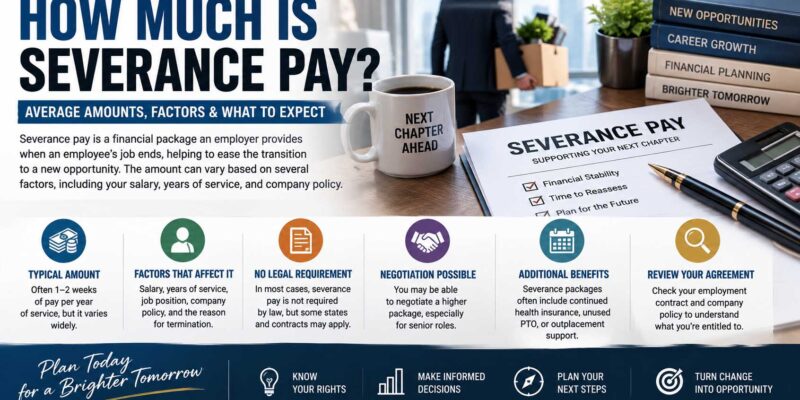
If you have been laid off or your employer has offered you a separation package, one of your first questions may be: how much is severance pay? There is no single amount that every employee receives. Instead, severance often depends on your salary, length of service, company policy, employment agreement, position, and the circumstances surrounding your departure.
Some employers offer one or two weeks of pay for every year worked. Others provide a fixed amount, several months of salary, continued benefits, or no severance at all. Therefore, understanding how companies calculate these packages can help you decide whether an offer is reasonable.
What Is Severance Pay?
Severance pay is compensation an employer may provide when an employee leaves the company under certain circumstances. Typically, companies offer it after layoffs, restructuring, downsizing, mergers, or elimination of a position.
In many situations, severance is different from your regular final paycheck. Your final wages generally cover money you already earned, while severance provides extra compensation connected with ending the employment relationship.
However, policies vary widely between employers. Therefore, anyone trying to understand how does severance pay work should first review the employment contract, employee handbook, severance plan, and written separation offer.
A package may include cash compensation as well as other benefits. For example, an employer might offer eight weeks of salary, temporary health insurance assistance, career-placement services, or accelerated vesting of certain benefits.
How Much Is Severance Pay Usually?
So, how much is severance pay usually for an employee who loses a job?
A common approach is to base the payment on years of service. For instance, an employer might offer one or two weeks of regular pay for each completed year of employment. Still, this is a common business practice rather than a universal requirement.
Consider an employee earning $78,000 annually. Their approximate weekly salary would be
If the employer provides two weeks of severance for each year worked and the employee has completed six years, the calculation would be:
6 years × 2 weeks = 12 weeks
12 × $1,500 = $18,000
As a result, the employee could receive $18,000 in gross severance before applicable taxes and deductions.
Companies can use completely different formulas, though. For example, one organization might provide four weeks to everyone affected by a layoff, while another might offer three months of base salary to managers.
How Much Is Severance Pay Based on Years Worked?
Years of service often influence severance because companies may want to recognize long-term employees when eliminating positions. Consequently, someone with 15 years at a company may receive a larger package than someone employed for one year.
Here is a simple example of how a company using two weeks per year might calculate severance:
| Years Worked | Weeks of Severance | Weekly Pay | Estimated Gross Severance |
|---|---|---|---|
| 2 years | 4 weeks | $1,200 | $4,800 |
| 5 years | 10 weeks | $1,200 | $12,000 |
| 10 years | 20 weeks | $1,200 | $24,000 |
| 15 years | 30 weeks | $1,200 | $36,000 |
These numbers are examples rather than guaranteed amounts. In practice, employers may set minimum and maximum payments. For instance, a policy could provide two weeks per year but cap total severance at 26 weeks.
Your compensation structure can also affect the calculation. Understanding the difference between salary and hourly employment can therefore be useful because employers may calculate severance differently for salaried and hourly workers.
How Much Severance Pay Is Normal?
When asking how much severance pay is normal, employees often expect a specific percentage or number of weeks. However, there is no universal standard that applies to every company or worker.
Several factors can affect an offer:
Length of employment. Longer service may result in more weeks of compensation when the company uses a service-based formula.
Position and seniority. Executives and senior managers sometimes negotiate severance terms when they join a company. Consequently, their packages can be significantly larger.
Employment contract. A contract may specify exactly what happens if the employer terminates the employee under qualifying circumstances.
Company policy. Large organizations sometimes maintain formal severance plans, while smaller businesses may make decisions individually.
Reason for separation. Layoffs and restructuring may qualify for severance, whereas employees terminated for serious misconduct may receive nothing beyond compensation legally owed to them.
Negotiation. In some cases, employees can negotiate the package before signing a separation agreement.
Therefore, the better question is not simply whether your package matches someone else’s. Instead, compare the offer with your contract, company policy, years of service, compensation level, benefits, and any rights you may be asked to waive.
What Can Be Included in a Severance Package?
Cash is usually the first thing employees notice. Still, the total value of a severance package can extend beyond salary.
For example, an employer may include continued insurance coverage, payment for unused leave where applicable, career coaching, outplacement assistance, bonuses, commissions, or certain stock-related benefits.
Paid time off deserves separate attention because its treatment depends on company policies and applicable law. Employees who have unused vacation should therefore understand do companies have to pay out PTO when employment ends instead of assuming unused time automatically becomes part of severance.
Likewise, knowing what is PTO and how the employer classifies vacation, sick leave, and combined paid-leave balances can help you distinguish earned benefits from extra separation compensation.
As a result, two severance packages offering the same cash payment may have very different overall values.
How Much Is Severance Pay Taxed?
Another common question is how much is severance pay taxed. Employees sometimes assume that the amount listed in their severance agreement is exactly what will reach their bank account. Usually, that is not the case.
In the United States, severance payments are generally treated as taxable wages for federal income-tax purposes. Payroll taxes can also apply. State and local taxes may affect the final amount depending on where the employee lives and works.
For example, suppose your employer offers $20,000 in gross severance. Your actual payment may be lower after applicable federal withholding, payroll taxes, state taxes, and other authorized deductions.
The withholding shown on a payment also does not necessarily equal your final tax liability. Your total tax situation for the year determines what you actually owe when you file your return.
Therefore, employees receiving a large package may want to speak with a qualified tax professional, particularly when severance arrives as a lump sum or when other substantial compensation is paid during the same tax year.
Lump-Sum vs. Salary-Continuation Severance
Employers generally structure severance payments in different ways. Two common approaches are a lump-sum payment and salary continuation.
With a lump sum, the employer pays the agreed severance in one payment, subject to applicable withholding and the terms of the agreement. This approach gives the former employee access to the money quickly.
With salary continuation, payments may continue according to a regular payroll schedule for a defined period. For example, an employee receiving 12 weeks of severance could continue receiving scheduled payments for those 12 weeks.
Neither arrangement is automatically better. Instead, employees should consider cash-flow needs, benefits, taxes, unemployment rules, and the exact language of the agreement.
Regular compensation also has broader trade-offs, so understanding the benefits of salary can provide useful context when comparing normal employment income with a temporary severance arrangement.
How Much Is Severance Pay in California?
Employees frequently ask how much is severance pay in California, particularly because California has extensive employment laws.
However, California generally does not require private employers to provide severance simply because an employee is terminated or laid off. Severance may instead arise from an employment agreement, employer policy, established severance plan, or negotiated separation agreement.
That means there is no standard California formula requiring every employer to pay a certain number of weeks for every year of service.
At the same time, severance should not be confused with wages and other compensation that an employer is legally required to pay. California has specific rules governing final wages and certain accrued benefits.
Large layoffs can also involve separate federal or state notice requirements depending on the employer and circumstances. Therefore, workers dealing with a significant layoff, disputed wages, contractual rights, or a complicated separation agreement may benefit from professional legal advice.
How to Evaluate a Severance Offer
Instead of looking only at the headline dollar amount, review the complete agreement before accepting it.
First, calculate the gross value of the cash compensation. Then, compare that amount with your weekly or monthly earnings and years of service.
Next, identify every non-cash benefit. Health coverage, bonus eligibility, commissions, stock treatment, unused vacation, and outplacement support can significantly change the package’s value.
After that, check what you must give up in exchange. Many severance agreements contain a release of legal claims. They may also include confidentiality, non-disparagement, cooperation, or other provisions.
Then, examine deadlines carefully. Some agreements provide a specific period for review, while certain agreements involving older workers may be subject to special federal requirements.
Finally, consider whether negotiation makes sense. A company may not change its offer, particularly during a standardized mass layoff. Still, employees with contractual rights, specialized positions, unresolved compensation, or unusual circumstances may have more room to negotiate.
Common Mistakes When Reviewing Severance
One common mistake is comparing your package directly with a friend’s severance package. Different employers use different policies, while seniority and contracts can also produce very different results.
Another mistake is focusing exclusively on gross pay. Instead, estimate the likely after-tax amount and consider the value of continued benefits.
Likewise, do not assume every payment listed in the separation paperwork is actually severance. Final wages, commissions, bonuses, expense reimbursements, and eligible unused leave may represent separate obligations.
Employees should also avoid signing an agreement they do not understand simply because they want the payment quickly. If the agreement contains confusing legal terms or requires the release of potentially significant rights, getting professional advice can be worthwhile.
Frequently Asked Questions
Is severance pay required by law?
In the United States, federal law generally does not require employers to provide severance pay simply because employment ends. However, an employment contract, collective bargaining agreement, company severance plan, or other legal obligation can change the situation.
Is one week per year a good severance package?
It can be reasonable under some employer policies, but there is no universal benchmark. Therefore, compare the offer with your company’s established practices, your seniority, position, contract, and overall compensation package.
Can I negotiate severance pay?
Sometimes. For example, employees may request additional compensation, extended benefits, changes to the termination date, different payment terms, or adjustments to other provisions. Still, an employer does not necessarily have to agree.
Does severance include unused vacation?
Not automatically. Severance and accrued vacation are separate concepts. Whether unused vacation must be paid can depend on applicable law and the employer’s policies.
Can severance affect unemployment benefits?
Potentially. Rules vary by jurisdiction and can depend on how the payment is structured. Therefore, check with the unemployment agency responsible for your state before assuming you will receive full benefits immediately.
What to Do Before Accepting Your Severance
When determining how much is severance pay worth in your situation, start with the numbers but do not stop there. Calculate the gross payment, estimate deductions, review benefits, check unused leave, and identify any compensation the company already owes you.
Then, read the complete agreement and pay close attention to the rights or commitments attached to the payment. If the package is substantial, legally complicated, or connected to a dispute, consider having an employment attorney or qualified financial professional review it before you sign.
A strong severance package is not simply the one with the largest check. Instead, it is one whose compensation, benefits, payment terms, and legal conditions make sense for your circumstances and give you a practical financial bridge to your next opportunity.